




Choose the correct statement on the basis of the paragraph.
(This question has multiple correct options)
A. dot product means multiplying the magnitude of A to the projection of B on A.
B. dot product means multiplying two vectors along X axis.
C. dot product means multiplying a vector by the perpendicular projection of the other vector on the first vector.
D. dot product makes the result a scalar.
Answer
 Verified
585.6k+ views
Hint:The Dot product of two vectors is given by, $\overrightarrow A \cdot \overrightarrow B = ab\cos \theta $ .
Here, a, and b are the magnitudes of vector A and vector B respectively and $\theta $ is the angle between them.
Complete step-by-step solution:
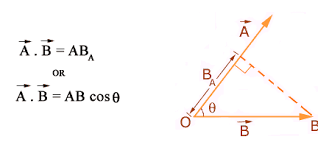
In the figure above the two vectors A and B make an angle $\theta $ . Here the magnitude of vector A is A and the magnitude of vector B is B.
Now, for the above figure we define Dot product as, ‘the product of magnitude of vector A and the projection of vector B on vector A.’
Now,
The magnitude of vector A ($\overrightarrow A $ ) = A ----------- (given)
The magnitude of vector B ($\overrightarrow B $ ) = B ----------- (given)
So, the projection of $\overrightarrow B $ on $\overrightarrow A $ =$B\cos \theta $ --------- (by definition of horizontal projection)
Thus by definition of Dot product of vectors,
Dot product of $\overrightarrow A $ and $\overrightarrow B $ = $\overrightarrow A \cdot \overrightarrow B = AB\cos \theta $ -------- (equation: 1)
In equation: 1, $A$ is the magnitude of $\overrightarrow A $ , and $B\cos \theta $ is the projection of $\overrightarrow B $ on $\overrightarrow A $ .
Thus, the dot product is multiplying the magnitude of A to the projection of B on A.
Hence, option A is correct.
Dot product tells you what amount of one vector goes in the direction of another vector.
For instance in the above figure $\overrightarrow B $ is not along $\overrightarrow A $ but at an angle $\theta $ with the same.
So, the dot product $\overrightarrow A \cdot \overrightarrow B = AB\cos \theta $ tells us what amount of $\overrightarrow B $ is along (in the direction) of $\overrightarrow A $ .
Hence, option B and option C are incorrect.
Now, as we all know quantities are divided into two categories:
1. Vectors (having magnitude and direction).
2. Scalars (having only magnitude)
In equation: 1 you can see that all the terms are scalars, since all are just magnitude, the dot product is actually a product of scalars.
Also, a product of two scalar quantities is a scalar quantity.
Hence, dot product makes the result a scalar.
So, option D is also correct.
Thus, the answers to this question are option A and option D.
Note:-
->Dot product of perpendicular vectors is zero, as the angle between them is 90 degrees the cosine of 90 is zero.
->Dot product’s definition tells it is all about horizontal projections so do not consider perpendicular projections while calculating dot products.
It is always helpful to draw a rough diagram to get a better understanding of the problem.
Here, a, and b are the magnitudes of vector A and vector B respectively and $\theta $ is the angle between them.
Complete step-by-step solution:
In the figure above the two vectors A and B make an angle $\theta $ . Here the magnitude of vector A is A and the magnitude of vector B is B.
Now, for the above figure we define Dot product as, ‘the product of magnitude of vector A and the projection of vector B on vector A.’
Now,
The magnitude of vector A ($\overrightarrow A $ ) = A ----------- (given)
The magnitude of vector B ($\overrightarrow B $ ) = B ----------- (given)
So, the projection of $\overrightarrow B $ on $\overrightarrow A $ =$B\cos \theta $ --------- (by definition of horizontal projection)
Thus by definition of Dot product of vectors,
Dot product of $\overrightarrow A $ and $\overrightarrow B $ = $\overrightarrow A \cdot \overrightarrow B = AB\cos \theta $ -------- (equation: 1)
In equation: 1, $A$ is the magnitude of $\overrightarrow A $ , and $B\cos \theta $ is the projection of $\overrightarrow B $ on $\overrightarrow A $ .
Thus, the dot product is multiplying the magnitude of A to the projection of B on A.
Hence, option A is correct.
Dot product tells you what amount of one vector goes in the direction of another vector.
For instance in the above figure $\overrightarrow B $ is not along $\overrightarrow A $ but at an angle $\theta $ with the same.
So, the dot product $\overrightarrow A \cdot \overrightarrow B = AB\cos \theta $ tells us what amount of $\overrightarrow B $ is along (in the direction) of $\overrightarrow A $ .
Hence, option B and option C are incorrect.
Now, as we all know quantities are divided into two categories:
1. Vectors (having magnitude and direction).
2. Scalars (having only magnitude)
In equation: 1 you can see that all the terms are scalars, since all are just magnitude, the dot product is actually a product of scalars.
Also, a product of two scalar quantities is a scalar quantity.
Hence, dot product makes the result a scalar.
So, option D is also correct.
Thus, the answers to this question are option A and option D.
Note:-
->Dot product of perpendicular vectors is zero, as the angle between them is 90 degrees the cosine of 90 is zero.
->Dot product’s definition tells it is all about horizontal projections so do not consider perpendicular projections while calculating dot products.
It is always helpful to draw a rough diagram to get a better understanding of the problem.
Recently Updated Pages
Master Class 12 Economics: Engaging Questions & Answers for Success

Master Class 12 Physics: Engaging Questions & Answers for Success
Master Class 12 English: Engaging Questions & Answers for Success
Master Class 12 Social Science: Engaging Questions & Answers for Success
Master Class 12 Maths: Engaging Questions & Answers for Success
Master Class 12 Business Studies: Engaging Questions & Answers for Success
Trending doubts
Which are the Top 10 Largest Countries of the World?
What are the major means of transport Explain each class 12 social science CBSE
Draw a labelled sketch of the human eye class 12 physics CBSE
Why cannot DNA pass through cell membranes class 12 biology CBSE
Differentiate between insitu conservation and exsitu class 12 biology CBSE
Draw a neat and well labeled diagram of TS of ovary class 12 biology CBSE