




Choose the correct sequence w.r.t. life cycle of Funaria.
A. Sporophyte (main body) $\to $ SMC $\xrightarrow{meiosis}$ Spore $\to $ Gametophyte (dependent)
B. Gametophyte (main body) $\to $ Syngamy $\to $ Zygote $\to $ Sporophyte (dependent)
C. Gametophyte $\to $ SMC $\xrightarrow{meiosis}$ Spore $(2n)$ $\to $ Sporophyte
D. Sporophyte $\to $ SMC $\xrightarrow{meiosis}$ Spore $(2n)$ $\to $ Gametophyte
Answer
 Verified
652.2k+ views
Hint: Funaria is a bryophyte that reproduces sexually with help of antheridium and archegonium. It is thought to be a primitive plant species. It grows from a spore and shows alternation of generation.
Complete answer:
The genus Funaria are bryophytes means that they can live in water as well as in soil. They are usually found as a green mat-like structure on rocks and trees. About 177 species are known. They are also called green moss or cord moss. It reproduces either by sexual or asexual reproduction. The sexual life cycle is predominantly haplo-diplontic. But the main plant body called gametophyte is free-living and haploid (n).
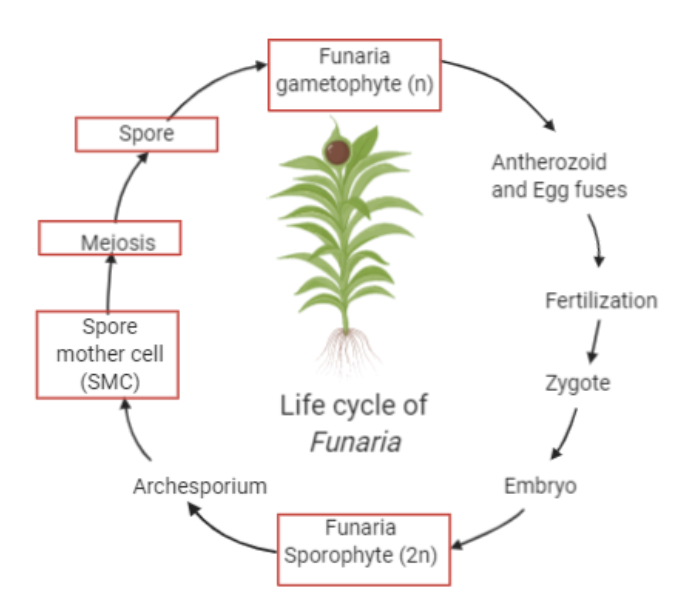
-The gametophyte part of the Funaria body consists of gametes called antheridium (male gamete) and archegonium (female gamete). The sporogonium part consists of spores.
-On maturation, the diploid sporophytes $(2n)$ produce spores through meiosis that are haploid and are dispersed. When they fall into suitable habitat the spores start growing by mitosis forming a protonema structure that is called gametophyte that is haploid.
-Through continuous mitosis, the protonema forms mature male and female gametophytes in antheridia and archegonia respectively. After this, both the gametes fuse to form a diploid zygote $(2n)$.
-The zygote formed then undergoes mitosis in the mature female gametophyte body. From this gametophyte, the sporophyte generation develops and again forms spores by meiosis to continue another cycle.
Thus, the right order of the life cycle of Funaria is Sporophyte $\to $ SMC $\xrightarrow{meiosis}$ Spore $(2n)$ $\to $ Gametophyte.
Hence, option D is the right answer.
Note: Funaria belongs to Bryophyte plants. Thus, its characteristic feature is to undergo alternation of generation. This means that a sporophyte forms a gametophyte and a gametophyte forms a sporophyte.
Complete answer:
The genus Funaria are bryophytes means that they can live in water as well as in soil. They are usually found as a green mat-like structure on rocks and trees. About 177 species are known. They are also called green moss or cord moss. It reproduces either by sexual or asexual reproduction. The sexual life cycle is predominantly haplo-diplontic. But the main plant body called gametophyte is free-living and haploid (n).
-The gametophyte part of the Funaria body consists of gametes called antheridium (male gamete) and archegonium (female gamete). The sporogonium part consists of spores.
-On maturation, the diploid sporophytes $(2n)$ produce spores through meiosis that are haploid and are dispersed. When they fall into suitable habitat the spores start growing by mitosis forming a protonema structure that is called gametophyte that is haploid.
-Through continuous mitosis, the protonema forms mature male and female gametophytes in antheridia and archegonia respectively. After this, both the gametes fuse to form a diploid zygote $(2n)$.
-The zygote formed then undergoes mitosis in the mature female gametophyte body. From this gametophyte, the sporophyte generation develops and again forms spores by meiosis to continue another cycle.
Thus, the right order of the life cycle of Funaria is Sporophyte $\to $ SMC $\xrightarrow{meiosis}$ Spore $(2n)$ $\to $ Gametophyte.
Hence, option D is the right answer.
Note: Funaria belongs to Bryophyte plants. Thus, its characteristic feature is to undergo alternation of generation. This means that a sporophyte forms a gametophyte and a gametophyte forms a sporophyte.
Recently Updated Pages
Which will be the least stable resonating structure class 11 chemistry CBSE

How many 5 digit telephone numbers can be construc-class-11-maths-CBSE
How do you find the angle of the resultant vector class 11 physics CBSE
Draw labelled diagram of the following i Gram seed class 11 biology CBSE
1 Quintal is equal to a 110 kg b 10 kg c 100kg d 1000 class 11 physics CBSE
What is the need and importance of classification class 11 biology CBSE
Trending doubts
Find the value of the expression given below sin 30circ class 11 maths CBSE
One Metric ton is equal to kg A 10000 B 1000 C 100 class 11 physics CBSE
Draw a diagram of nephron and explain its structur class 11 biology CBSE
10 examples of friction in our daily life
Draw a diagram of a plant cell and label at least eight class 11 biology CBSE
Difference Between Prokaryotic Cells and Eukaryotic Cells