




Cholecystokinin is the secretion of
(a) Duodenum, which causes contraction of the gallbladder.
(b) Goblet cells of the ileum stimulate secretion of succus entries
(c) Liver and control secondary sex characters.
(d) The stomach stimulates the pancreas to release juice.
Answer
 Verified
616.8k+ views
Hint: This is the first part of the small intestine and receives the partially digested food from the stomach as it is directly attached to the stomach. It absorbs some nutrients from the semi-digested food.
Complete answer:
Cholecystokinin is a peptide hormone that is responsible for promoting fat and protein digestion in the gastrointestinal system. It is synthesized by the cell in the small intestinal epithelium and is secreted in the duodenum. It induces the release of pancreatic digestive enzymes and bile from the gallbladder.
Cholecystokinin is secreted by small-intestinal upper cells. The release of hydrochloric acid, amino acids, or fatty acids into the stomach or duodenum induces its secretion. Cholecystokinin induces contraction of the gallbladder and releases stored bile into the intestine. It also promotes pancreatic juice secretion and can induce satiety (the feeling of being full) . Several theories exist about the capacity of cholecystokinin to induce satiety. One theory is that meal-induced cholecystokinin secretion stimulates the hypothalamus satiety center in the brain so that the person feels full and stops eating. A second theory is that because cholecystokinin prevents stomach emptying, the sense of satiety could be the product of stomach distension.
So, the correct answer is ‘Duodenum, which causes contraction of the gallbladder’.
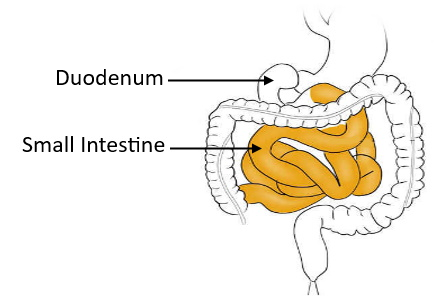
Note: Diseases caused by excessive or defective cholecystokinin secretion are uncommon. Cholecystokinin deficiency was identified as part of an autoimmune polyglandular syndrome in humans and was presented as a clinically related pancreatic exocrine insufficiency malabsorption syndrome. There is also mounting evidence that aberrations in the expression of cholecystokinin or its receptor within the human brain may play a role in the pathogenesis of some forms of anxiety and schizophrenia.
Complete answer:
Cholecystokinin is a peptide hormone that is responsible for promoting fat and protein digestion in the gastrointestinal system. It is synthesized by the cell in the small intestinal epithelium and is secreted in the duodenum. It induces the release of pancreatic digestive enzymes and bile from the gallbladder.
Cholecystokinin is secreted by small-intestinal upper cells. The release of hydrochloric acid, amino acids, or fatty acids into the stomach or duodenum induces its secretion. Cholecystokinin induces contraction of the gallbladder and releases stored bile into the intestine. It also promotes pancreatic juice secretion and can induce satiety (the feeling of being full) . Several theories exist about the capacity of cholecystokinin to induce satiety. One theory is that meal-induced cholecystokinin secretion stimulates the hypothalamus satiety center in the brain so that the person feels full and stops eating. A second theory is that because cholecystokinin prevents stomach emptying, the sense of satiety could be the product of stomach distension.
So, the correct answer is ‘Duodenum, which causes contraction of the gallbladder’.
Note: Diseases caused by excessive or defective cholecystokinin secretion are uncommon. Cholecystokinin deficiency was identified as part of an autoimmune polyglandular syndrome in humans and was presented as a clinically related pancreatic exocrine insufficiency malabsorption syndrome. There is also mounting evidence that aberrations in the expression of cholecystokinin or its receptor within the human brain may play a role in the pathogenesis of some forms of anxiety and schizophrenia.
Recently Updated Pages
Master Class 11 Social Science: Engaging Questions & Answers for Success

Master Class 11 English: Engaging Questions & Answers for Success
Master Class 11 Maths: Engaging Questions & Answers for Success
Master Class 11 Chemistry: Engaging Questions & Answers for Success
Master Class 11 Biology: Engaging Questions & Answers for Success
Master Class 11 Physics: Engaging Questions & Answers for Success
Trending doubts
Differentiate between an exothermic and an endothermic class 11 chemistry CBSE
One Metric ton is equal to kg A 10000 B 1000 C 100 class 11 physics CBSE
Difference Between Prokaryotic Cells and Eukaryotic Cells
There are 720 permutations of the digits 1 2 3 4 5 class 11 maths CBSE
Draw a diagram of a plant cell and label at least eight class 11 biology CBSE
Two of the body parts which do not appear in MRI are class 11 biology CBSE