




Choanocytes are present in body of animals associated with phylum ________.
A. Porifera
B. Coelenterate
C. Aschelminthes
D. Hemichordate
Answer
 Verified
652.8k+ views
Hint: Above listed options are phylum which belongs to a kingdom animal. Choanocytes are commonly called collar cells. These cells form the inner lining of the sponges which have a central flagellum. Choanocytes are found in sponges and the phylum which it belongs to is known as pore bearer.
Complete step by step answer: Choanocytes are found in the body of sponges which belong to phylum Porifera. Phylum Porifera is called pore bearers because its body shows the presence of pores over the body. Choanocytes are also called collar cells which form the inner lining of the sponges which contain a flagellum for locomotion and are surrounded by a collar of microvilli. These collar cells or choanocytes form a type of cell layer called choanoderm inside the sponges. In asconoid sponges, they are seen as the dotting surface of the spongocoel. They form radial canals in syconoid sponges. Their function is to filter particles out of the water which is entering into the spongocoel. Spongocoel is a large cavity of sponges and water enters it by the small pores called ostia and moves out from large pores called osculum. As choanocytes are seen in sponges and sponges belong to phylum Porifera.
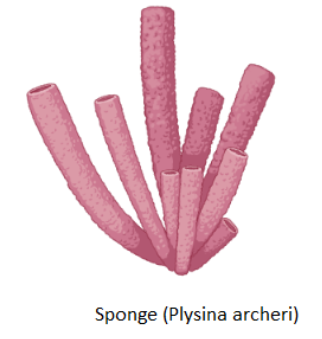
So, option A is the correct option.
Note: Even though the function of choanocyte is to filter the particles out of the water before entering into spongocoel, due to the fact that sponges lack reproductive organs choanocytes can also convert into spermatocytes during sexual reproduction. In sponges, all cells are capable of living on their own but most of the function is carried out by choanocytes such as ingestion and passing digested food to other cells via amoebocytes.
Complete step by step answer: Choanocytes are found in the body of sponges which belong to phylum Porifera. Phylum Porifera is called pore bearers because its body shows the presence of pores over the body. Choanocytes are also called collar cells which form the inner lining of the sponges which contain a flagellum for locomotion and are surrounded by a collar of microvilli. These collar cells or choanocytes form a type of cell layer called choanoderm inside the sponges. In asconoid sponges, they are seen as the dotting surface of the spongocoel. They form radial canals in syconoid sponges. Their function is to filter particles out of the water which is entering into the spongocoel. Spongocoel is a large cavity of sponges and water enters it by the small pores called ostia and moves out from large pores called osculum. As choanocytes are seen in sponges and sponges belong to phylum Porifera.
So, option A is the correct option.
Note: Even though the function of choanocyte is to filter the particles out of the water before entering into spongocoel, due to the fact that sponges lack reproductive organs choanocytes can also convert into spermatocytes during sexual reproduction. In sponges, all cells are capable of living on their own but most of the function is carried out by choanocytes such as ingestion and passing digested food to other cells via amoebocytes.
Recently Updated Pages
Which will be the least stable resonating structure class 11 chemistry CBSE

How many 5 digit telephone numbers can be construc-class-11-maths-CBSE
How do you find the angle of the resultant vector class 11 physics CBSE
Draw labelled diagram of the following i Gram seed class 11 biology CBSE
1 Quintal is equal to a 110 kg b 10 kg c 100kg d 1000 class 11 physics CBSE
What is the need and importance of classification class 11 biology CBSE
Trending doubts
Find the value of the expression given below sin 30circ class 11 maths CBSE
One Metric ton is equal to kg A 10000 B 1000 C 100 class 11 physics CBSE
10 examples of friction in our daily life
Draw a diagram of a plant cell and label at least eight class 11 biology CBSE
Proton was discovered by A Thomson B Rutherford C Chadwick class 11 chemistry CBSE
10 examples of diffusion in everyday life