




Chlorobenzene can be prepared by reacting aniline with:
(A)- Hydrochloric acid
(B)- Cuprous chloride
(C)- Chlorine in the presence of anhydrous aluminium chloride
(D)- Nitrous acid followed by heating with cuprous chloride
Answer
 Verified
651k+ views
Hint: Start the solution by drawing the structure of the reactant. Recall what type of reactions aniline undergoes with the given reagents in the options. The product formed must not contain any substituent on the benzene ring except chlorine atom.
Complete answer:
-Aniline is a base which is an aromatic amine.
-The question says that aniline is reacted with a reagent and gives chlorobenzene. This means that the amine group of the aniline is to be replaced on reaction with the reagent with a chlorine atom.
-Recall the knowledge that amine group can only be replaced after it has been converted to diazonium salt form which is an unstable compound and direct halogenation of aniline gives halogen derivatives of aniline.
-When hydrochloric acid is added to aniline, the aniline being a base will abstract the proton forming anilinium chloride salt.
-Nitrous acid produced in situ by sodium nitrite and hydrochloric acid on reaction with aniline at low temperature $(0{}^\circ C-5{}^\circ C)$ converts aniline to a benzene diazonium salt and this reaction is known as diazotization.
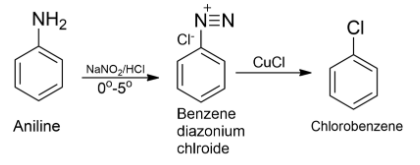
-When a freshly prepared solution of benzene diazonium salt is treated with cuprous oxide, chlorobenzene is obtained. This reaction is known as Sandmeyer’s reaction.
-Therefore, as the conclusion, we can say that chlorobenzene can be prepared by reacting aniline with nitrous acid followed by heating with cuprous chloride (CuCl).
Hence, the correct answer is option D.
Note:
Chlorobenzene can also be prepared by treating diazonium salt with hydrochloric acid and copper powder. This reaction is known as Gattermann reaction and gives a better yield than Sandmeyer reaction. Always remember that aromatic compounds readily undergo electrophilic substitution reaction, therefore direct halogenations will yield halo-substituted compounds.
Complete answer:
-Aniline is a base which is an aromatic amine.
-The question says that aniline is reacted with a reagent and gives chlorobenzene. This means that the amine group of the aniline is to be replaced on reaction with the reagent with a chlorine atom.
-Recall the knowledge that amine group can only be replaced after it has been converted to diazonium salt form which is an unstable compound and direct halogenation of aniline gives halogen derivatives of aniline.
-When hydrochloric acid is added to aniline, the aniline being a base will abstract the proton forming anilinium chloride salt.
-Nitrous acid produced in situ by sodium nitrite and hydrochloric acid on reaction with aniline at low temperature $(0{}^\circ C-5{}^\circ C)$ converts aniline to a benzene diazonium salt and this reaction is known as diazotization.
-When a freshly prepared solution of benzene diazonium salt is treated with cuprous oxide, chlorobenzene is obtained. This reaction is known as Sandmeyer’s reaction.
-Therefore, as the conclusion, we can say that chlorobenzene can be prepared by reacting aniline with nitrous acid followed by heating with cuprous chloride (CuCl).
Hence, the correct answer is option D.
Note:
Chlorobenzene can also be prepared by treating diazonium salt with hydrochloric acid and copper powder. This reaction is known as Gattermann reaction and gives a better yield than Sandmeyer reaction. Always remember that aromatic compounds readily undergo electrophilic substitution reaction, therefore direct halogenations will yield halo-substituted compounds.
Recently Updated Pages
Explain the structure of megasporangium class 12 biology CBSE

Why is chloroform kept in dark coloured bottles class 12 chemistry CBSE
Derive the balancing condition of a Wheatstone bri class 12 physics CBSE
Draw VI characteristics of a pn junction diode Explain class 12 physics CBSE
Is it possible to carry pride in ones language too class 12 english CBSE
In a population at Hardy Weinberg equilibrium the allele class 12 biology CBSE
Trending doubts
Draw a labelled sketch of the human eye class 12 physics CBSE
Which are the Top 10 Largest Countries of the World?
Draw ray diagrams each showing i myopic eye and ii class 12 physics CBSE
One megawatt is equal to how many units of electri class 12 physics CBSE
Which is the correct genotypic ratio of mendel dihybrid class 12 biology CBSE
Give 10 examples of unisexual and bisexual flowers