




Chargaff’s rule is to?
A. Single-stranded DNA and RNA
B. Single-stranded RNA
C. Double-stranded DNA
D. Single-stranded DNA
Answer
 Verified
528.3k+ views
Hint: It tells about the ratio of the different nitrogenous bases that are present inside the DNA molecule as it helps in determining the various structure and composition of DNA in different organisms. It is constant for a species.
Complete answer:
The DNA of any organism should have purine and pyrimidine bases in a 1:1 ratio. Chargaff's rule is also known as the base pair rule. It states that guanine and cytosine amounts should be the same while the ratio of adenine and thiamine should be the same.
This rule was named after its discoverer in 1950, Erwin Chargaff. This ratio of nitrogenous bases is found in both the DNA strands.The Chargaff rule is dependent on the DNA structure presented by Watson and Crick.
This model shows that the percentage of the nitrogenous base pairs is equal to the double-stranded DNA. This is called the first parity rule.
The second parity rule states that the percentage of adenine is equal to the percentage of thiamine while the percentage of thymine is equal to the percentage of cytosine. This is the case of both the single strands of DNA.
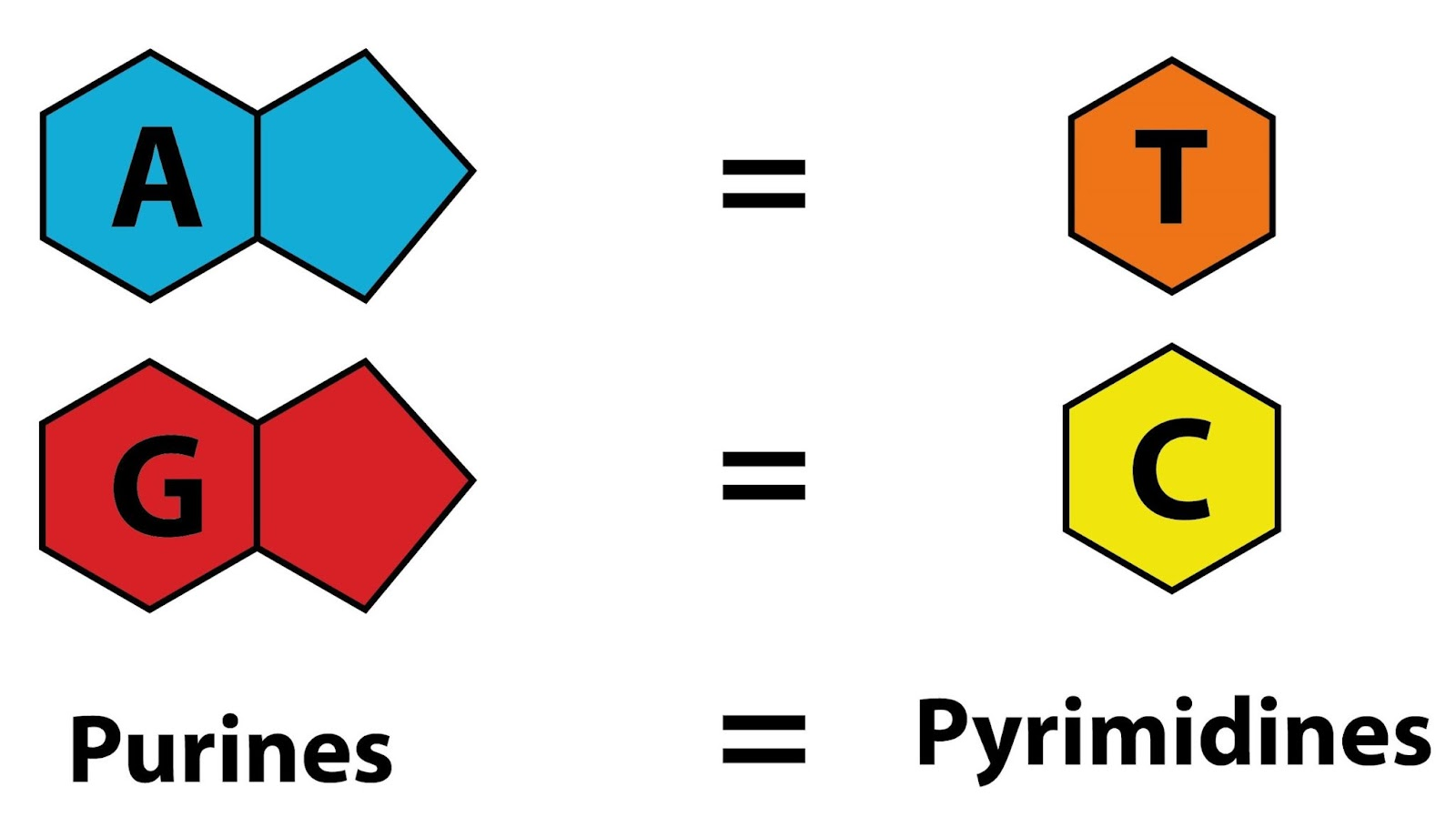
The percentage of nitrogenous bases is found to be different in different organisms resulting in the variation of various species. This changing ability of the DNA makes it compatible to be genetic material. This makes the study of the DNA structure easier.
Hence, the correct option is C.) the double-stranded DNA only can follow the chargaff’s rule as this requires base pairing.
NOTE:
Chargaff’s rule is also known as the ‘grammar of biology’ because it states the features that maintain the structure of DNA and specifies the rules which govern them. Purines and pyrimidine are the nitrogenous bases that help in holding the structure of the DNA in a place with hydrogen bonds.
Complete answer:
The DNA of any organism should have purine and pyrimidine bases in a 1:1 ratio. Chargaff's rule is also known as the base pair rule. It states that guanine and cytosine amounts should be the same while the ratio of adenine and thiamine should be the same.
This rule was named after its discoverer in 1950, Erwin Chargaff. This ratio of nitrogenous bases is found in both the DNA strands.The Chargaff rule is dependent on the DNA structure presented by Watson and Crick.
This model shows that the percentage of the nitrogenous base pairs is equal to the double-stranded DNA. This is called the first parity rule.
The second parity rule states that the percentage of adenine is equal to the percentage of thiamine while the percentage of thymine is equal to the percentage of cytosine. This is the case of both the single strands of DNA.
The percentage of nitrogenous bases is found to be different in different organisms resulting in the variation of various species. This changing ability of the DNA makes it compatible to be genetic material. This makes the study of the DNA structure easier.
Hence, the correct option is C.) the double-stranded DNA only can follow the chargaff’s rule as this requires base pairing.
NOTE:
Chargaff’s rule is also known as the ‘grammar of biology’ because it states the features that maintain the structure of DNA and specifies the rules which govern them. Purines and pyrimidine are the nitrogenous bases that help in holding the structure of the DNA in a place with hydrogen bonds.
Recently Updated Pages
Master Class 12 Economics: Engaging Questions & Answers for Success

Master Class 12 English: Engaging Questions & Answers for Success
Master Class 12 Social Science: Engaging Questions & Answers for Success
Master Class 12 Maths: Engaging Questions & Answers for Success
Master Class 12 Physics: Engaging Questions & Answers for Success
Master Class 9 General Knowledge: Engaging Questions & Answers for Success
Trending doubts
Which are the Top 10 Largest Countries of the World?
Draw a labelled sketch of the human eye class 12 physics CBSE
Differentiate between homogeneous and heterogeneous class 12 chemistry CBSE
Why is the cell called the structural and functional class 12 biology CBSE
Draw ray diagrams each showing i myopic eye and ii class 12 physics CBSE
Which is the correct genotypic ratio of mendel dihybrid class 12 biology CBSE