




$C{{H}_{3}}-CHC{{l}_{2}}$ on hydrolysis will give
(A)- $C{{H}_{3}}CHO$
(B)- $C{{H}_{3}}COOH$
(C)- $C{{H}_{3}}C{{H}_{2}}OH$
(D)- $C{{H}_{3}}-O-C{{H}_{3}}$
Answer
 Verified
591k+ views
Hint: In the hydrolysis of the given compound, the nucleophile from the water molecule, displaces the halogen atoms in the compound, in presence of an alkaline medium. Also, the halides are good leaving groups, thus producing a C-O double-bond in the carbonyl compound formed.
Complete answer:
Hydrolysis of the given gem-dihalide compound, that is, 1,1-dichloroethane, takes place in presence of basic medium. It undergoes nucleophilic substitution reactions.
The ${{S}_{N}}2$ mechanism is followed, in which the nucleophile, that is, the hydroxide ion from the water molecule, attacks the partially electropositive carbon atom of the compound from the back.
At the same time, in the transition state, the chloride ion of the compound departs from the front because being a weak conjugate base, it is relatively stable in nature. Thus, acting as a good leaving group. A gem-halohydrin is formed.
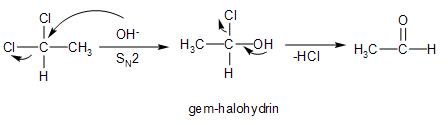
The remaining chloride group, also being a good leaving group departs from the compound, leading to the formation of carbonyl group. The product formed is acetaldehyde.
Therefore, $C{{H}_{3}}-CHC{{l}_{2}}$on hydrolysis will give option (A)- $C{{H}_{3}}CHO$.
Additional information:
In the geminal dihalide, when both the halogens are present on the terminal carbon, it gives aldehyde on hydrolysis, whereas when the halides are present on non-terminal carbon, ketones are produced.
Note:
1,1-dichloroethane is also known as Ethylidene halide, in which both the halide groups are present on the same carbon atom.
Also, the chloride ion is a better leaving group because it is a conjugate base of a strong acid, HCl, which dissociates to give the ion which is very stable.
Complete answer:
Hydrolysis of the given gem-dihalide compound, that is, 1,1-dichloroethane, takes place in presence of basic medium. It undergoes nucleophilic substitution reactions.
The ${{S}_{N}}2$ mechanism is followed, in which the nucleophile, that is, the hydroxide ion from the water molecule, attacks the partially electropositive carbon atom of the compound from the back.
At the same time, in the transition state, the chloride ion of the compound departs from the front because being a weak conjugate base, it is relatively stable in nature. Thus, acting as a good leaving group. A gem-halohydrin is formed.
The remaining chloride group, also being a good leaving group departs from the compound, leading to the formation of carbonyl group. The product formed is acetaldehyde.
Therefore, $C{{H}_{3}}-CHC{{l}_{2}}$on hydrolysis will give option (A)- $C{{H}_{3}}CHO$.
Additional information:
In the geminal dihalide, when both the halogens are present on the terminal carbon, it gives aldehyde on hydrolysis, whereas when the halides are present on non-terminal carbon, ketones are produced.
Note:
1,1-dichloroethane is also known as Ethylidene halide, in which both the halide groups are present on the same carbon atom.
Also, the chloride ion is a better leaving group because it is a conjugate base of a strong acid, HCl, which dissociates to give the ion which is very stable.
Recently Updated Pages
Basicity of sulphurous acid and sulphuric acid are

Master Class 12 English: Engaging Questions & Answers for Success
Master Class 12 Social Science: Engaging Questions & Answers for Success
Master Class 12 Maths: Engaging Questions & Answers for Success
Master Class 12 Economics: Engaging Questions & Answers for Success
Master Class 12 Physics: Engaging Questions & Answers for Success
Trending doubts
Which are the Top 10 Largest Countries of the World?
Draw a labelled sketch of the human eye class 12 physics CBSE
Which state in the country is at the forefront in controlling class 12 social science CBSE
Mention the role of cyanobacteria as a biofertiliz class 12 biology ICSE
Where is the largest hydroelectric power station located class 12 biology CBSE
Which country did Danny Casey play for class 12 english CBSE