




What is centripetal acceleration? Derive the expression for centripetal acceleration.
Answer
 Verified
649.8k+ views
Hint: In circular motion centripetal force is perpendicular to velocity. Also if the particles decrease or increase their speeds in circular motion then acceleration is generated which deviates the net acceleration from pointing towards the centre.
Formula used:
$a=\dfrac{v^{2}}{r}$
Complete answer:
We know that the motions are two types: one is straight motion and the circular motion. Then we know that circular motion, though the magnitude of velocity is a constant, the direction of velocity is changing. A circle. It is also defined as rotation of an object along a circular path. It can be of two forms, uniform circular motion, with constant angular rate of rotation and constant speed, or non-uniform circular motion with a changing rate of rotation.
Consider a body of mass $m$ moving along the circumference of a circle. the radius of a circle $r$ with velocity $v$,as shown in the figure. Then if a small force $F$ is applied on the body, then we know that the force is given as $F=ma$.
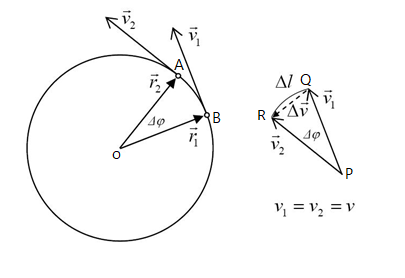
Where, $a$ is the acceleration and is given as the rate of change of velocity $\Delta v$ with respect to time.
Consider the \[\vartriangle OAB\] and $\triangle PQR$, then $\dfrac{\Delta v}{AB}=\dfrac{v}{r}$
Clearly, $AB=v\Delta t$
$\implies \dfrac{\Delta v}{v\Delta t}=\dfrac{v}{r}$
$\implies \dfrac{\Delta v}{\Delta t}=\dfrac{v^{2}}{r}$
$\implies a=\dfrac{v^{2}}{r}$
Thus, the acceleration due to centripetal force is given by,$a=\dfrac{v^{2}}{r}$. Clearly as the velocity $v$ and the radius $r$ of the circle are constant, acceleration $a$ will also remain a constant.
Note:
Centripetal force is the force that acts on a body moving in a circular path and is directed towards the centre around which the body is moving. If the particles decrease or increase their speeds during the circular motion the net force deviates the particle from its initial path.
Formula used:
$a=\dfrac{v^{2}}{r}$
Complete answer:
We know that the motions are two types: one is straight motion and the circular motion. Then we know that circular motion, though the magnitude of velocity is a constant, the direction of velocity is changing. A circle. It is also defined as rotation of an object along a circular path. It can be of two forms, uniform circular motion, with constant angular rate of rotation and constant speed, or non-uniform circular motion with a changing rate of rotation.
Consider a body of mass $m$ moving along the circumference of a circle. the radius of a circle $r$ with velocity $v$,as shown in the figure. Then if a small force $F$ is applied on the body, then we know that the force is given as $F=ma$.
Where, $a$ is the acceleration and is given as the rate of change of velocity $\Delta v$ with respect to time.
Consider the \[\vartriangle OAB\] and $\triangle PQR$, then $\dfrac{\Delta v}{AB}=\dfrac{v}{r}$
Clearly, $AB=v\Delta t$
$\implies \dfrac{\Delta v}{v\Delta t}=\dfrac{v}{r}$
$\implies \dfrac{\Delta v}{\Delta t}=\dfrac{v^{2}}{r}$
$\implies a=\dfrac{v^{2}}{r}$
Thus, the acceleration due to centripetal force is given by,$a=\dfrac{v^{2}}{r}$. Clearly as the velocity $v$ and the radius $r$ of the circle are constant, acceleration $a$ will also remain a constant.
Note:
Centripetal force is the force that acts on a body moving in a circular path and is directed towards the centre around which the body is moving. If the particles decrease or increase their speeds during the circular motion the net force deviates the particle from its initial path.
Recently Updated Pages
Which will be the least stable resonating structure class 11 chemistry CBSE

How many 5 digit telephone numbers can be construc-class-11-maths-CBSE
How do you find the angle of the resultant vector class 11 physics CBSE
Draw labelled diagram of the following i Gram seed class 11 biology CBSE
1 Quintal is equal to a 110 kg b 10 kg c 100kg d 1000 class 11 physics CBSE
What is the need and importance of classification class 11 biology CBSE
Trending doubts
Find the value of the expression given below sin 30circ class 11 maths CBSE
One Metric ton is equal to kg A 10000 B 1000 C 100 class 11 physics CBSE
10 examples of friction in our daily life
Draw a diagram of a plant cell and label at least eight class 11 biology CBSE
Difference between physical and chemical change class 11 chemistry CBSE
Proton was discovered by A Thomson B Rutherford C Chadwick class 11 chemistry CBSE