




What is the cause of Brownian movement in colloids?
Answer
 Verified
639k+ views
Hint: Let’s start with discussing the Brownian movement; Brownian movement can be defined as the random movement of the particles at microscopic level. This type of motion generally depicts the random fluctuation in position inside the fluid subdomain. The motion is zigzag and unpredictable in nature.
Complete step by step answer:
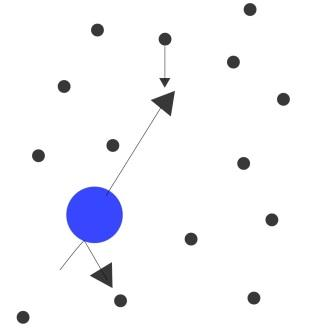
Diagram showing the brownian movement of particle
We must know the Brownian motion/movement is observed due to collision between the particles inside the fluid subdomain. The Brownian motion rate is dependent on the temperature, number of particles, size of particles and viscosity of the medium. The rate of Brownian motion will increase as we increase the temperature, increase the number of particles (as it increases the frequency of collision), smaller the size of particles and the lower the viscosity of the dispersing medium.
Coming to the question, the cause of Brownian movement in colloids is due to the unbalanced4 bombardment or we can say collision between the particles or the particles and the walls of the container or the particles of colloids and the particles of dispersion medium.
It is to be noted that this Brownian motion helps in stabilising the colloidal solution as this Brownian motion doesn’t allow the particles of the sol. to settle down and hence the colloidal solution remains stable.
Note:
We can observe Brownian motion by seeing dust particles through a tiny ray of light in a dark room. You will observe that the dust particles are randomly moving and are not settling down. Also if you focus on a single particle then after sometime that particle will disappear. This shows the unpredictable motion of the particles.
Complete step by step answer:
Diagram showing the brownian movement of particle
We must know the Brownian motion/movement is observed due to collision between the particles inside the fluid subdomain. The Brownian motion rate is dependent on the temperature, number of particles, size of particles and viscosity of the medium. The rate of Brownian motion will increase as we increase the temperature, increase the number of particles (as it increases the frequency of collision), smaller the size of particles and the lower the viscosity of the dispersing medium.
Coming to the question, the cause of Brownian movement in colloids is due to the unbalanced4 bombardment or we can say collision between the particles or the particles and the walls of the container or the particles of colloids and the particles of dispersion medium.
It is to be noted that this Brownian motion helps in stabilising the colloidal solution as this Brownian motion doesn’t allow the particles of the sol. to settle down and hence the colloidal solution remains stable.
Note:
We can observe Brownian motion by seeing dust particles through a tiny ray of light in a dark room. You will observe that the dust particles are randomly moving and are not settling down. Also if you focus on a single particle then after sometime that particle will disappear. This shows the unpredictable motion of the particles.
Recently Updated Pages
Basicity of sulphurous acid and sulphuric acid are

Master Class 11 English: Engaging Questions & Answers for Success
Master Class 11 Physics: Engaging Questions & Answers for Success
Master Class 11 Computer Science: Engaging Questions & Answers for Success
Master Class 11 Chemistry: Engaging Questions & Answers for Success
Master Class 11 Social Science: Engaging Questions & Answers for Success
Trending doubts
Difference Between Prokaryotic Cells and Eukaryotic Cells
Two of the body parts which do not appear in MRI are class 11 biology CBSE
One Metric ton is equal to kg A 10000 B 1000 C 100 class 11 physics CBSE
10 examples of friction in our daily life
Draw a diagram of nephron and explain its structur class 11 biology CBSE
What will happen if the mucus is not secreted by the class 11 biology CBSE