




Cardiac muscle fibers are different from skeletal muscles because these are
(a)Semi-spindle, involuntary
(b)Non-striated, voluntary
(c)Non-striated, involuntary
(d)Antagonistic
Answer
 Verified
605.4k+ views
Hint: In the human body there are three major types of muscles present which are skeletal, smooth, and cardiac muscle. All three muscles are different from each other in certain structural and functional properties.
Complete answer:
The cardiac muscles are shorter in length than skeletal muscles. The structure of the cardiac muscles is known to be semi-spindle where in the case of skeletal muscle they are cylindrical. We have control over skeletal muscles as they are controlled by the somatic nervous system but in the case of the cardiac muscles, they are involuntary in function.
Additional Information: -The skeletal muscles are mostly attached to bones with collagen fibers called the tendons. Skeletal muscles consist of muscle fibers which are a group of fascicles bonded together.
-These muscle fibers are cylindrically shaped with multiple nucleus and multiple mitochondria to sustain the demanded energy. Extra mitochondria provide more energy by ATP production.
-Smooth muscle cells are composed of sheets of smooth muscle cells; these cells contain fibers of actin and myosin.
So, the correct answer is ‘Semi-spindle, involuntary’.
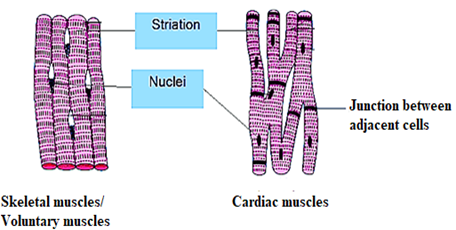
Note: -The heart wall consists of three layers, which are Epicardium (the outermost layer), myocardium (middle thick layer), and endocardium (innermost layer).
-Since the cardiac muscles are involuntary and are not controlled by the somatic nervous system, is the reason why we are not able to control the heartbeat-like controlling other muscles.
-Muscle fibers are made of Microfibrils which in turn is composed of Sarcomeres, which is the reason for the basic functioning of muscle i.e muscle contraction.
Complete answer:
The cardiac muscles are shorter in length than skeletal muscles. The structure of the cardiac muscles is known to be semi-spindle where in the case of skeletal muscle they are cylindrical. We have control over skeletal muscles as they are controlled by the somatic nervous system but in the case of the cardiac muscles, they are involuntary in function.
Additional Information: -The skeletal muscles are mostly attached to bones with collagen fibers called the tendons. Skeletal muscles consist of muscle fibers which are a group of fascicles bonded together.
-These muscle fibers are cylindrically shaped with multiple nucleus and multiple mitochondria to sustain the demanded energy. Extra mitochondria provide more energy by ATP production.
-Smooth muscle cells are composed of sheets of smooth muscle cells; these cells contain fibers of actin and myosin.
So, the correct answer is ‘Semi-spindle, involuntary’.
Note: -The heart wall consists of three layers, which are Epicardium (the outermost layer), myocardium (middle thick layer), and endocardium (innermost layer).
-Since the cardiac muscles are involuntary and are not controlled by the somatic nervous system, is the reason why we are not able to control the heartbeat-like controlling other muscles.
-Muscle fibers are made of Microfibrils which in turn is composed of Sarcomeres, which is the reason for the basic functioning of muscle i.e muscle contraction.
Recently Updated Pages
Master Class 11 Social Science: Engaging Questions & Answers for Success

Master Class 11 English: Engaging Questions & Answers for Success
Master Class 11 Maths: Engaging Questions & Answers for Success
Master Class 11 Chemistry: Engaging Questions & Answers for Success
Master Class 11 Biology: Engaging Questions & Answers for Success
Master Class 11 Physics: Engaging Questions & Answers for Success
Trending doubts
Differentiate between an exothermic and an endothermic class 11 chemistry CBSE
One Metric ton is equal to kg A 10000 B 1000 C 100 class 11 physics CBSE
Difference Between Prokaryotic Cells and Eukaryotic Cells
There are 720 permutations of the digits 1 2 3 4 5 class 11 maths CBSE
Draw a diagram of a plant cell and label at least eight class 11 biology CBSE
Which chemical is known as king of chemicals A H 2 class 11 chemistry CBSE