




Car A and car B start moving simultaneously in the same direction along the line joining them. Car A is with constant acceleration a = $ 4m{{s}^{-2}} $ . While carB moves with constant velocity v = 1m/s. At t = 0 car A is 10m behind car B. find the time when car A overtakes car B.
(A) 2s
(B) $ 2.5 $ s
(C) 1s
(D) $ 1.5 $ s
Answer
 Verified
594.3k+ views
Hint: Find the relative velocity and relative acceleration and then using those values in Newton's second equation of motion we can get the time taken by car A to overtake car B.
Relative velocity is defined as the velocity of an object B in the rest frame of another object A.
Relative acceleration is the comparison of the acceleration of two bodies.
Newton’s second equation of motion is given as:
$\Rightarrow s=ut+\dfrac{1}{2}a{{t}^{2}} $.
Complete step by step solution
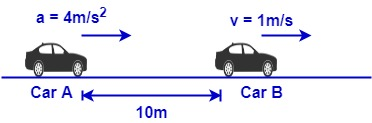
Here,
$\Rightarrow {{u}_{A}}=0 $
$\Rightarrow {{u}_{B}}=1m/s $
$\Rightarrow {{u}_{AB}}={{u}_{A}}-{{u}_{B}} $
$\Rightarrow {{u}_{AB}}=0-1 $
$\Rightarrow {{u}_{AB}}=-1m/s $
Also,
$\Rightarrow {{a}_{A}}=4m/{{s}^{2}} $
$\Rightarrow {{a}_{B}}=0 $
$\Rightarrow {a_{AB}}={a_A}-{a_B} $
$\Rightarrow {{a}_{AB}}=4-0 $
$\Rightarrow {{a}_{AB}}=4m/{{s}^{2}} $
Now using Newton’s second equation of motion i.e.
$\Rightarrow s=ut+\dfrac{1}{2}a{{t}^{2}} $
Here, s = 10m
And u, t and are the relative terms
So,
$ \begin{align}
&\Rightarrow 10=(-1)t+\dfrac{1}{2}(4){{t}^{2}} \\
&\Rightarrow 10=-t+2{{t}^{2}} \\
&\Rightarrow 2{{t}^{2}}-t-10=0 \\
\end{align} $
Solving the quadratic equation;
$\Rightarrow t=\dfrac{-b\pm \sqrt{{{b}^{2}}-4ac}}{2a} $
Here, a = 2
b $ =-1 $
c $ =-10 $
We get;
$\Rightarrow t=\dfrac{-(-1)\pm \sqrt{{{(-1)}^{2}}-4(2)(-10)}}{2(2)} $
$\Rightarrow \dfrac{1\pm \sqrt{1-(-80)}}{4} $
$\Rightarrow \dfrac{1\pm \sqrt{1+80}}{4} $
$\Rightarrow \dfrac{1\pm \sqrt{81}}{4} $
$\Rightarrow \dfrac{1\pm 9}{4} $
As a negative value of time is not possible so we will only take the positive values only.
$\Rightarrow t=\dfrac{1+9}{4} $
$\Rightarrow t=\dfrac{10}{4} $
$\Rightarrow t=2.5s $
Therefore, option (B) is correct.
Note
In second equation of motion, remember to use the relative terms of velocity and acceleration as we are to calculate time of car A w.r.t. car B respectively. We have to remember some mathematical formulas like how to solve quadratic equations and some trigonometry. Using the concept of relative velocity and relative acceleration we can find out the speed of any object with respect to another object, that is we can compare two object's velocity and we can find out which object is moving with high speed and which is moving with low speed.
Relative velocity is defined as the velocity of an object B in the rest frame of another object A.
Relative acceleration is the comparison of the acceleration of two bodies.
Newton’s second equation of motion is given as:
$\Rightarrow s=ut+\dfrac{1}{2}a{{t}^{2}} $.
Complete step by step solution
Here,
$\Rightarrow {{u}_{A}}=0 $
$\Rightarrow {{u}_{B}}=1m/s $
$\Rightarrow {{u}_{AB}}={{u}_{A}}-{{u}_{B}} $
$\Rightarrow {{u}_{AB}}=0-1 $
$\Rightarrow {{u}_{AB}}=-1m/s $
Also,
$\Rightarrow {{a}_{A}}=4m/{{s}^{2}} $
$\Rightarrow {{a}_{B}}=0 $
$\Rightarrow {a_{AB}}={a_A}-{a_B} $
$\Rightarrow {{a}_{AB}}=4-0 $
$\Rightarrow {{a}_{AB}}=4m/{{s}^{2}} $
Now using Newton’s second equation of motion i.e.
$\Rightarrow s=ut+\dfrac{1}{2}a{{t}^{2}} $
Here, s = 10m
And u, t and are the relative terms
So,
$ \begin{align}
&\Rightarrow 10=(-1)t+\dfrac{1}{2}(4){{t}^{2}} \\
&\Rightarrow 10=-t+2{{t}^{2}} \\
&\Rightarrow 2{{t}^{2}}-t-10=0 \\
\end{align} $
Solving the quadratic equation;
$\Rightarrow t=\dfrac{-b\pm \sqrt{{{b}^{2}}-4ac}}{2a} $
Here, a = 2
b $ =-1 $
c $ =-10 $
We get;
$\Rightarrow t=\dfrac{-(-1)\pm \sqrt{{{(-1)}^{2}}-4(2)(-10)}}{2(2)} $
$\Rightarrow \dfrac{1\pm \sqrt{1-(-80)}}{4} $
$\Rightarrow \dfrac{1\pm \sqrt{1+80}}{4} $
$\Rightarrow \dfrac{1\pm \sqrt{81}}{4} $
$\Rightarrow \dfrac{1\pm 9}{4} $
As a negative value of time is not possible so we will only take the positive values only.
$\Rightarrow t=\dfrac{1+9}{4} $
$\Rightarrow t=\dfrac{10}{4} $
$\Rightarrow t=2.5s $
Therefore, option (B) is correct.
Note
In second equation of motion, remember to use the relative terms of velocity and acceleration as we are to calculate time of car A w.r.t. car B respectively. We have to remember some mathematical formulas like how to solve quadratic equations and some trigonometry. Using the concept of relative velocity and relative acceleration we can find out the speed of any object with respect to another object, that is we can compare two object's velocity and we can find out which object is moving with high speed and which is moving with low speed.
Recently Updated Pages
Master Class 11 Social Science: Engaging Questions & Answers for Success

Master Class 11 Chemistry: Engaging Questions & Answers for Success
Master Class 9 General Knowledge: Engaging Questions & Answers for Success
Master Class 9 Maths: Engaging Questions & Answers for Success
Master Class 9 Science: Engaging Questions & Answers for Success
Master Class 9 English: Engaging Questions & Answers for Success
Trending doubts
One Metric ton is equal to kg A 10000 B 1000 C 100 class 11 physics CBSE
Difference Between Prokaryotic Cells and Eukaryotic Cells
Two of the body parts which do not appear in MRI are class 11 biology CBSE
1 ton equals to A 100 kg B 1000 kg C 10 kg D 10000 class 11 physics CBSE
10 examples of friction in our daily life
Name the Largest and the Smallest Cell in the Human Body ?