




Capitulum inflorescence is seen in
A) Cruciferae
B) Liliaceae
C) Compositae
D) Solanaceae
Answer
 Verified
629.7k+ views
Hint: Capitulum inflorescence is present in the largest family of flowering plants.
Complete answer:
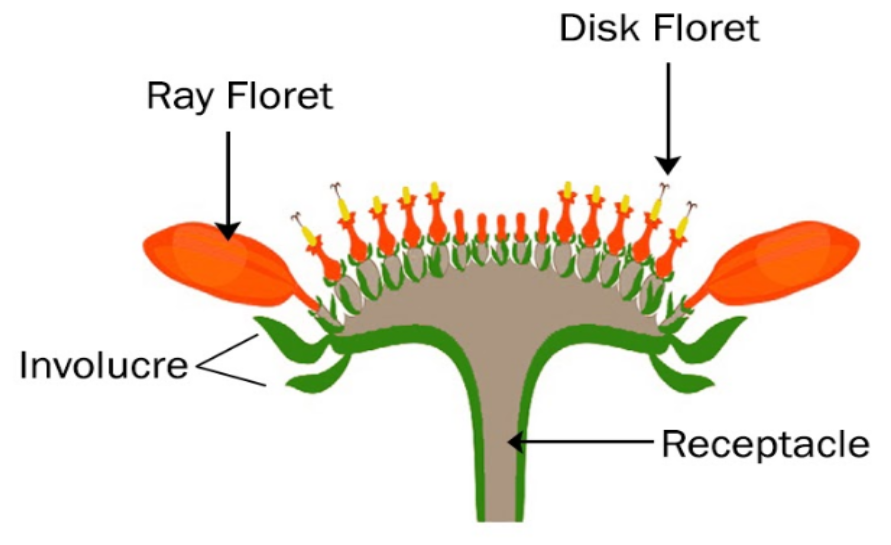
A capitulum or head is the characteristic inflorescence of the sunflower family Compositae or Asteraceae. The inflorescence mainly consists of ray flowers, disk flowers, or both ray and disk flowers. The ovary of each flower is present below the attachment of the corolla and stamens, and it is called epigynous or inferior ovary. The peduncle is almost flattened to form a receptacle that bears the small sessile flowers called florets. The florets arranged at the periphery side of the receptacle are called ray florets, and which are arranged at the centre side are called disc florets. Ray florets are zygomorphic and female while disc florets are actinomorphic and bisexual.The florets are arranged in a centripetal fashion. The inflorescence is seen as clustering of small flowers, to form a single flower. It is surrounded by one or more whorls of bracts called involucre.
Example: Tagetes, Zinnia, Sunflower (Helianthus annuus), Cosmos, Chrysanthemum, Sonchus.
Solitary inflorescence is present in the Malvaceae family, cymose inflorescence is present in the Solanaceae family and the raceme inflorescence is present in the Cruciferae family.
So, the correct answer is Compositae.
Note: Peduncle gets flattened out at the apex into a platform-like structure, called receptacle. Centripetal arrangement means younger towards the centre and older towards the periphery.
Complete answer:
Fig. Capitulum
A capitulum or head is the characteristic inflorescence of the sunflower family Compositae or Asteraceae. The inflorescence mainly consists of ray flowers, disk flowers, or both ray and disk flowers. The ovary of each flower is present below the attachment of the corolla and stamens, and it is called epigynous or inferior ovary. The peduncle is almost flattened to form a receptacle that bears the small sessile flowers called florets. The florets arranged at the periphery side of the receptacle are called ray florets, and which are arranged at the centre side are called disc florets. Ray florets are zygomorphic and female while disc florets are actinomorphic and bisexual.The florets are arranged in a centripetal fashion. The inflorescence is seen as clustering of small flowers, to form a single flower. It is surrounded by one or more whorls of bracts called involucre.
Example: Tagetes, Zinnia, Sunflower (Helianthus annuus), Cosmos, Chrysanthemum, Sonchus.
Solitary inflorescence is present in the Malvaceae family, cymose inflorescence is present in the Solanaceae family and the raceme inflorescence is present in the Cruciferae family.
So, the correct answer is Compositae.
Note: Peduncle gets flattened out at the apex into a platform-like structure, called receptacle. Centripetal arrangement means younger towards the centre and older towards the periphery.
Recently Updated Pages
Master Class 12 Economics: Engaging Questions & Answers for Success

Master Class 12 English: Engaging Questions & Answers for Success
Master Class 12 Social Science: Engaging Questions & Answers for Success
Master Class 12 Maths: Engaging Questions & Answers for Success
Master Class 12 Physics: Engaging Questions & Answers for Success
Master Class 11 Social Science: Engaging Questions & Answers for Success
Trending doubts
One Metric ton is equal to kg A 10000 B 1000 C 100 class 11 physics CBSE
Difference Between Prokaryotic Cells and Eukaryotic Cells
Two of the body parts which do not appear in MRI are class 11 biology CBSE
1 ton equals to A 100 kg B 1000 kg C 10 kg D 10000 class 11 physics CBSE
Draw a diagram of nephron and explain its structur class 11 biology CBSE
10 examples of friction in our daily life