




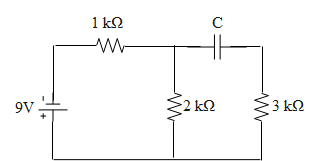
When the capacitor is fully charged, find the current drawn from the cell.
a) 2mA
b) 1mA
c) 3mA
d) 9mA
Answer
 Verified
585k+ views
Hint: A capacitor connected across a DC supply keeps on charging till the capacitor gets fully charged. In steady state after some time the electric current passing through the capacitor will be numerically equal to zero. Hence we can ignore the capacitor and the resistance 3k ohms as if they are not present in the circuit. The above resistors i.e. 1k and 2k ohms are in series. Therefore using ohm's law we can determine the current in the circuit.
Complete step by step answer:
The ohm's law states that the current (I) flowing through the metallic wire is directly proportional to the potential difference (V) provided the external physical parameters remain the same. This statement can mathematically be represented as,
$V=IR$ where R is the resistance of the metallic wire.
We can see from the circuit diagram no current will pass through the capacitor in steady state and thereby no current will pass through the 3k ohms resistor as well. Therefore the current will only pass through resistances 1k and 2k ohms. These two resistances are connected in series. Therefore the equivalent resistance in the circuit is
$\begin{align}
& R=1k+2k \\
& R=3k\Omega \\
\end{align}$
The resistance is connected to a battery of emf 9 volts. Therefore using ohm's law, the current in the circuit is,
$\begin{align}
& V=IR \\
& \Rightarrow 9=I\left( 3 \times 10^3 \right) \\
& \Rightarrow I=\dfrac{9}{3 \times 10^3} = 3\times {{10}^{-3}}A \\
& \Rightarrow I=3mA \\
\end{align}$
So, the correct answer is “Option C”.
Note:
At the initial stages as soon as the battery is connected to the circuit the current will flow through the resistor. Hence at the initial stage the current through the capacitor is not zero. At steady state the current through the capacitor will be zero. This duration of time is experimentally found out to be 2RC, where R is the resistance connected in series with the capacitor of capacitance C.
Complete step by step answer:
The ohm's law states that the current (I) flowing through the metallic wire is directly proportional to the potential difference (V) provided the external physical parameters remain the same. This statement can mathematically be represented as,
$V=IR$ where R is the resistance of the metallic wire.
We can see from the circuit diagram no current will pass through the capacitor in steady state and thereby no current will pass through the 3k ohms resistor as well. Therefore the current will only pass through resistances 1k and 2k ohms. These two resistances are connected in series. Therefore the equivalent resistance in the circuit is
$\begin{align}
& R=1k+2k \\
& R=3k\Omega \\
\end{align}$
The resistance is connected to a battery of emf 9 volts. Therefore using ohm's law, the current in the circuit is,
$\begin{align}
& V=IR \\
& \Rightarrow 9=I\left( 3 \times 10^3 \right) \\
& \Rightarrow I=\dfrac{9}{3 \times 10^3} = 3\times {{10}^{-3}}A \\
& \Rightarrow I=3mA \\
\end{align}$
So, the correct answer is “Option C”.
Note:
At the initial stages as soon as the battery is connected to the circuit the current will flow through the resistor. Hence at the initial stage the current through the capacitor is not zero. At steady state the current through the capacitor will be zero. This duration of time is experimentally found out to be 2RC, where R is the resistance connected in series with the capacitor of capacitance C.
Recently Updated Pages
Master Class 12 Economics: Engaging Questions & Answers for Success

Master Class 12 Physics: Engaging Questions & Answers for Success
Master Class 12 English: Engaging Questions & Answers for Success
Master Class 12 Social Science: Engaging Questions & Answers for Success
Master Class 12 Maths: Engaging Questions & Answers for Success
Master Class 12 Business Studies: Engaging Questions & Answers for Success
Trending doubts
Which are the Top 10 Largest Countries of the World?
What are the major means of transport Explain each class 12 social science CBSE
Draw a labelled sketch of the human eye class 12 physics CBSE
Why cannot DNA pass through cell membranes class 12 biology CBSE
Differentiate between insitu conservation and exsitu class 12 biology CBSE
Draw a neat and well labeled diagram of TS of ovary class 12 biology CBSE