




Can we generate the PWM from PPM?
Answer
 Verified
545.7k+ views
Hint: PWM is known as pulse width modulation. PPM is known as the pulse position modulation
The Pulse Width Modulation sends a narrow or a wide pulse within the interval, and the width of the pulse is the value.
Pulse Position Modulation sends a fixed amplitude pulse, but the timing of the pulse within the interval is the value.
Complete step-by-step solution:
We can generate the PWM signal from the PPM signal by using the following steps.
The reference pulse of a fixed period is generated from the incoming PPM waveform and SR flip flop is set by the reference pulse.
Due to the set-reset signals applied at the flip flop, we can generate the PWM signal as the output.
The PWM signal can be demodulated by using the PWM modulator.
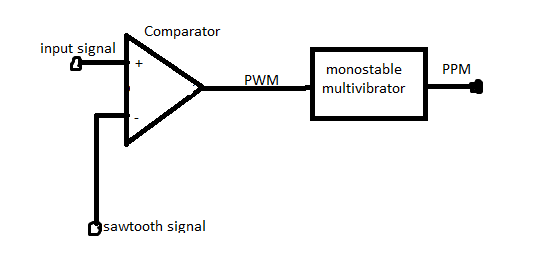
From the comparator output, we can obtain the PWM signal then this output is given to the monostable multivibrator.
For each trailing edge of the PWM signal, the monostable multivibrator output goes high.
The trailing edge of the PWM signal continuously shifting with proportional to the modulating signal
The generated PPM pulses have the same amplitude and width. The below diagram explains the generation of PPM from the PWM signals.
Note:The PPM signal has good noise immunity because it has constant amplitude.
The transmitted power always remains constant because of this constant amplitude.
The PPM requires a large bandwidth for the transmission of undistorted pulses. The Position of the PPM pulses varies with concern to the reference signal.
The Pulse Width Modulation sends a narrow or a wide pulse within the interval, and the width of the pulse is the value.
Pulse Position Modulation sends a fixed amplitude pulse, but the timing of the pulse within the interval is the value.
Complete step-by-step solution:
We can generate the PWM signal from the PPM signal by using the following steps.
The reference pulse of a fixed period is generated from the incoming PPM waveform and SR flip flop is set by the reference pulse.
Due to the set-reset signals applied at the flip flop, we can generate the PWM signal as the output.
The PWM signal can be demodulated by using the PWM modulator.
From the comparator output, we can obtain the PWM signal then this output is given to the monostable multivibrator.
For each trailing edge of the PWM signal, the monostable multivibrator output goes high.
The trailing edge of the PWM signal continuously shifting with proportional to the modulating signal
The generated PPM pulses have the same amplitude and width. The below diagram explains the generation of PPM from the PWM signals.
Note:The PPM signal has good noise immunity because it has constant amplitude.
The transmitted power always remains constant because of this constant amplitude.
The PPM requires a large bandwidth for the transmission of undistorted pulses. The Position of the PPM pulses varies with concern to the reference signal.
Recently Updated Pages
Master Class 12 Business Studies: Engaging Questions & Answers for Success

Master Class 12 Chemistry: Engaging Questions & Answers for Success
Master Class 12 Biology: Engaging Questions & Answers for Success
Class 12 Question and Answer - Your Ultimate Solutions Guide
Master Class 11 English: Engaging Questions & Answers for Success
Master Class 11 Social Science: Engaging Questions & Answers for Success
Trending doubts
Which are the Top 10 Largest Countries of the World?
Draw a labelled sketch of the human eye class 12 physics CBSE
Differentiate between homogeneous and heterogeneous class 12 chemistry CBSE
In order to find out the different types of gametes class 12 biology NEET_UG
Why is the cell called the structural and functional class 12 biology CBSE
Draw ray diagrams each showing i myopic eye and ii class 12 physics CBSE