




Can an equilateral triangle be a right triangle?
Answer
 Verified
524.1k+ views
Hint: A triangle that has all its sides equal in dimension and each angle measure up to $60$ degrees, is called an equilateral triangle.
A right triangle, also known as an orthogonal triangle, is a triangle in which one angle is a right angle. The side opposite the right angle is called the hypotenuse and it is the longest of all the sides.
Complete step by step answer:
In this question we have to show that an equilateral triangle can be a right- angled triangle or not.
Equilateral triangle is a triangle that has all its equal in dimension and each angle is equal to $60^\circ $.
An equilateral triangle can never be a right triangle because in a right - angled triangle one angle is of $90^\circ $ and if by definition of equilateral triangle we make all angles equal to $90^\circ $ so their sum is equal to $270^\circ $ which can’t be possible as the sum of all angles of triangle is equal to $180^\circ $. So, we can’t make all angles equal to $90^\circ $.
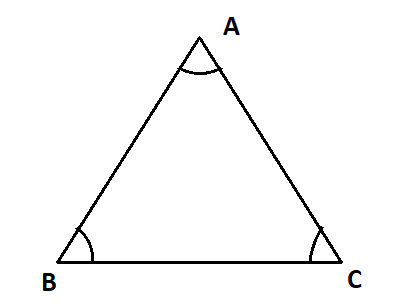
In a right- angled triangle all sides are not equal in dimensions as the hypotenuse side is the longest side and by Pythagoras theorem the square of the hypotenuse is equal to the sum of the sum of squares of the other two sides.
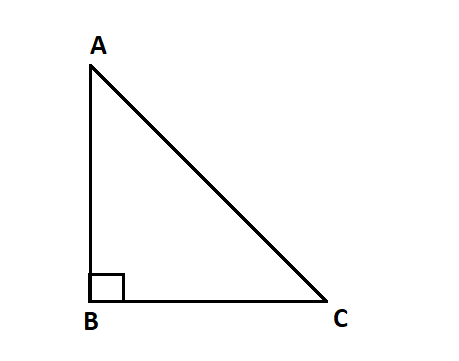
So according to the definition of an equilateral triangle, an equilateral triangle can not be a right -angled triangle.
Hence, an equilateral triangle can never be a right- angled triangle.
Note: Alternative way:
We can solve using the length of sides of triangles. Pythagoras theorem states that in a right- angled triangle the square of the hypotenuse is equal to the sum of the square of its base and height. In a right- angled triangle, the side opposite to the right angle is always bigger than the other two sides. So, a right- angled triangle can be a scalene or an isosceles triangle as in scalene triangle all sides have different lengths and in isosceles triangle two sides are equal in length.
A right triangle, also known as an orthogonal triangle, is a triangle in which one angle is a right angle. The side opposite the right angle is called the hypotenuse and it is the longest of all the sides.
Complete step by step answer:
In this question we have to show that an equilateral triangle can be a right- angled triangle or not.
Equilateral triangle is a triangle that has all its equal in dimension and each angle is equal to $60^\circ $.
An equilateral triangle can never be a right triangle because in a right - angled triangle one angle is of $90^\circ $ and if by definition of equilateral triangle we make all angles equal to $90^\circ $ so their sum is equal to $270^\circ $ which can’t be possible as the sum of all angles of triangle is equal to $180^\circ $. So, we can’t make all angles equal to $90^\circ $.
In a right- angled triangle all sides are not equal in dimensions as the hypotenuse side is the longest side and by Pythagoras theorem the square of the hypotenuse is equal to the sum of the sum of squares of the other two sides.
So according to the definition of an equilateral triangle, an equilateral triangle can not be a right -angled triangle.
Hence, an equilateral triangle can never be a right- angled triangle.
Note: Alternative way:
We can solve using the length of sides of triangles. Pythagoras theorem states that in a right- angled triangle the square of the hypotenuse is equal to the sum of the square of its base and height. In a right- angled triangle, the side opposite to the right angle is always bigger than the other two sides. So, a right- angled triangle can be a scalene or an isosceles triangle as in scalene triangle all sides have different lengths and in isosceles triangle two sides are equal in length.
Recently Updated Pages
Master Class 11 Social Science: Engaging Questions & Answers for Success

Master Class 11 English: Engaging Questions & Answers for Success
Master Class 11 Maths: Engaging Questions & Answers for Success
Master Class 11 Chemistry: Engaging Questions & Answers for Success
Master Class 11 Biology: Engaging Questions & Answers for Success
Class 11 Question and Answer - Your Ultimate Solutions Guide
Trending doubts
Find the sum of series 1 + 2 + 3 + 4 + 5 + + 100 class 9 maths CBSE
Difference Between Plant Cell and Animal Cell
Fill the blanks with the suitable prepositions 1 The class 9 english CBSE
What is pollution? How many types of pollution? Define it
What is the Full Form of ICSE / ISC ?
Name 10 Living and Non living things class 9 biology CBSE