




What is called Central Dogma in molecular biology?
Answer
 Verified
585.3k+ views
Hint:Molecular biology, including molecular synthesis, alteration, mechanisms, and interactions, is the branch of biology that concerns the molecular basis of biological activity in and between cells.
Complete answer:The core dogma explains the flow of cell genetic material, the replication of DNA, and the coding of RNA via the transcription process, and further translation of RNA codes for proteins.
Through the context, it is possible to grasp the idea of a series of interactions. Biopolymers are among the most common. Proteins, RNA, and DNA, which are further classified into general transfers, unknown transfers, and special transfers, are the main categories of biopolymers.
In an unusual circumstance in the laboratory, special transfers occur. In virtually all cells, a general transition occurs. The normal flow of information through transcription and translation is described. Transfers that are unknown are said to never occur.
Steps in Core Dogma-
In two separate steps, the core dogma takes place:
Transcription- This is the mechanism through which the RNA polymerase enzyme transfers information from a single strand of DNA to RNA. There are three parts of the DNA strand that undergo this process, namely the promoter, the structural gene, and the terminator.
Translation- This is the mechanism by which the RNA codes for particular proteins. It is an active process in which energy is needed. The charged tRNA molecules provide this energy.
Below is the picture of the central dogma.
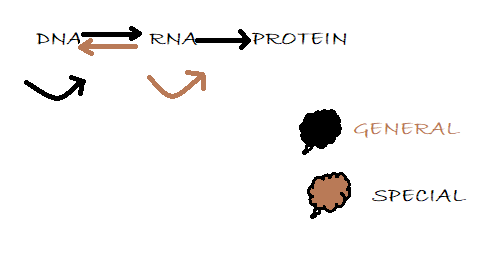
Note: The 'Core Dogma' is the method of translating the instructions in DNA into a functional product. Francis Crick, the discoverer of the structure of DNA, first suggested it in 1958. The core dogma explains the two-step mechanism of transcription and translation by which data flows into proteins in genes: DNA to RNA to protein.
Complete answer:The core dogma explains the flow of cell genetic material, the replication of DNA, and the coding of RNA via the transcription process, and further translation of RNA codes for proteins.
Through the context, it is possible to grasp the idea of a series of interactions. Biopolymers are among the most common. Proteins, RNA, and DNA, which are further classified into general transfers, unknown transfers, and special transfers, are the main categories of biopolymers.
In an unusual circumstance in the laboratory, special transfers occur. In virtually all cells, a general transition occurs. The normal flow of information through transcription and translation is described. Transfers that are unknown are said to never occur.
Steps in Core Dogma-
In two separate steps, the core dogma takes place:
Transcription- This is the mechanism through which the RNA polymerase enzyme transfers information from a single strand of DNA to RNA. There are three parts of the DNA strand that undergo this process, namely the promoter, the structural gene, and the terminator.
Translation- This is the mechanism by which the RNA codes for particular proteins. It is an active process in which energy is needed. The charged tRNA molecules provide this energy.
Below is the picture of the central dogma.
Note: The 'Core Dogma' is the method of translating the instructions in DNA into a functional product. Francis Crick, the discoverer of the structure of DNA, first suggested it in 1958. The core dogma explains the two-step mechanism of transcription and translation by which data flows into proteins in genes: DNA to RNA to protein.
Recently Updated Pages
Three beakers labelled as A B and C each containing 25 mL of water were taken A small amount of NaOH anhydrous CuSO4 and NaCl were added to the beakers A B and C respectively It was observed that there was an increase in the temperature of the solutions contained in beakers A and B whereas in case of beaker C the temperature of the solution falls Which one of the following statements isarecorrect i In beakers A and B exothermic process has occurred ii In beakers A and B endothermic process has occurred iii In beaker C exothermic process has occurred iv In beaker C endothermic process has occurred

Master Class 12 Social Science: Engaging Questions & Answers for Success
Master Class 12 Physics: Engaging Questions & Answers for Success
Master Class 12 Maths: Engaging Questions & Answers for Success
Master Class 12 Economics: Engaging Questions & Answers for Success
Master Class 12 Chemistry: Engaging Questions & Answers for Success
Three beakers labelled as A B and C each containing 25 mL of water were taken A small amount of NaOH anhydrous CuSO4 and NaCl were added to the beakers A B and C respectively It was observed that there was an increase in the temperature of the solutions contained in beakers A and B whereas in case of beaker C the temperature of the solution falls Which one of the following statements isarecorrect i In beakers A and B exothermic process has occurred ii In beakers A and B endothermic process has occurred iii In beaker C exothermic process has occurred iv In beaker C endothermic process has occurred
Master Class 12 Social Science: Engaging Questions & Answers for Success
Master Class 12 Physics: Engaging Questions & Answers for Success
Trending doubts
Which are the Top 10 Largest Countries of the World?
Draw a labelled sketch of the human eye class 12 physics CBSE
Differentiate between homogeneous and heterogeneous class 12 chemistry CBSE
What are the major means of transport Explain each class 12 social science CBSE
Sulphuric acid is known as the king of acids State class 12 chemistry CBSE
Why should a magnesium ribbon be cleaned before burning class 12 chemistry CBSE