




What do we call the Vertebrate group which possess dry Scalp skins?
Answer
 Verified
510.6k+ views
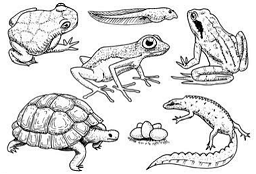
Hint: The dry scalp skinned animals are typically known as Reptiles. Reptiles are the vertebrate class of animals such as- snakes, lizards, crocodiles, turtles and tortoises. They are distinguished by external features like-dry scaly skin and laying eggs which are soft-shelled and need protection.
Complete answer:
Reptiles are cold-blooded animals some are marine and aquatic and some prefer to stay on land. All species of reptiles fertilize eggs internally. However, crocodiles have four-chambered hearts like mammals.
The proto-reptiles around $312$ millions years ago were on earth during the Carboniferous period. The tetrapod has adapted to life on dry land. Reptiles are creatures which are oviparous and some species of squamates are viviparous. The offspring developed within the mother are using a placenta that contains the eggshell.
Reptile eggs are surrounded by membranes for protection and transport and adapt to reproduction on land. Many species feed the foetus through the placenta of mammals and also prolonged care before hatching.
Unlike amphibians the reptiles have moist skin which are slimy in nature and scaly skin. Some amphibians possess scaly skin but most of the reptiles have it. The tough skin of reptiles protects them from any external injuries and it is tough to tear their scaly skin.
Note:
The covering of a reptile's skin is made up of keratin, a protein which makes up the hair and horns in animals for toughness. The crocodiles are the largest of all the reptiles among the species; the saltwater crocodile is the formidable predator of the planet. Around $23$ feet and weigh more than $1000$ kilograms. the group of air-breathing animals have internal fertilization.
Complete answer:
Reptiles are cold-blooded animals some are marine and aquatic and some prefer to stay on land. All species of reptiles fertilize eggs internally. However, crocodiles have four-chambered hearts like mammals.
The proto-reptiles around $312$ millions years ago were on earth during the Carboniferous period. The tetrapod has adapted to life on dry land. Reptiles are creatures which are oviparous and some species of squamates are viviparous. The offspring developed within the mother are using a placenta that contains the eggshell.
Reptile eggs are surrounded by membranes for protection and transport and adapt to reproduction on land. Many species feed the foetus through the placenta of mammals and also prolonged care before hatching.
Unlike amphibians the reptiles have moist skin which are slimy in nature and scaly skin. Some amphibians possess scaly skin but most of the reptiles have it. The tough skin of reptiles protects them from any external injuries and it is tough to tear their scaly skin.
Note:
The covering of a reptile's skin is made up of keratin, a protein which makes up the hair and horns in animals for toughness. The crocodiles are the largest of all the reptiles among the species; the saltwater crocodile is the formidable predator of the planet. Around $23$ feet and weigh more than $1000$ kilograms. the group of air-breathing animals have internal fertilization.
Recently Updated Pages
Master Class 12 Economics: Engaging Questions & Answers for Success

Master Class 12 English: Engaging Questions & Answers for Success
Master Class 12 Social Science: Engaging Questions & Answers for Success
Master Class 12 Maths: Engaging Questions & Answers for Success
Master Class 12 Physics: Engaging Questions & Answers for Success
Master Class 9 General Knowledge: Engaging Questions & Answers for Success
Trending doubts
1 ton equals to A 100 kg B 1000 kg C 10 kg D 10000 class 11 physics CBSE
Draw a diagram of nephron and explain its structur class 11 biology CBSE
Draw a diagram of a plant cell and label at least eight class 11 biology CBSE
Bond order ofO2 O2+ O2 and O22 is in order A O2 langle class 11 chemistry CBSE
How do I convert ms to kmh Give an example class 11 physics CBSE
Proton was discovered by A Thomson B Rutherford C Chadwick class 11 chemistry CBSE