




Calculate the radius of the $n^{th}$ orbit
A. $\sqrt{\dfrac{nh}{2\pi eB}}$
B. $\sqrt{\dfrac{nheB}{2\pi }}$
C. $\sqrt{\dfrac{nhe}{2\pi B}}$
D. $\sqrt{\dfrac{nhB}{2\pi e}}$
Answer
 Verified
641.1k+ views
Hint: First we will use Bohr’s postulates to write an expression of angular momentum of the electron. Then we will balance the magnetic Lorentz force and the centripetal force on the electron and finally we will use both these equations to find the value of radius of the orbit.
Formula used:
Bohr’s postulate regarding acceptable angular momentum of electron for a stable orbit
$mvr=\dfrac{nh}{2\pi }$
Complete step by step answer:
According to Bohr’s postulates, for an orbit to be stable angular momentum of electron in it must be an integral multiple of $\dfrac{h}{2\pi }$. Using this we get the formula $mvr=\dfrac{nh}{2\pi }\Rightarrow mv=\dfrac{nh}{2\pi r}$.
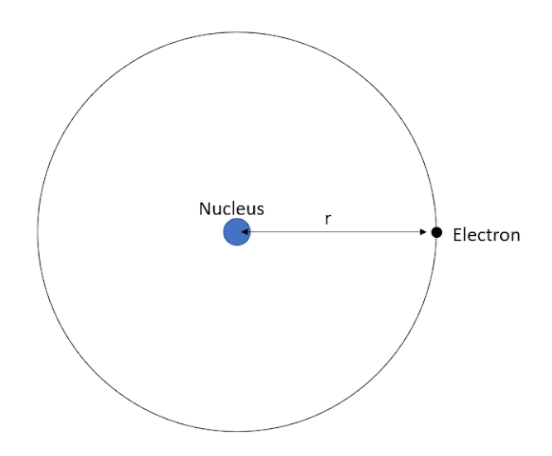
We will assume the electron moves in a magnetic field of magnitude B acting perpendicular to the plane of motion of the electron. The magnitude of Lorentz force on it will then be the product of its charge, the velocity with which it moves and the magnitude of the magnetic field. This magnetic force will be the force that provides the necessary centripetal acceleration for the motion of the electron in a circular orbit. So, we will get the balancing equation as $\dfrac{m{{v}^{2}}}{r}=qvB\Rightarrow mv=qBr$. We will equate the value of mv from this equation and the previously calculated value of mv to get $qBr=\dfrac{nh}{2\pi r}\Rightarrow {{r}^{2}}=\dfrac{nh}{2\pi qB}$. The charge on the electron is e. We will replace that value in the equation and finally get the radius of the $n^{th}$ orbit as $r=\sqrt{\dfrac{nh}{2\pi eB}}$.
So, the correct answer is “Option A”.
Note: We can also find a totally different expression for the radius of the $n^{th}$ orbit of electron in which we balance the centripetal force with the electrostatic force of attraction between the positively charged nucleus and the electron. But all the options given have magnetic components in them so we will use this approach.
Formula used:
Bohr’s postulate regarding acceptable angular momentum of electron for a stable orbit
$mvr=\dfrac{nh}{2\pi }$
Complete step by step answer:
According to Bohr’s postulates, for an orbit to be stable angular momentum of electron in it must be an integral multiple of $\dfrac{h}{2\pi }$. Using this we get the formula $mvr=\dfrac{nh}{2\pi }\Rightarrow mv=\dfrac{nh}{2\pi r}$.
We will assume the electron moves in a magnetic field of magnitude B acting perpendicular to the plane of motion of the electron. The magnitude of Lorentz force on it will then be the product of its charge, the velocity with which it moves and the magnitude of the magnetic field. This magnetic force will be the force that provides the necessary centripetal acceleration for the motion of the electron in a circular orbit. So, we will get the balancing equation as $\dfrac{m{{v}^{2}}}{r}=qvB\Rightarrow mv=qBr$. We will equate the value of mv from this equation and the previously calculated value of mv to get $qBr=\dfrac{nh}{2\pi r}\Rightarrow {{r}^{2}}=\dfrac{nh}{2\pi qB}$. The charge on the electron is e. We will replace that value in the equation and finally get the radius of the $n^{th}$ orbit as $r=\sqrt{\dfrac{nh}{2\pi eB}}$.
So, the correct answer is “Option A”.
Note: We can also find a totally different expression for the radius of the $n^{th}$ orbit of electron in which we balance the centripetal force with the electrostatic force of attraction between the positively charged nucleus and the electron. But all the options given have magnetic components in them so we will use this approach.
Recently Updated Pages
Master Class 12 Economics: Engaging Questions & Answers for Success

Master Class 12 Biology: Engaging Questions & Answers for Success
Master Class 11 English: Engaging Questions & Answers for Success
Master Class 11 Physics: Engaging Questions & Answers for Success
Master Class 11 Computer Science: Engaging Questions & Answers for Success
Master Class 11 Chemistry: Engaging Questions & Answers for Success
Trending doubts
Draw a labelled sketch of the human eye class 12 physics CBSE
Why is the cell called the structural and functional class 12 biology CBSE
Draw ray diagrams each showing i myopic eye and ii class 12 physics CBSE
Which are the Top 10 Largest Countries of the World?
Differentiate between homogeneous and heterogeneous class 12 chemistry CBSE
Which is the correct genotypic ratio of mendel dihybrid class 12 biology CBSE