




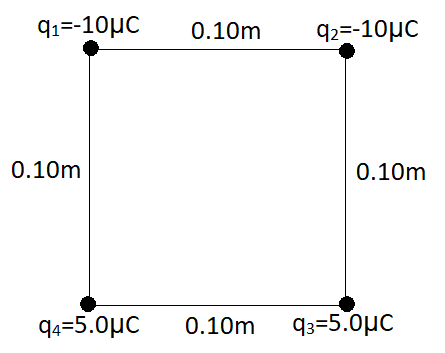
Calculate the electric potential at the center of the square in figure
Answer
 Verified
598.5k+ views
Hint To find the potential at the center, we need to calculate the potential at the center due to each of the charges. And the distance of the charges from the center will be half of the diagonal of the square given.
Formula Used:
In this solution we will be using the following formula,
$\Rightarrow V = \dfrac{{kq}}{r} $
where $ V $ is the potential, $ q $ is the charge and $ r $ is the distance.
Complete step by step answer
In the given diagram in the question we can see that the charges are placed in the form of a square and we need to find the potential at the center of this square.
Now the distance of each charge will be half of the diagonal of the square of side $ 0.10m $ .
Now we have the value of the diagonal as, $ d = \sqrt {{{0.1}^2} + {{0.1}^2}} $
So calculating we have,
$\Rightarrow d = \sqrt {2 \times 0.1} $
Now the distance of the charge from the center is given as,
$\Rightarrow r = \dfrac{d}{2} $
So we get, $ r = \dfrac{{\sqrt {2 \times {{0.1}^2}} }}{2} = 0.1\dfrac{{\sqrt 2 }}{2} $
Hence the distance is, $ r = \dfrac{{0.1}}{{\sqrt 2 }} $
Therefore each of the charges is at a distance $ r = \dfrac{{0.1}}{{\sqrt 2 }} $ .
Now the potential is given as, $ V = \dfrac{{kq}}{r} $
The potential at the center will be the sum of the potential due to each of the charges,
$\Rightarrow V = \dfrac{{k{q_1}}}{r} + \dfrac{{k{q_2}}}{r} + \dfrac{{k{q_3}}}{r} + \dfrac{{k{q_4}}}{r} $
Taking common $ \dfrac{k}{r} $ we get,
$\Rightarrow V = \dfrac{k}{r}\left[ {{q_1} + {q_2} + {q_3} + {q_4}} \right] $
In the question we are given, $ {q_1} = - 10\mu C $ , $ {q_2} = - 10\mu C $ , $ {q_3} = 5.0\mu C $ and $ {q_4} = 5.0\mu C $
Now substituting we get,
$\Rightarrow V = \dfrac{k}{r}\left[ { - 10 - 10 + 5 + 5} \right] \times {10^{ - 6}} $
On calculating we get, $ V = \dfrac{k}{r}\left[ { - 10} \right] \times {10^{ - 6}} $
The value of $ k $ is $ 9 \times {10^9} $ so substituting we get,
$\Rightarrow V = - \dfrac{{9 \times {{10}^9}}}{{\dfrac{{0.1}}{{\sqrt 2 }}}} \times 10 \times {10^{ - 6}} $
So we get,
$\Rightarrow V = - \dfrac{{9 \times {{10}^9}}}{{0.1}} \times 10\sqrt 2 \times {10^{ - 6}} $
On calculating we have,
$\Rightarrow V = - 9\sqrt 2 \times {10^5} $
So we get the potential at the center as,
$\Rightarrow V = - 1.27 \times {10^6}V $.
Note
The electric potential at a point is the amount of work which is needed to move a charge from a reference point to the given point in an electric field without producing acceleration. Typically we take the reference point at infinity.
Formula Used:
In this solution we will be using the following formula,
$\Rightarrow V = \dfrac{{kq}}{r} $
where $ V $ is the potential, $ q $ is the charge and $ r $ is the distance.
Complete step by step answer
In the given diagram in the question we can see that the charges are placed in the form of a square and we need to find the potential at the center of this square.
Now the distance of each charge will be half of the diagonal of the square of side $ 0.10m $ .
Now we have the value of the diagonal as, $ d = \sqrt {{{0.1}^2} + {{0.1}^2}} $
So calculating we have,
$\Rightarrow d = \sqrt {2 \times 0.1} $
Now the distance of the charge from the center is given as,
$\Rightarrow r = \dfrac{d}{2} $
So we get, $ r = \dfrac{{\sqrt {2 \times {{0.1}^2}} }}{2} = 0.1\dfrac{{\sqrt 2 }}{2} $
Hence the distance is, $ r = \dfrac{{0.1}}{{\sqrt 2 }} $
Therefore each of the charges is at a distance $ r = \dfrac{{0.1}}{{\sqrt 2 }} $ .
Now the potential is given as, $ V = \dfrac{{kq}}{r} $
The potential at the center will be the sum of the potential due to each of the charges,
$\Rightarrow V = \dfrac{{k{q_1}}}{r} + \dfrac{{k{q_2}}}{r} + \dfrac{{k{q_3}}}{r} + \dfrac{{k{q_4}}}{r} $
Taking common $ \dfrac{k}{r} $ we get,
$\Rightarrow V = \dfrac{k}{r}\left[ {{q_1} + {q_2} + {q_3} + {q_4}} \right] $
In the question we are given, $ {q_1} = - 10\mu C $ , $ {q_2} = - 10\mu C $ , $ {q_3} = 5.0\mu C $ and $ {q_4} = 5.0\mu C $
Now substituting we get,
$\Rightarrow V = \dfrac{k}{r}\left[ { - 10 - 10 + 5 + 5} \right] \times {10^{ - 6}} $
On calculating we get, $ V = \dfrac{k}{r}\left[ { - 10} \right] \times {10^{ - 6}} $
The value of $ k $ is $ 9 \times {10^9} $ so substituting we get,
$\Rightarrow V = - \dfrac{{9 \times {{10}^9}}}{{\dfrac{{0.1}}{{\sqrt 2 }}}} \times 10 \times {10^{ - 6}} $
So we get,
$\Rightarrow V = - \dfrac{{9 \times {{10}^9}}}{{0.1}} \times 10\sqrt 2 \times {10^{ - 6}} $
On calculating we have,
$\Rightarrow V = - 9\sqrt 2 \times {10^5} $
So we get the potential at the center as,
$\Rightarrow V = - 1.27 \times {10^6}V $.
Note
The electric potential at a point is the amount of work which is needed to move a charge from a reference point to the given point in an electric field without producing acceleration. Typically we take the reference point at infinity.
Recently Updated Pages
Master Class 12 Business Studies: Engaging Questions & Answers for Success

Master Class 12 Biology: Engaging Questions & Answers for Success
Master Class 12 Chemistry: Engaging Questions & Answers for Success
Class 12 Question and Answer - Your Ultimate Solutions Guide
Master Class 11 Social Science: Engaging Questions & Answers for Success
Master Class 11 English: Engaging Questions & Answers for Success
Trending doubts
Which are the Top 10 Largest Countries of the World?
Draw a labelled sketch of the human eye class 12 physics CBSE
Name the crygenes that control cotton bollworm and class 12 biology CBSE
Differentiate between homogeneous and heterogeneous class 12 chemistry CBSE
Ribosomal RNA is actively synthesised in A Nucleoplasm class 12 biology CBSE
How many molecules of ATP and NADPH are required information class 12 biology CBSE