




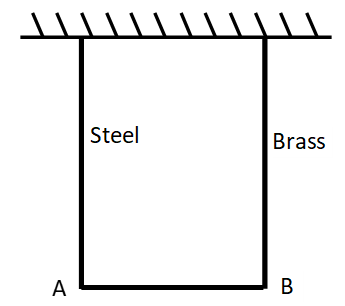
Calculate the diameter of the brass wire.
A. $2.1 \times {10^{ - 4}}m$
B. $4.2 \times {10^{ - 4}}m$
C. $8.4 \times {10^{ - 4}}m$
D. $16.8 \times {10^{ - 4}}m$
Answer
 Verified
654.6k+ views
Hint: Correction if the question calculates the diameter of brass wire. Given diameter of steel wire is $0.6mm$ and $\dfrac{{{y_b}}}{{{y_s}}} = \dfrac{1}{2} $ . Since the weight AB are equally distributed in both wires, the strain will be the same in both i.e. ratio of stress to young's modulus of elasticity will be constant.
(1) $\dfrac{{Stress}}{{Young's{\text{ modules}}}} = cons\tan t$
(2) Area of base of wire $ = \pi {r^2}$
Where r is the radius of base.
Complete step by step answer:
Since both the wires i.e. steel and brass are subjected to weight AB this weight will produce elongation in the wire.
The ratio of longitudinal stress as the longitudinal strain within the elastic limit is known as young’s modulus of elasticity, Y.
Now, as the weight is equally distributed on both wires, so the strain in both the wires will be the same.
Now, young’s modulus, $Y = \dfrac{{Stress}}{{Strain}}$
$ \Rightarrow \dfrac{{Stress}}{Y} = Strain$
As strain is same, it can be treated constant here
So, $\dfrac{{Stress}}{Y} = Cons\tan t$
$ \Rightarrow {\left( {\dfrac{{Stress}}{Y}} \right)_{brass}} = {\left( {\dfrac{{Stress}}{Y}} \right)_{steel}}$…. (i)
Now, stress $ = \dfrac{{Force}}{{Area}}$
And, Area $ = \pi {r^2}$… (Where r is radius of wire)
So, stress $ = \dfrac{{Force}}{{\pi {r^2}}}$
Also, since weights are equally distributed, force will also be the same in both.
So, equation (i) become
$
\dfrac{{Force}}{{{{\left( {Area} \right)}_{brass}} \times {Y_b}}} = \dfrac{{Force}}{{{{\left( {Area} \right)}_{steel}} \times {Y_s}}} \\
\Rightarrow \dfrac{1}{{\pi r_b^2 \times {Y_b}}} = \dfrac{1}{{\pi r_s^2 \times {Y_s}}} \\
$
Where, ${Y_b}$ is young’s modulus for brass and ${Y_s}$ is young’s modulus for steel
Also, ${r_b}$ is radius of brass and ${r_s}$ is radius of steel $ = \dfrac{{0.6}}{2} = 0.3m$
$ = 0.3 \times {10^{ - 3}}$
$
\Rightarrow \dfrac{1}{{r_b^2 \times {Y_b}}} = \dfrac{1}{{r_s^2 \times {Y_s}}} \\
\Rightarrow \dfrac{1}{{r_b^2}} = \dfrac{{{Y_b}}}{{{Y_s}}} \times \dfrac{1}{{r_s^2}} \\
\Rightarrow \dfrac{1}{{r_b^2}} = \dfrac{1}{2} \times \dfrac{1}{{{{\left( {0.3 \times {{10}^{ - 3}}} \right)}^2}}} \\
\Rightarrow r_b^{} = \sqrt {2 \times {{\left( {0.3 \times {{10}^{ - 3}}} \right)}^2}} \\
\Rightarrow {r_b} = 1.414 \times 0.3 \times {10^{ - 3}} = 0.424m \times {10^{ - 3}} \\
$
So, diameter of brass $ = 2 \times 0.4242 \times {10^{ - 3}}$
$ = 0.8484 \times {10^{ - 3}}$
$ = 8.4 \times {10^{ - 4}}m$
So, the correct answer is “Option C”.
Note:
Here $ Area = {\pi r^2} $ because the area is to be taken where the force acts. As the force acts on the base of wire. So, the area of the base which is circular in shape is taken.
(1) $\dfrac{{Stress}}{{Young's{\text{ modules}}}} = cons\tan t$
(2) Area of base of wire $ = \pi {r^2}$
Where r is the radius of base.
Complete step by step answer:
Since both the wires i.e. steel and brass are subjected to weight AB this weight will produce elongation in the wire.
The ratio of longitudinal stress as the longitudinal strain within the elastic limit is known as young’s modulus of elasticity, Y.
Now, as the weight is equally distributed on both wires, so the strain in both the wires will be the same.
Now, young’s modulus, $Y = \dfrac{{Stress}}{{Strain}}$
$ \Rightarrow \dfrac{{Stress}}{Y} = Strain$
As strain is same, it can be treated constant here
So, $\dfrac{{Stress}}{Y} = Cons\tan t$
$ \Rightarrow {\left( {\dfrac{{Stress}}{Y}} \right)_{brass}} = {\left( {\dfrac{{Stress}}{Y}} \right)_{steel}}$…. (i)
Now, stress $ = \dfrac{{Force}}{{Area}}$
And, Area $ = \pi {r^2}$… (Where r is radius of wire)
So, stress $ = \dfrac{{Force}}{{\pi {r^2}}}$
Also, since weights are equally distributed, force will also be the same in both.
So, equation (i) become
$
\dfrac{{Force}}{{{{\left( {Area} \right)}_{brass}} \times {Y_b}}} = \dfrac{{Force}}{{{{\left( {Area} \right)}_{steel}} \times {Y_s}}} \\
\Rightarrow \dfrac{1}{{\pi r_b^2 \times {Y_b}}} = \dfrac{1}{{\pi r_s^2 \times {Y_s}}} \\
$
Where, ${Y_b}$ is young’s modulus for brass and ${Y_s}$ is young’s modulus for steel
Also, ${r_b}$ is radius of brass and ${r_s}$ is radius of steel $ = \dfrac{{0.6}}{2} = 0.3m$
$ = 0.3 \times {10^{ - 3}}$
$
\Rightarrow \dfrac{1}{{r_b^2 \times {Y_b}}} = \dfrac{1}{{r_s^2 \times {Y_s}}} \\
\Rightarrow \dfrac{1}{{r_b^2}} = \dfrac{{{Y_b}}}{{{Y_s}}} \times \dfrac{1}{{r_s^2}} \\
\Rightarrow \dfrac{1}{{r_b^2}} = \dfrac{1}{2} \times \dfrac{1}{{{{\left( {0.3 \times {{10}^{ - 3}}} \right)}^2}}} \\
\Rightarrow r_b^{} = \sqrt {2 \times {{\left( {0.3 \times {{10}^{ - 3}}} \right)}^2}} \\
\Rightarrow {r_b} = 1.414 \times 0.3 \times {10^{ - 3}} = 0.424m \times {10^{ - 3}} \\
$
So, diameter of brass $ = 2 \times 0.4242 \times {10^{ - 3}}$
$ = 0.8484 \times {10^{ - 3}}$
$ = 8.4 \times {10^{ - 4}}m$
So, the correct answer is “Option C”.
Note:
Here $ Area = {\pi r^2} $ because the area is to be taken where the force acts. As the force acts on the base of wire. So, the area of the base which is circular in shape is taken.
Recently Updated Pages
Which of the following graphs shows the variation of class 12 physics CBSE

Draw a labelled diagram of the human male reproductive class 12 biology CBSE
Describe the experiment to compare the emf of two cells class 12 physics CBSE
What is standard hydrogen electrode
What is conventional current and electric current class 12 physics CBSE
2Bromopentane is treated with an alcoholic KOH solution class 12 chemistry CBSE
Trending doubts
Draw a labelled sketch of the human eye class 12 physics CBSE
Which are the Top 10 Largest Countries of the World?
A member of Simon commission later became Prime Minister class 12 social science CBSE
Differentiate between homogeneous and heterogeneous class 12 chemistry CBSE
Draw ray diagrams each showing i myopic eye and ii class 12 physics CBSE
Which is the correct genotypic ratio of mendel dihybrid class 12 biology CBSE