




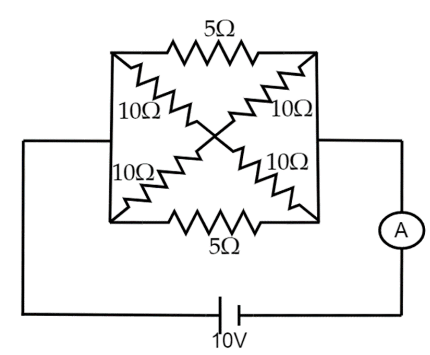
Calculate the current shown by the ammeter in the circuit.
Answer
 Verified
544.5k+ views
Hint: Learn how to calculate resistance of a parallel circuit. Redraw the diagram by using a simpler parallel and series circuit to find the equivalent resistance of the circuit and use Ohm’s law to find the current.
Formula used:
The ohm’s law is given by,
\[V = IR\]
where,\[V\] is the voltage across the circuit component \[I\] is the current through the circuit and \[R\]is the resistance of the element.
Equivalent resistance connected in series is given by,
\[{R_{eq}} = {R_1} + {R_2} + {R_3} + ...\]
The equivalent resistance in a parallel circuit is given by,
\[\dfrac{1}{{{R_{eq}}}} = \dfrac{1}{{{R_1}}} + \dfrac{1}{{{R_2}}} + ....\]
where, \[{R_{eq}}\] is the equivalent resistance of the circuit and \[{R_1}\] ,\[{R_2}\]… are the resistances connected in parallel.
Complete step by step answer:
We have given here the circuit in the figure. We have to find the current through the ammeter, which is the same as the net current through the circuit. To find the net current we have to find the net resistance of the circuit. Now, the circuit can be redrawn as follows.
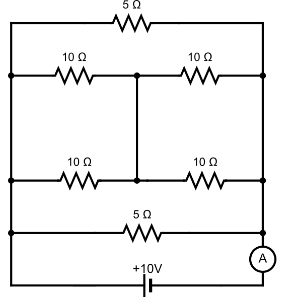
Now, in this circuit the connection of the four \[10\Omega \] resistance are in parallel and the two parallel branches are in series connections
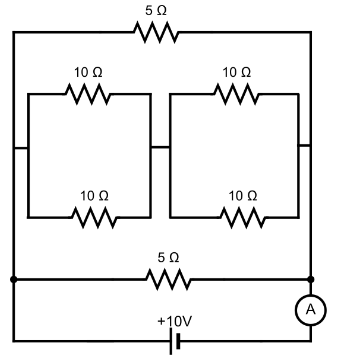
Hence, the resistance of the \[10\Omega \]branch will be,
\[\dfrac{{10 \times 10}}{{10 + 10}} + \dfrac{{10 \times 10}}{{10 + 10}} = 2 \times 5 = 10\Omega \]
Hence, we can redraw the circuit as:
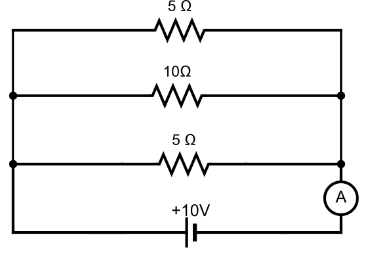
Hence, all the resistance are in parallel. So, the equivalent resistance of the circuit will be,
\[\dfrac{1}{{{R_{eq}}}} = \dfrac{1}{{10}} + \dfrac{1}{5} + \dfrac{1}{5}\]
\[\Rightarrow \dfrac{1}{{{R_{eq}}}} = \dfrac{1}{{10}} + \dfrac{2}{5}\]
\[\Rightarrow \dfrac{1}{{{R_{eq}}}} = \dfrac{{1 + 4}}{{10}}\]
\[\therefore {R_{eq}} = \dfrac{{10}}{5} = 2\]
Hence, equivalent resistance of the circuit is \[2\Omega \].
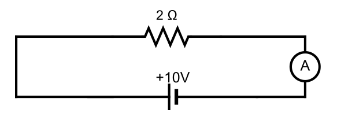
Hence, the current through the circuit will be \[I = \dfrac{{10}}{2} = 5\,A\].
Note: To solve this type of question first realize the circuit and redraw it. Then, look for parallel and series combinations in the branches to find the equivalent resistance of the circuit. The series connection is only established when the resistance are joined end to end while for parallel connections they are joined at the same ends. Keep this always in mind while redrawing the circuit.
Formula used:
The ohm’s law is given by,
\[V = IR\]
where,\[V\] is the voltage across the circuit component \[I\] is the current through the circuit and \[R\]is the resistance of the element.
Equivalent resistance connected in series is given by,
\[{R_{eq}} = {R_1} + {R_2} + {R_3} + ...\]
The equivalent resistance in a parallel circuit is given by,
\[\dfrac{1}{{{R_{eq}}}} = \dfrac{1}{{{R_1}}} + \dfrac{1}{{{R_2}}} + ....\]
where, \[{R_{eq}}\] is the equivalent resistance of the circuit and \[{R_1}\] ,\[{R_2}\]… are the resistances connected in parallel.
Complete step by step answer:
We have given here the circuit in the figure. We have to find the current through the ammeter, which is the same as the net current through the circuit. To find the net current we have to find the net resistance of the circuit. Now, the circuit can be redrawn as follows.
Now, in this circuit the connection of the four \[10\Omega \] resistance are in parallel and the two parallel branches are in series connections
Hence, the resistance of the \[10\Omega \]branch will be,
\[\dfrac{{10 \times 10}}{{10 + 10}} + \dfrac{{10 \times 10}}{{10 + 10}} = 2 \times 5 = 10\Omega \]
Hence, we can redraw the circuit as:
Hence, all the resistance are in parallel. So, the equivalent resistance of the circuit will be,
\[\dfrac{1}{{{R_{eq}}}} = \dfrac{1}{{10}} + \dfrac{1}{5} + \dfrac{1}{5}\]
\[\Rightarrow \dfrac{1}{{{R_{eq}}}} = \dfrac{1}{{10}} + \dfrac{2}{5}\]
\[\Rightarrow \dfrac{1}{{{R_{eq}}}} = \dfrac{{1 + 4}}{{10}}\]
\[\therefore {R_{eq}} = \dfrac{{10}}{5} = 2\]
Hence, equivalent resistance of the circuit is \[2\Omega \].
Hence, the current through the circuit will be \[I = \dfrac{{10}}{2} = 5\,A\].
Note: To solve this type of question first realize the circuit and redraw it. Then, look for parallel and series combinations in the branches to find the equivalent resistance of the circuit. The series connection is only established when the resistance are joined end to end while for parallel connections they are joined at the same ends. Keep this always in mind while redrawing the circuit.
Recently Updated Pages
Master Class 12 Business Studies: Engaging Questions & Answers for Success

Master Class 12 Chemistry: Engaging Questions & Answers for Success
Master Class 12 Biology: Engaging Questions & Answers for Success
Class 12 Question and Answer - Your Ultimate Solutions Guide
Master Class 11 Social Science: Engaging Questions & Answers for Success
Master Class 11 Chemistry: Engaging Questions & Answers for Success
Trending doubts
Which are the Top 10 Largest Countries of the World?
Draw a labelled sketch of the human eye class 12 physics CBSE
Name the crygenes that control cotton bollworm and class 12 biology CBSE
Differentiate between homogeneous and heterogeneous class 12 chemistry CBSE
How many molecules of ATP and NADPH are required information class 12 biology CBSE
In a transcription unit the promoter is said to be class 12 biology CBSE