




Calculate the buoyant force acting on an object immersed in water, if the object displaces four kilograms of water.
Answer
 Verified
627k+ views
Hint: When an object is placed in a fluid, the object’s weight pushes down the fluid while an upward force called buoyancy force will push the object upward against the gravitational force. If we can equate the forces acting in the vertical direction, we can easily find the buoyant force acting on the object.
Formulas used:
${{F}_{b}}={{V}_{s}}\times D\times g$
Complete step-by-step solution:
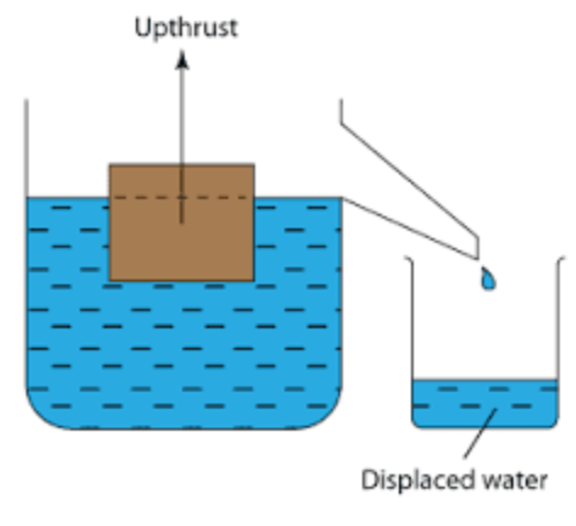
Buoyancy is a force that acts in the opposite direction of gravity which affects all objects submerged in a fluid. In the above case, water is given as the fluid. Therefore, the density of water is $D=1$.
The ${{V}_{s}}$or the displaced water in the above diagram will be the volume submerged, which is given in the question as ${{V}_{s}}=4$. The acceleration of gravity is equals to $g=10m{{s}^{-2}}$
Substituting these values in the above question, we get
$\begin{align}
& {{F}_{b}}=(4)(1)(10) \\
& {{F}_{b}}=40N \\
\end{align}$
Therefore, the buoyant force acting on the object is $40N$
Additional information:
The main principle of buoyancy tells that the buoyant force of an object submerged in water in a fluid is equal to the weight of the fluid displaced. The concept is also known as Archimedes principle. It was named after the Greek mathematician and a physicist named Archimedes who discovered it. This buoyant force is also called an upward force or lifting force. In modern days, it is used for various purposes. The scuba divers who perfected their buoyancy skills glide through the water effortlessly by using less energy and conserving more air and also hovering in different sorts of positions.
Note: The force of buoyancy will be the same no matter how deep an object is immersed, it doesn’t depend on the depth of water. Also, the term volume in the formula is the volume of the water fluid displaced but not the volume of the object that is immersed. The density in the term is also the density of the fluid but not the density of the object immersed.
Formulas used:
${{F}_{b}}={{V}_{s}}\times D\times g$
Complete step-by-step solution:
Buoyancy is a force that acts in the opposite direction of gravity which affects all objects submerged in a fluid. In the above case, water is given as the fluid. Therefore, the density of water is $D=1$.
The ${{V}_{s}}$or the displaced water in the above diagram will be the volume submerged, which is given in the question as ${{V}_{s}}=4$. The acceleration of gravity is equals to $g=10m{{s}^{-2}}$
Substituting these values in the above question, we get
$\begin{align}
& {{F}_{b}}=(4)(1)(10) \\
& {{F}_{b}}=40N \\
\end{align}$
Therefore, the buoyant force acting on the object is $40N$
Additional information:
The main principle of buoyancy tells that the buoyant force of an object submerged in water in a fluid is equal to the weight of the fluid displaced. The concept is also known as Archimedes principle. It was named after the Greek mathematician and a physicist named Archimedes who discovered it. This buoyant force is also called an upward force or lifting force. In modern days, it is used for various purposes. The scuba divers who perfected their buoyancy skills glide through the water effortlessly by using less energy and conserving more air and also hovering in different sorts of positions.
Note: The force of buoyancy will be the same no matter how deep an object is immersed, it doesn’t depend on the depth of water. Also, the term volume in the formula is the volume of the water fluid displaced but not the volume of the object that is immersed. The density in the term is also the density of the fluid but not the density of the object immersed.
Recently Updated Pages
Master Class 11 English: Engaging Questions & Answers for Success

Master Class 11 Social Science: Engaging Questions & Answers for Success
Master Class 11 Maths: Engaging Questions & Answers for Success
Master Class 11 Biology: Engaging Questions & Answers for Success
Master Class 11 Physics: Engaging Questions & Answers for Success
Master Class 11 Chemistry: Engaging Questions & Answers for Success
Trending doubts
Difference Between Plant Cell and Animal Cell
Fill the blanks with the suitable prepositions 1 The class 9 english CBSE
What is pollution? How many types of pollution? Define it
Name 10 Living and Non living things class 9 biology CBSE
What is the full form of pH?
On an outline map of India show its neighbouring c class 9 social science CBSE