




Calculate the acceleration of the moon towards the Earth’s centre.
Answer
 Verified
617.1k+ views
Hint: Recall that the acceleration of the moon towards the Earth’s centre is the centripetal/radial acceleration of the moon. To this end, first determine the revolutionary period of the moon and the distance travelled by the moon in the circular path to arrive at its linear velocity. Then arrive at its appropriate centripetal acceleration acting along the radius of the circular path it describes around the Earth.
Formula Used:
Radial/centripetal acceleration: $a_r = \dfrac{v^2}{r}$
Complete answer:
The acceleration of the moon directed towards the earth’s centre is nothing but the acceleration of the moon arising due to the centripetal force of gravitational attraction between the Earth and the moon. In circular motion, we call this as radial acceleration which is essentially the acceleration of the moon along the radius of the circular path it traces as it revolves around the Earth and is directed towards the centre of this circular path, which in this case is the Earth’s centre.
Quantitatively, radial acceleration is given as:
$\vec{a_r} = \dfrac{\vec{v}^2}{r}$, where $\vec{v}$ is the linear velocity and$\;r$ is the radius of the circular path transcribed by the moving object.
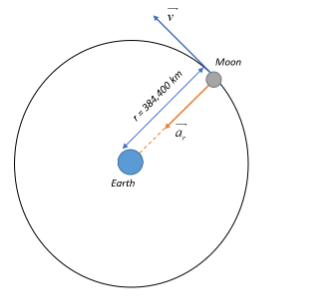
Now, the moon completes one revolution around the Earth in a period of:
$t = 27.3\;days = 27.3 \times 24 \times 60 \times 60 = 2,358,720\;s$,
and this revolution describes a circular path of radius:
$r = 384,400\;km = 384,400 \times 10^{3} = 3.844 \times 10^{8}\;m$, which is nothing but the distance between the Earth and the moon.
The distance travelled by the moon in describing this circular path will be:
$d = 2\pi r = 2 \times \pi \times 3.844 \times 10^8 = 24.15 \times 10^{8}\;m $
Therefore, the linear velocity with which the moon travels this distance around the Earth can be given as:
$\vec{v} = \dfrac{d}{t} = \dfrac{24.15 \times 10^{8}}{2,358,720} = 1.024 \times 10^{-5} \times 10^{8} = 1.024 \times 10^{3}\;ms^{-1}$
The acceleration of the moon towards the Earths’ centre can thus be given as:
$\vec{a_r} = \dfrac{\vec{v}^2}{r} = \dfrac{(1.024 \times 10^3)^2}{3.844 \times 10^{8}} = 0.2728 \times 10^6 \times 10^{-8} = 2.728 \times 10^{-3}\;ms^{-2}$
Note:
It is important to understand that the radial acceleration of the moon arises from the existence of a gravitational force of attraction between the Earth and the moon. In this case, the acceleration can alternatively be calculated from Newton’s Law of Gravitation as follows:
$\vec{F} = \dfrac{GMm}{r^2}$
$\Rightarrow m\vec{a_r} = \dfrac{GMm}{r^2} \Rightarrow \vec{a_r} = \dfrac{GM}{r^2}$,
where gravitational constant $G = 6.674 \times 10^{-11}\;Nm^2kg^{-2}$,
$M = 5.972 \times 10^{24}\;kg$ is the mass of the Earth and $\;m$ is the mass of the moon.
Plugging in the values, we get:
$\vec{a_r} = \dfrac{6.674 \times 10^{-11} \times 5.972 \times 10^{24}}{(3.844 \times 10^{8})^2} = 2.7 \times 10^{-11+24-16} = 2.7 \times 10^{-3}\;ms^{-2}$, which is consistent with our result.
Formula Used:
Radial/centripetal acceleration: $a_r = \dfrac{v^2}{r}$
Complete answer:
The acceleration of the moon directed towards the earth’s centre is nothing but the acceleration of the moon arising due to the centripetal force of gravitational attraction between the Earth and the moon. In circular motion, we call this as radial acceleration which is essentially the acceleration of the moon along the radius of the circular path it traces as it revolves around the Earth and is directed towards the centre of this circular path, which in this case is the Earth’s centre.
Quantitatively, radial acceleration is given as:
$\vec{a_r} = \dfrac{\vec{v}^2}{r}$, where $\vec{v}$ is the linear velocity and$\;r$ is the radius of the circular path transcribed by the moving object.
Now, the moon completes one revolution around the Earth in a period of:
$t = 27.3\;days = 27.3 \times 24 \times 60 \times 60 = 2,358,720\;s$,
and this revolution describes a circular path of radius:
$r = 384,400\;km = 384,400 \times 10^{3} = 3.844 \times 10^{8}\;m$, which is nothing but the distance between the Earth and the moon.
The distance travelled by the moon in describing this circular path will be:
$d = 2\pi r = 2 \times \pi \times 3.844 \times 10^8 = 24.15 \times 10^{8}\;m $
Therefore, the linear velocity with which the moon travels this distance around the Earth can be given as:
$\vec{v} = \dfrac{d}{t} = \dfrac{24.15 \times 10^{8}}{2,358,720} = 1.024 \times 10^{-5} \times 10^{8} = 1.024 \times 10^{3}\;ms^{-1}$
The acceleration of the moon towards the Earths’ centre can thus be given as:
$\vec{a_r} = \dfrac{\vec{v}^2}{r} = \dfrac{(1.024 \times 10^3)^2}{3.844 \times 10^{8}} = 0.2728 \times 10^6 \times 10^{-8} = 2.728 \times 10^{-3}\;ms^{-2}$
Note:
It is important to understand that the radial acceleration of the moon arises from the existence of a gravitational force of attraction between the Earth and the moon. In this case, the acceleration can alternatively be calculated from Newton’s Law of Gravitation as follows:
$\vec{F} = \dfrac{GMm}{r^2}$
$\Rightarrow m\vec{a_r} = \dfrac{GMm}{r^2} \Rightarrow \vec{a_r} = \dfrac{GM}{r^2}$,
where gravitational constant $G = 6.674 \times 10^{-11}\;Nm^2kg^{-2}$,
$M = 5.972 \times 10^{24}\;kg$ is the mass of the Earth and $\;m$ is the mass of the moon.
Plugging in the values, we get:
$\vec{a_r} = \dfrac{6.674 \times 10^{-11} \times 5.972 \times 10^{24}}{(3.844 \times 10^{8})^2} = 2.7 \times 10^{-11+24-16} = 2.7 \times 10^{-3}\;ms^{-2}$, which is consistent with our result.
Recently Updated Pages
Which will be the least stable resonating structure class 11 chemistry CBSE

How many 5 digit telephone numbers can be construc-class-11-maths-CBSE
How do you find the angle of the resultant vector class 11 physics CBSE
Draw labelled diagram of the following i Gram seed class 11 biology CBSE
1 Quintal is equal to a 110 kg b 10 kg c 100kg d 1000 class 11 physics CBSE
What is the need and importance of classification class 11 biology CBSE
Trending doubts
One Metric ton is equal to kg A 10000 B 1000 C 100 class 11 physics CBSE
Find the value of the expression given below sin 30circ class 11 maths CBSE
10 examples of friction in our daily life
Draw a diagram of a plant cell and label at least eight class 11 biology CBSE
Difference between physical and chemical change class 11 chemistry CBSE
Proton was discovered by A Thomson B Rutherford C Chadwick class 11 chemistry CBSE