




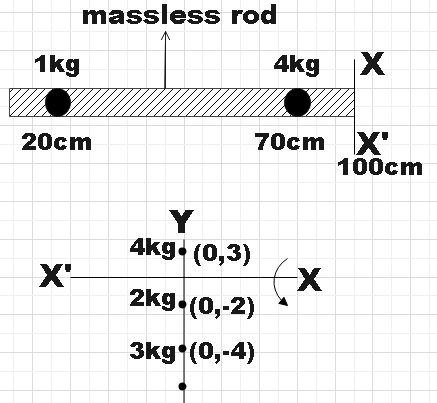
Calculate moment of inertia w.r.t rotational axis XX’ in following figures
A. $92kg{{m}^{2}},1kg{{m}^{2}}$
B. $32kg{{m}^{2}},1kg{{m}^{2}}$
C. $1kg{{m}^{2}},92kg{{m}^{2}}$
D. $1kg{{m}^{2}},32kg{{m}^{2}}$
Answer
 Verified
616.2k+ views
Hint: In order to answer this question, all you have to have is a basic idea about the moment of inertia. You could thus recall the expression for the moment of inertia of mass m at a certain distance r from the reference axis. You could then substitute the given values and find the answer for both the cases.
Formula used:
Moment of inertia,
$I=M{{R}^{2}}$
Complete answer:
In the question, we are given two figures with some masses and position at which these masses are clearly given. We are supposed to find the moment of inertia about the rotational axis XX’.
Let us recall the very definition of moment of inertia. This quantity is defined as the product of mass and the square of the distance from the mentioned reference axis to the centre of mass. That is, mathematically, this quantity can be given by,
$I=M{{R}^{2}}$
Now for the first figure, we have masses 4kg and 1kg kept at 30cm and 80cm from the given reference axis. As the options are given in SI units let us convert these distances into SI units to get, 0.3m and 0.8m respectively.
So the net moment of inertia of the system will be the sum of the moments of inertia due to 4kg and 1kg masses, that is,
${{I}_{XX'}}=4{{\left( 0.3 \right)}^{2}}+1{{\left( 0.8 \right)}^{2}}$
$\Rightarrow {{I}_{XX'}}=0.36+0.64$
$\therefore {{I}_{XX'}}=1kg{{m}^{2}}$ ……………………………………………….. (1)
Now for the second figure we have three masses and the net moment of inertia of the system about XX’ axis could be given by,
${{I}_{XX'}}=2{{\left( 2 \right)}^{2}}+3{{\left( 4 \right)}^{2}}+4{{\left( 3 \right)}^{2}}$
$\Rightarrow {{I}_{XX'}}=8+48+36$
$\therefore {{I}_{XX'}}=92kg{{m}^{2}}$ …………………………………………………. (2)
From (1) and (2) we found that option C is the correct answer.
Note:
While finding the moment of inertia it is not necessary that you substitute the values in their SI units. But we have to look for the unit given in the options and thus substitute accordingly. Also, distance should be measured from the reference axis about which we calculate the moment of inertia.
Recently Updated Pages
Which will be the least stable resonating structure class 11 chemistry CBSE

How many 5 digit telephone numbers can be construc-class-11-maths-CBSE
How do you find the angle of the resultant vector class 11 physics CBSE
Draw labelled diagram of the following i Gram seed class 11 biology CBSE
1 Quintal is equal to a 110 kg b 10 kg c 100kg d 1000 class 11 physics CBSE
What is the need and importance of classification class 11 biology CBSE
Trending doubts
Find the value of the expression given below sin 30circ class 11 maths CBSE
One Metric ton is equal to kg A 10000 B 1000 C 100 class 11 physics CBSE
10 examples of friction in our daily life
Draw a diagram of a plant cell and label at least eight class 11 biology CBSE
Difference between physical and chemical change class 11 chemistry CBSE
Proton was discovered by A Thomson B Rutherford C Chadwick class 11 chemistry CBSE