




How to calculate ammeter and voltmeter readings?
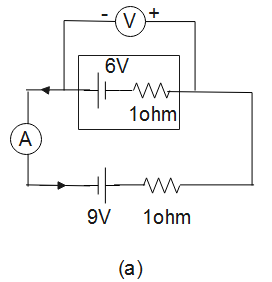
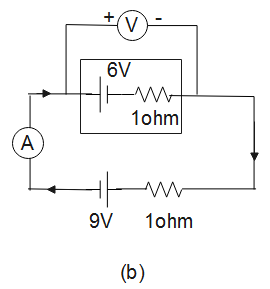
In the two circuits shown in the figure, determine the readings of ideal ammeter (A) and ideal voltmeter (V):
Answer
 Verified
594k+ views
Hint: In this question, we will use the basic ohm’s law, according to which we have relation between current, voltage and resistance of a given circuit. Now, by applying the given values and solving will give us the required result. We will also know about the basics of ohm’s law.
Formula used:
$\eqalign{& I \propto V \cr
& I = \dfrac{V}{R} \cr} $
Complete step by step solution:
According to the ohm’s law on constant temperature the current I pass through the conductor is directly proportional to the potential difference V across its ends.
$\eqalign{
& I \propto V \cr
& I = \dfrac{V}{R} \cr} $
From the circuit (a): we can see that both batteries are connected in series. So, the total voltage will be:
$\eqalign{& V = 9V + 6V \cr
& \Rightarrow V = 15V \cr} $
Now, we can see that the in series resistance is 2 ohms. So, the current is given by:
$I = \dfrac{V}{R}$
By substituting the value of voltage and the resistance in above equation we get:
$\eqalign{& I = \dfrac{{15}}{2} \cr
& \Rightarrow I = 7.5A \cr} $
Now, we find the voltage drop across top 1 ohm resistors is given by
${V_a} = I \times R$
By substituting the value of current and the resistance in above equation we get:
${V_a} = 7.5 \times 1 = 7.5V$
Since the right side is positive. So, the Voltmeter reads $ + 7.5V - 6V = + 1.5V$
Now in the given circuit (b):
In this circuit the 9 V and 6 V connected sources oppose. So, the resultant voltage is only 3V instead of 15V
we can see that both batteries are connected in series. So, the total voltage will be:
$\eqalign{
& V = 9V - 6V \cr
& \Rightarrow V = 3V \cr} $ Now, we can see that the in series resistance is 2 ohms.
So, the current is given by:
$I = \dfrac{V}{R}$
By substituting the value of voltage and the resistance in above equation we get:
$\eqalign{
& I = \dfrac{3}{2} \cr
& \Rightarrow I = 1.5A \cr} $
Now, we find the voltage drop across top 1 ohm resistors is given by
${V_a} = I \times R$
By substituting the value of current and the resistance in above equation we get:
${V_a} = 1.5 \times 1 = 1.5V$
Since the right side is positive. So, the Voltmeter reads $ + 1.5V + 6V = + 7.5V$
Therefore, we can conclude that in circuit (a) voltage is 1.5V and current is 7.5A, whereas in circuit (b) voltage is 7.5V and current is 1.5A.
Additional information:
As we know if we Plot V-I Graph comes out to be a straight line. It experimentally verified Ohm's law.
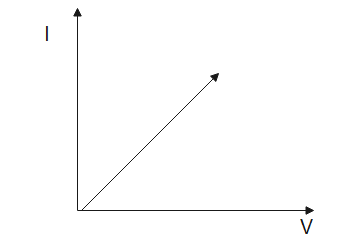
So, we can say that ohm’s law doesn't hold under all conditions like non-constant temperature and pressure. So, ohm’s law is only valid for conductors.
Note:
We should remember that there are limitations to the Ohm’s law. They are valid only for conductors not for all materials. We should also note that resistance is inversely proportional to the flow of current. The unit of resistance is ohm, named after the scientist.
Formula used:
$\eqalign{& I \propto V \cr
& I = \dfrac{V}{R} \cr} $
Complete step by step solution:
According to the ohm’s law on constant temperature the current I pass through the conductor is directly proportional to the potential difference V across its ends.
$\eqalign{
& I \propto V \cr
& I = \dfrac{V}{R} \cr} $
From the circuit (a): we can see that both batteries are connected in series. So, the total voltage will be:
$\eqalign{& V = 9V + 6V \cr
& \Rightarrow V = 15V \cr} $
Now, we can see that the in series resistance is 2 ohms. So, the current is given by:
$I = \dfrac{V}{R}$
By substituting the value of voltage and the resistance in above equation we get:
$\eqalign{& I = \dfrac{{15}}{2} \cr
& \Rightarrow I = 7.5A \cr} $
Now, we find the voltage drop across top 1 ohm resistors is given by
${V_a} = I \times R$
By substituting the value of current and the resistance in above equation we get:
${V_a} = 7.5 \times 1 = 7.5V$
Since the right side is positive. So, the Voltmeter reads $ + 7.5V - 6V = + 1.5V$
Now in the given circuit (b):
In this circuit the 9 V and 6 V connected sources oppose. So, the resultant voltage is only 3V instead of 15V
we can see that both batteries are connected in series. So, the total voltage will be:
$\eqalign{
& V = 9V - 6V \cr
& \Rightarrow V = 3V \cr} $ Now, we can see that the in series resistance is 2 ohms.
So, the current is given by:
$I = \dfrac{V}{R}$
By substituting the value of voltage and the resistance in above equation we get:
$\eqalign{
& I = \dfrac{3}{2} \cr
& \Rightarrow I = 1.5A \cr} $
Now, we find the voltage drop across top 1 ohm resistors is given by
${V_a} = I \times R$
By substituting the value of current and the resistance in above equation we get:
${V_a} = 1.5 \times 1 = 1.5V$
Since the right side is positive. So, the Voltmeter reads $ + 1.5V + 6V = + 7.5V$
Therefore, we can conclude that in circuit (a) voltage is 1.5V and current is 7.5A, whereas in circuit (b) voltage is 7.5V and current is 1.5A.
Additional information:
As we know if we Plot V-I Graph comes out to be a straight line. It experimentally verified Ohm's law.
So, we can say that ohm’s law doesn't hold under all conditions like non-constant temperature and pressure. So, ohm’s law is only valid for conductors.
Note:
We should remember that there are limitations to the Ohm’s law. They are valid only for conductors not for all materials. We should also note that resistance is inversely proportional to the flow of current. The unit of resistance is ohm, named after the scientist.
Recently Updated Pages
Master Class 12 Economics: Engaging Questions & Answers for Success

Master Class 12 English: Engaging Questions & Answers for Success
Master Class 12 Social Science: Engaging Questions & Answers for Success
Master Class 12 Maths: Engaging Questions & Answers for Success
Master Class 12 Physics: Engaging Questions & Answers for Success
Master Class 9 General Knowledge: Engaging Questions & Answers for Success
Trending doubts
Which are the Top 10 Largest Countries of the World?
Draw a labelled sketch of the human eye class 12 physics CBSE
Differentiate between homogeneous and heterogeneous class 12 chemistry CBSE
Why is the cell called the structural and functional class 12 biology CBSE
Draw ray diagrams each showing i myopic eye and ii class 12 physics CBSE
Which is the correct genotypic ratio of mendel dihybrid class 12 biology CBSE