




${{C}_ {4}} {{H}_ {8}} {{O}_ {2}} $ represents:
(A) an acid only
(B) an ester only
(C) a ketone only
(D) an acid and an ester also
Answer
 Verified
583.8k+ views
Hint: Functional groups are specific substituents or moieties within molecules that may be responsible for the characteristic chemical reactions of those molecules. The same functional group will undergo the same or similar chemical reaction regardless of the size of the molecule it is a part of.
Complete step by step solution:
We have been provided with ${{C}_ {4}} {{H}_ {8}} {{O}_ {2}} $,
The IUPAC name of the given compound is ethyl acetate,
Ethyl acetate is the organic compound with the formula ${{C}_ {4}} {{H}_ {8}} {{O}_ {2}} $. This colourless liquid has a characteristic sweet smell and is used in glues, nail polish removers, and in the decaffeination process of tea and coffee.
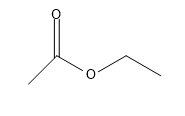
We need to tell the functional group attached to it:
So, we know that: A group of atoms whose bonding is the same from molecule to molecule. A functional group has similar behaviour regardless of the molecule that contains it, so molecules with identical functional groups tend to have similar chemical and physical properties.
So, in ethyl acetate -COOH functional group is attached,
Carboxylic acids are a homologous series in which the compounds contain a functional group called the carboxyl group (-COOH). The general molecular formula for carboxylic acids is ${{C}_{n}} {{H}_{2n+1}} COOH$. Carboxylic acids contain at least one carboxyl group.
So, from this we can say that ${{C}_ {4}} {{H}_ {8}} {{O}_ {2}} $ represents acid only.
Therefore, we can conclude that option (A) is correct.
Note: Ethyl acetate is highly flammable, as well as toxic when ingested or inhaled, and this chemical can be seriously damaging to internal organs in the case of repeated or prolonged exposure. Ethyl acetate can also cause irritation when it comes into contact with the eyes or skin.
Complete step by step solution:
We have been provided with ${{C}_ {4}} {{H}_ {8}} {{O}_ {2}} $,
The IUPAC name of the given compound is ethyl acetate,
Ethyl acetate is the organic compound with the formula ${{C}_ {4}} {{H}_ {8}} {{O}_ {2}} $. This colourless liquid has a characteristic sweet smell and is used in glues, nail polish removers, and in the decaffeination process of tea and coffee.
We need to tell the functional group attached to it:
So, we know that: A group of atoms whose bonding is the same from molecule to molecule. A functional group has similar behaviour regardless of the molecule that contains it, so molecules with identical functional groups tend to have similar chemical and physical properties.
So, in ethyl acetate -COOH functional group is attached,
Carboxylic acids are a homologous series in which the compounds contain a functional group called the carboxyl group (-COOH). The general molecular formula for carboxylic acids is ${{C}_{n}} {{H}_{2n+1}} COOH$. Carboxylic acids contain at least one carboxyl group.
So, from this we can say that ${{C}_ {4}} {{H}_ {8}} {{O}_ {2}} $ represents acid only.
Therefore, we can conclude that option (A) is correct.
Note: Ethyl acetate is highly flammable, as well as toxic when ingested or inhaled, and this chemical can be seriously damaging to internal organs in the case of repeated or prolonged exposure. Ethyl acetate can also cause irritation when it comes into contact with the eyes or skin.
Recently Updated Pages
Master Class 12 Economics: Engaging Questions & Answers for Success

Master Class 12 Physics: Engaging Questions & Answers for Success
Master Class 12 English: Engaging Questions & Answers for Success
Master Class 12 Social Science: Engaging Questions & Answers for Success
Master Class 12 Maths: Engaging Questions & Answers for Success
Master Class 12 Business Studies: Engaging Questions & Answers for Success
Trending doubts
Which are the Top 10 Largest Countries of the World?
What are the major means of transport Explain each class 12 social science CBSE
Draw a labelled sketch of the human eye class 12 physics CBSE
Why cannot DNA pass through cell membranes class 12 biology CBSE
Differentiate between insitu conservation and exsitu class 12 biology CBSE
Draw a neat and well labeled diagram of TS of ovary class 12 biology CBSE