




By what factor will the rate constant for the reverse catalysed reaction increase compared to that for the reverse uncatalysed reaction.
Answer
 Verified
565.2k+ views
Hint: The Arrhenius equation is an equation that represents the relationship between the temperature of many physical and chemical reactions with the rate of the reaction. In other words, the Arrhenius equation gives the dependence of the rate constant of a chemical reaction on the absolute temperature. Arrhenius equation helps in determining the rate of chemical reactions and their activation energies too.
Complete answer:
Step 1: Identifying the values of various components of the Arrhenius equation for a reverse catalyzed reaction:
For the reaction:
$2{H_2}{O_2} \to 2{H_2}O + {O_2}$
Arrhenius equation is equal to
\[k = A{e^{\dfrac{{ - Ea}}{{RT}}}}\]
Where, \[{E_a}\] is the activation energy while R is the universal gas constant, and T is the absolute temperature.
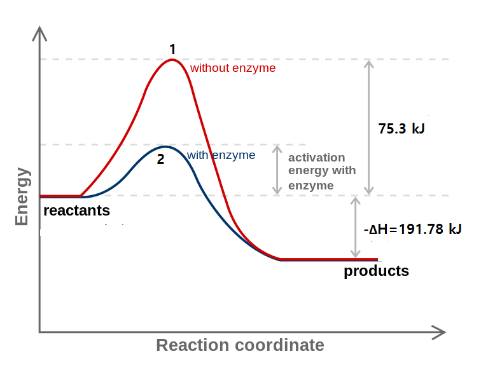
Form the figure, for backward reaction the value of activation energy is
${E_{{a_1}}} = 75.3 + \left| {\Delta H} \right| = 75.3 + 191.78{\text{ kJ/mol = 267}}{\text{.08}} \times {\text{1}}{{\text{0}}^3}$ J/mol
\[{E_{{a_2}}}{\text{ = }}56.6 + \left| {\Delta H} \right| = 56.6 + 191.78{\text{ kJ/mol}} = {\text{ }}248.38 \times {10^3}\] J/mol
T= 298K and R=$8.314{\text{ J }}{{\text{K}}^{ - 1}}mo{l^{ - 1}}$
Step 2: Solving the Arrhenius equation by substituting the values:
$\dfrac{{{k_1}}}{{{k_2}}} = \dfrac{{A{e^{\dfrac{{ - E{a_1}}}{{RT}}}}}}{{A{e^{\dfrac{{ - E{a_2}}}{{RT}}}}}}$
$\Rightarrow \dfrac{{{k_1}}}{{{k_2}}} = e\dfrac{{{E_{{a_1}}} - {E_{{a_2}}}}}{{RT}}$
$\Rightarrow \dfrac{{{k_1}}}{{{k_2}}} = e\dfrac{{(267.08 - 248.28) \times {{10}^3}}}{{8.314 \times 298}}$
$\Rightarrow \dfrac{{{k_1}}}{{{k_2}}} = {e^{7.54}}$
$\Rightarrow \dfrac{{{k_1}}}{{{k_2}}} = 1896.4$
Therefore, by the factor of 1896.4, the rate constant increases in a reverse catalyzed reaction.
Note:
Catalyst is a substance that alters the rate of reaction without itself undergoing any change or without itself participating in the reaction. Moreover, a catalyst lowers the activation energy required for a reaction to proceed thereby speeding up the reaction. Also, a catalyst can accelerate a reaction by reducing the rate-limiting transition state. The addition of a catalyst alters the reaction pathway and as the reaction pathway is changed, the activation energy for both forward and reverse reaction decreases but the frequency factor increases.
Complete answer:
Step 1: Identifying the values of various components of the Arrhenius equation for a reverse catalyzed reaction:
For the reaction:
$2{H_2}{O_2} \to 2{H_2}O + {O_2}$
Arrhenius equation is equal to
\[k = A{e^{\dfrac{{ - Ea}}{{RT}}}}\]
Where, \[{E_a}\] is the activation energy while R is the universal gas constant, and T is the absolute temperature.
Form the figure, for backward reaction the value of activation energy is
${E_{{a_1}}} = 75.3 + \left| {\Delta H} \right| = 75.3 + 191.78{\text{ kJ/mol = 267}}{\text{.08}} \times {\text{1}}{{\text{0}}^3}$ J/mol
\[{E_{{a_2}}}{\text{ = }}56.6 + \left| {\Delta H} \right| = 56.6 + 191.78{\text{ kJ/mol}} = {\text{ }}248.38 \times {10^3}\] J/mol
T= 298K and R=$8.314{\text{ J }}{{\text{K}}^{ - 1}}mo{l^{ - 1}}$
Step 2: Solving the Arrhenius equation by substituting the values:
$\dfrac{{{k_1}}}{{{k_2}}} = \dfrac{{A{e^{\dfrac{{ - E{a_1}}}{{RT}}}}}}{{A{e^{\dfrac{{ - E{a_2}}}{{RT}}}}}}$
$\Rightarrow \dfrac{{{k_1}}}{{{k_2}}} = e\dfrac{{{E_{{a_1}}} - {E_{{a_2}}}}}{{RT}}$
$\Rightarrow \dfrac{{{k_1}}}{{{k_2}}} = e\dfrac{{(267.08 - 248.28) \times {{10}^3}}}{{8.314 \times 298}}$
$\Rightarrow \dfrac{{{k_1}}}{{{k_2}}} = {e^{7.54}}$
$\Rightarrow \dfrac{{{k_1}}}{{{k_2}}} = 1896.4$
Therefore, by the factor of 1896.4, the rate constant increases in a reverse catalyzed reaction.
Note:
Catalyst is a substance that alters the rate of reaction without itself undergoing any change or without itself participating in the reaction. Moreover, a catalyst lowers the activation energy required for a reaction to proceed thereby speeding up the reaction. Also, a catalyst can accelerate a reaction by reducing the rate-limiting transition state. The addition of a catalyst alters the reaction pathway and as the reaction pathway is changed, the activation energy for both forward and reverse reaction decreases but the frequency factor increases.
Recently Updated Pages
If x a + bt + ct2 where x is in meters and t is in class 11 physics CBSE

A car covers the first half distance between two places class 11 physics CBSE
The resultant of two vectors overrightarrow P and overrightarrow class 11 physics CBSE
Find the value of cos 135 class 11 maths CBSE
A mass M is held in place by an applied force F and class 11 physics CBSE
A solution of glucose in water is labelled as 10 dfracwv class 11 chemistry CBSE
Trending doubts
One Metric ton is equal to kg A 10000 B 1000 C 100 class 11 physics CBSE
Find the value of the expression given below sin 30circ class 11 maths CBSE
What do you mean by retardation What is its SI uni class 11 physics CBSE
Draw a diagram of nephron and explain its structur class 11 biology CBSE
10 examples of friction in our daily life
Difference between physical and chemical change class 11 chemistry CBSE