




Briefly describe the structure of the Brain.
Answer
 Verified
663k+ views
Hint: The major organ in the central nervous system enclosed in the skull. It is made up of soft tissue which includes grey matter and white matter. It is also covered by three layers of membranes, each having different properties.
Complete answer:
-The brain is the largest mass of nervous tissue located in the cranial cavity in the body.
-The blood supply to the brain is carried out by the Carotid artery where the brain receives about 15% of the cardiac output which includes 750 ml blood/mt.
-It is made up of about 1000 billion neurons 7 each neuron is surrounded by about 10 glial cells or neuroglia.
-Being an important part of the body thus, it is covered by ‘meninges’ like spinal cord where outer dura mater, middle arachnoid mater, and inner pia mater.
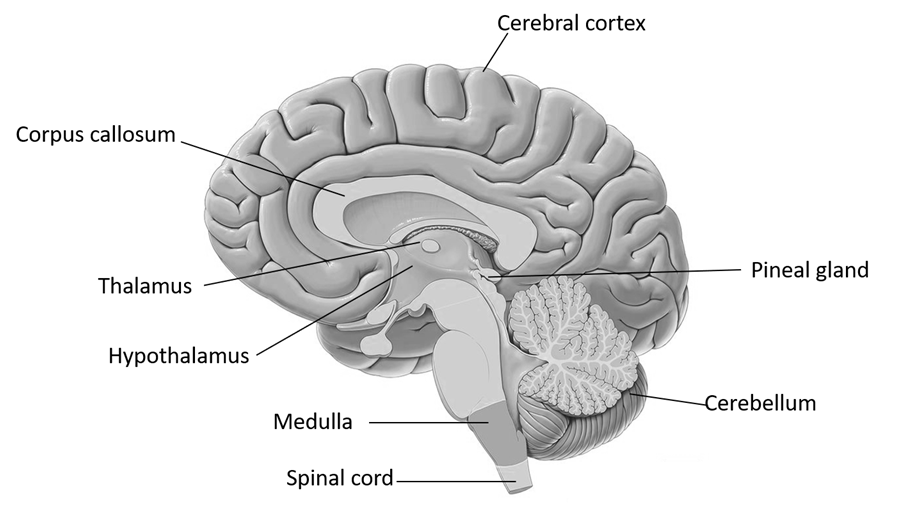
-Cerebrum
-The largest egg-shaped part of the brain also known as the forebrain occupies the anterior and middle cranial.
-The area is responsible for process thoughts, judgment, memory, probes solving and languages, imagination.
-It is further divided into- Cerebrum, Thalamus, and Limbic systems.
-The cerebrum has two layers- gray matter or outer layer mostly composed of neuron cell bodies and white matter, fiber tracts inside the gray matter. The example corpus callosum connects the hemisphere.
-Cerebellum
-The second-largest part of the brain is situated behind the pons occupying posterior cranial fossa.
-The important function of the cerebellum is the coordination of voluntary muscular movement, posture, and balance.
-A deep groove is seen as ‘transverse fissure’ separating cerebrum and cerebellum.
-The external surface, called the cerebellar cortex, looks like a butterfly where a constricted area is called ‘vermis’.
-Brain Stem
-The brain stem is attached to the spinal cord.
-The brain stem consists of- Mid bain, Pons, and medulla oblongata connected to the cerebellum by a superior middle and inferior cerebellar peduncle.
-The brain stems superiorly continuous with diencephalon and inferiorly continuous with the spinal cord.
-Diencephalon
-The diencephalon is a posterior part of the forebrain that connects the midbrain with cerebral hemispheres enclosing the third ventricle.
-It is further divided into- thalamus, hypothalamus, epithalamus, and pineal gland.
Note:
-Among all vertebrates humans have the largest brain relative to body size.
-The brain contains about 75% of the water that means water is essential for the brain to work properly.
-The size of the male brain is larger than the female brain.
Complete answer:
-The brain is the largest mass of nervous tissue located in the cranial cavity in the body.
-The blood supply to the brain is carried out by the Carotid artery where the brain receives about 15% of the cardiac output which includes 750 ml blood/mt.
-It is made up of about 1000 billion neurons 7 each neuron is surrounded by about 10 glial cells or neuroglia.
-Being an important part of the body thus, it is covered by ‘meninges’ like spinal cord where outer dura mater, middle arachnoid mater, and inner pia mater.
-Cerebrum
-The largest egg-shaped part of the brain also known as the forebrain occupies the anterior and middle cranial.
-The area is responsible for process thoughts, judgment, memory, probes solving and languages, imagination.
-It is further divided into- Cerebrum, Thalamus, and Limbic systems.
-The cerebrum has two layers- gray matter or outer layer mostly composed of neuron cell bodies and white matter, fiber tracts inside the gray matter. The example corpus callosum connects the hemisphere.
-Cerebellum
-The second-largest part of the brain is situated behind the pons occupying posterior cranial fossa.
-The important function of the cerebellum is the coordination of voluntary muscular movement, posture, and balance.
-A deep groove is seen as ‘transverse fissure’ separating cerebrum and cerebellum.
-The external surface, called the cerebellar cortex, looks like a butterfly where a constricted area is called ‘vermis’.
-Brain Stem
-The brain stem is attached to the spinal cord.
-The brain stem consists of- Mid bain, Pons, and medulla oblongata connected to the cerebellum by a superior middle and inferior cerebellar peduncle.
-The brain stems superiorly continuous with diencephalon and inferiorly continuous with the spinal cord.
-Diencephalon
-The diencephalon is a posterior part of the forebrain that connects the midbrain with cerebral hemispheres enclosing the third ventricle.
-It is further divided into- thalamus, hypothalamus, epithalamus, and pineal gland.
Note:
-Among all vertebrates humans have the largest brain relative to body size.
-The brain contains about 75% of the water that means water is essential for the brain to work properly.
-The size of the male brain is larger than the female brain.
Recently Updated Pages
If x a + bt + ct2 where x is in meters and t is in class 11 physics CBSE

A car covers the first half distance between two places class 11 physics CBSE
The resultant of two vectors overrightarrow P and overrightarrow class 11 physics CBSE
Find the value of cos 135 class 11 maths CBSE
A mass M is held in place by an applied force F and class 11 physics CBSE
A solution of glucose in water is labelled as 10 dfracwv class 11 chemistry CBSE
Trending doubts
One Metric ton is equal to kg A 10000 B 1000 C 100 class 11 physics CBSE
Find the value of the expression given below sin 30circ class 11 maths CBSE
What do you mean by retardation What is its SI uni class 11 physics CBSE
Draw a diagram of nephron and explain its structur class 11 biology CBSE
10 examples of friction in our daily life
Difference between physical and chemical change class 11 chemistry CBSE