




What is the breakdown product of haemoglobin?
(a)Bilirubin
(b)Iron
(c)Biliverdin
(d)Calcium
Answer
 Verified
646.8k+ views
Hint: The material in your blood is yellowish. It develops after the breakdown of red blood cells, and it passes before being excreted through your liver, gallbladder, and digestive tract. Its amounts usually fall anywhere between 0.3 and 1.2 milligrammes (mg / dL) per deciliter.
Complete answer:
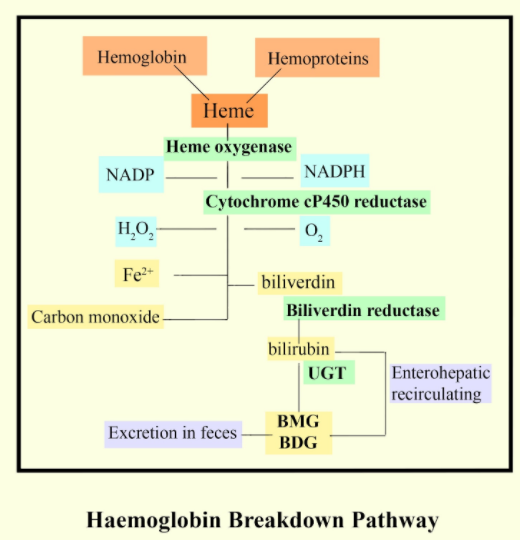
Red blood cell haemoglobin molecules are broken down into two subunits, heme (the part containing iron) and globin. In addition, the heme breaks down into iron and biliverdin, a green pigment. Biliverdin is then transformed to bilirubin, an orange pigment. Bilirubin is thus an end product of heme-containing proteins for degradation. Around 80% of bilirubin is produced in the reticuloendothelial system (RES) by the degradation of erythrocyte haemoglobin.
Additional Information: The iron-containing oxygen-transport metalloprotein in the red blood cells of almost all vertebrates, as well as the tissues of some invertebrates, is haemoglobin or haemoglobin + -o-+ globulin, abbreviated as Hb or Hgb. Haemoglobin in the blood transfers oxygen to the rest of the body from the lungs or gills.
The haemoglobin is degraded or broken into globin, the protein component, iron (preserved for later use), and heme (see middle graphic) as the red blood cells disintegrate. Initially, the heme splits into biliverdin, an orange-yellow pigment that is quickly reduced to bilirubin, a green pigment (see bottom graphic).
Calcium is present in abundance in dairy products. So it is the end product of casein breakdown. It is present and preserved in bones.
So, the correct answer is ‘bilirubin’.
Note: Bilirubin, a brownish-yellow bile pigment secreted by the liver in vertebrates, which gives its characteristic colour to solid waste products (faeces). It is made as the end result of red-blood-cell (haemoglobin) breakdown in bone marrow cells and in the liver.
Complete answer:
Red blood cell haemoglobin molecules are broken down into two subunits, heme (the part containing iron) and globin. In addition, the heme breaks down into iron and biliverdin, a green pigment. Biliverdin is then transformed to bilirubin, an orange pigment. Bilirubin is thus an end product of heme-containing proteins for degradation. Around 80% of bilirubin is produced in the reticuloendothelial system (RES) by the degradation of erythrocyte haemoglobin.
Additional Information: The iron-containing oxygen-transport metalloprotein in the red blood cells of almost all vertebrates, as well as the tissues of some invertebrates, is haemoglobin or haemoglobin + -o-+ globulin, abbreviated as Hb or Hgb. Haemoglobin in the blood transfers oxygen to the rest of the body from the lungs or gills.
The haemoglobin is degraded or broken into globin, the protein component, iron (preserved for later use), and heme (see middle graphic) as the red blood cells disintegrate. Initially, the heme splits into biliverdin, an orange-yellow pigment that is quickly reduced to bilirubin, a green pigment (see bottom graphic).
Calcium is present in abundance in dairy products. So it is the end product of casein breakdown. It is present and preserved in bones.
So, the correct answer is ‘bilirubin’.
Note: Bilirubin, a brownish-yellow bile pigment secreted by the liver in vertebrates, which gives its characteristic colour to solid waste products (faeces). It is made as the end result of red-blood-cell (haemoglobin) breakdown in bone marrow cells and in the liver.
Recently Updated Pages
If x a + bt + ct2 where x is in meters and t is in class 11 physics CBSE

A car covers the first half distance between two places class 11 physics CBSE
The resultant of two vectors overrightarrow P and overrightarrow class 11 physics CBSE
Find the value of cos 135 class 11 maths CBSE
A mass M is held in place by an applied force F and class 11 physics CBSE
A solution of glucose in water is labelled as 10 dfracwv class 11 chemistry CBSE
Trending doubts
One Metric ton is equal to kg A 10000 B 1000 C 100 class 11 physics CBSE
Find the value of the expression given below sin 30circ class 11 maths CBSE
What do you mean by retardation What is its SI uni class 11 physics CBSE
Draw a diagram of nephron and explain its structur class 11 biology CBSE
10 examples of friction in our daily life
Difference between physical and chemical change class 11 chemistry CBSE