




Botryoidal tissue is a characteristic of
(a) Earthworm
(b) Ascaris
(c) Hirudinaria
(d) Rabbit
Answer
 Verified
621k+ views
Hint: The body is often cylindrical with one sucker at each end. The front sucker encompasses the mouth and is typically littler than the rare one. They leave their hosts just to attach cocoons to rocks, shells, and other hard surfaces.
Complete answer:
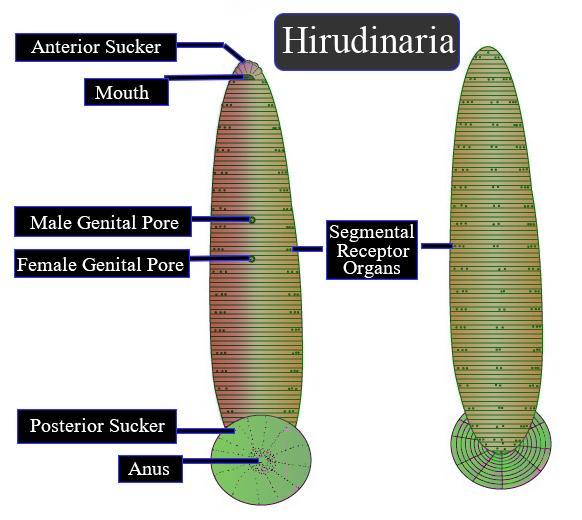
Botryoidal tissue is formed by two different types of cells, the first one is the granular botryoidal, and the second one is flattened endothelial in leeches. Its cell can contain brown pigment and it may serve as an excretory function. Hirudinaria is a soft, vermiform, elongated, and dorsi ventrally flattened worm. It is 10 to 15 cm long. Near the posterior, the body is broad, and while the body is narrow near the anterior end. The dorsal surface is fairly convex and the ventral surface is pretty much flat.
Additional Information: The body is separated into 33 fragments. Remotely it is divided into more portions which are called annuli. There are 109 annuli present in a leech. The quantity of annuli shifts in various sections. A common fragment of the central aspect of the body incorporates five annuli. The anterior sucker or oral sucker is oval and ventrally-directed, which is formed by the first 3 segments, and it includes the mouth.
So, the correct answer is ‘Hirudinaria’.
Note: Mouth is a triradiate aperture present in the anterior sucker. 17 pairs of nephridiopores are present. One set lies ventrally on the last annulus of each section from 6 to 22 portions. The male genital gap is a mid-ventral opening between the second and third annuli of the tenth portion. The female genital opening lies mid-ventrally in between the second and third annuli of the 11th segment.
Complete answer:
Botryoidal tissue is formed by two different types of cells, the first one is the granular botryoidal, and the second one is flattened endothelial in leeches. Its cell can contain brown pigment and it may serve as an excretory function. Hirudinaria is a soft, vermiform, elongated, and dorsi ventrally flattened worm. It is 10 to 15 cm long. Near the posterior, the body is broad, and while the body is narrow near the anterior end. The dorsal surface is fairly convex and the ventral surface is pretty much flat.
Additional Information: The body is separated into 33 fragments. Remotely it is divided into more portions which are called annuli. There are 109 annuli present in a leech. The quantity of annuli shifts in various sections. A common fragment of the central aspect of the body incorporates five annuli. The anterior sucker or oral sucker is oval and ventrally-directed, which is formed by the first 3 segments, and it includes the mouth.
So, the correct answer is ‘Hirudinaria’.
Note: Mouth is a triradiate aperture present in the anterior sucker. 17 pairs of nephridiopores are present. One set lies ventrally on the last annulus of each section from 6 to 22 portions. The male genital gap is a mid-ventral opening between the second and third annuli of the tenth portion. The female genital opening lies mid-ventrally in between the second and third annuli of the 11th segment.
Recently Updated Pages
Master Class 12 Business Studies: Engaging Questions & Answers for Success

Master Class 12 Chemistry: Engaging Questions & Answers for Success
Master Class 12 Biology: Engaging Questions & Answers for Success
Class 12 Question and Answer - Your Ultimate Solutions Guide
Master Class 11 English: Engaging Questions & Answers for Success
Master Class 11 Social Science: Engaging Questions & Answers for Success
Trending doubts
Which are the Top 10 Largest Countries of the World?
Draw a labelled sketch of the human eye class 12 physics CBSE
The end of compass needle which points towards north class 12 physics CBSE
Differentiate between homogeneous and heterogeneous class 12 chemistry CBSE
In order to find out the different types of gametes class 12 biology NEET_UG
Why is the cell called the structural and functional class 12 biology CBSE