




Both RBC and WBC are formed in the
A. Thymus
B. Adrenal
C. Thyroid
D. Bone marrow
Answer
 Verified
615.6k+ views
Hint:
RBC and WBC do not originate in the bloodstream itself but specific blood-forming organs. Both of them are produced in the soft tissue. The production is controlled by the erythropoietin. RBC and WBC both have different life spans.
Complete answer:
RBCs and WBCs are the two components of the blood produced by hematopoiesis (other components being platelets and plasma). RBCs carry oxygen and collect carbon dioxide through the use of hemoglobin. WBCs are cells of the immune system and are involved in defending the body against both infectious diseases and foreign materials. All the blood cells are derived from a multipotent cell in the bone marrow, known as a hematopoietic stem cell. Thus, the correct answer is an option (D), 'Bone marrow'.
The thymus gland produces thymosin hormone which plays a vital role in the maturation of T cells, hence providing immunity. Thymus hormones are hormones produced by the thymus. They are generally small proteins, which regulate the development and selection of an immune-competent repertoire of T cells and stimulate antibody production by B cells. So, option A is incorrect
Adrenal glands produce glucocorticoids, mineralocorticoids, androgens, epinephrine, and norepinephrine. So, option B is incorrect
Thyroid glands produce Triiodothyronine and Tetraiodothyronine (thyroxine) which maintain the basal metabolic rate. So, option C is incorrect
Hence the correct option is D.
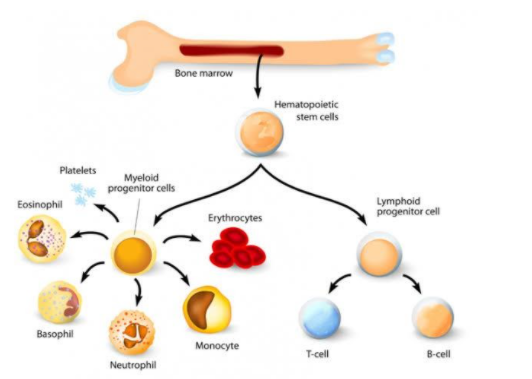
Note: RBC and WBC both are formed in the bone marrow. RBC is formed in the red bone marrow of bones. Stem cells in the bone marrow are called hemocytoblasts to give rise to all of the formed elements in the blood. As these are the components of the blood produced by hematopoietic stem cells. RBC does not have the nucleus of maturity.
RBC and WBC do not originate in the bloodstream itself but specific blood-forming organs. Both of them are produced in the soft tissue. The production is controlled by the erythropoietin. RBC and WBC both have different life spans.
Complete answer:
RBCs and WBCs are the two components of the blood produced by hematopoiesis (other components being platelets and plasma). RBCs carry oxygen and collect carbon dioxide through the use of hemoglobin. WBCs are cells of the immune system and are involved in defending the body against both infectious diseases and foreign materials. All the blood cells are derived from a multipotent cell in the bone marrow, known as a hematopoietic stem cell. Thus, the correct answer is an option (D), 'Bone marrow'.
The thymus gland produces thymosin hormone which plays a vital role in the maturation of T cells, hence providing immunity. Thymus hormones are hormones produced by the thymus. They are generally small proteins, which regulate the development and selection of an immune-competent repertoire of T cells and stimulate antibody production by B cells. So, option A is incorrect
Adrenal glands produce glucocorticoids, mineralocorticoids, androgens, epinephrine, and norepinephrine. So, option B is incorrect
Thyroid glands produce Triiodothyronine and Tetraiodothyronine (thyroxine) which maintain the basal metabolic rate. So, option C is incorrect
Hence the correct option is D.
Note: RBC and WBC both are formed in the bone marrow. RBC is formed in the red bone marrow of bones. Stem cells in the bone marrow are called hemocytoblasts to give rise to all of the formed elements in the blood. As these are the components of the blood produced by hematopoietic stem cells. RBC does not have the nucleus of maturity.
Recently Updated Pages
Master Class 11 English: Engaging Questions & Answers for Success

Master Class 11 Maths: Engaging Questions & Answers for Success
Class 11 Question and Answer - Your Ultimate Solutions Guide
Master Class 11 Biology: Engaging Questions & Answers for Success
Master Class 11 Physics: Engaging Questions & Answers for Success
Master Class 11 Accountancy: Engaging Questions & Answers for Success
Trending doubts
Differentiate between an exothermic and an endothermic class 11 chemistry CBSE
One Metric ton is equal to kg A 10000 B 1000 C 100 class 11 physics CBSE
Difference Between Prokaryotic Cells and Eukaryotic Cells
There are 720 permutations of the digits 1 2 3 4 5 class 11 maths CBSE
Draw a diagram of a plant cell and label at least eight class 11 biology CBSE
1 Quintal is equal to a 110 kg b 10 kg c 100kg d 1000 class 11 physics CBSE