




Both, hydrarch and xerarch succession lead to
(a)Medium water condition
(b)Xeric condition
(c)Highly dry condition
(d) Excessive wet conditions
Answer
 Verified
622.5k+ views
Hint: Ecological succession is a sequence of series from barren land to the climax. In ecological terms, the developmental stages of a community are known as seral stages and the final stage as the climax. The initial community of the area, which is replaced in time by a sequence of succeeding communities until the climax is reached, is called the pioneer stage of the pioneer community.
Complete answer:
Hydrarch succession happens in water regions and the successive arrangement progresses from hydric to the mesic conditions. As against the xerarch succession happens in dry zones and arrangement progress from xeric to mesic conditions. Consequently, both hydrarch and xerarch succession lead to medium water conditions (mesic)- neither excessively dry (xeric) nor excessively wet (hydric). Biotic succession in both arid areas and water bodies leads to long-lived plants, greater species diversity, niche specialization, increase in biomass, higher soil humus, food webs, stable biotic community, and mesic conditions.
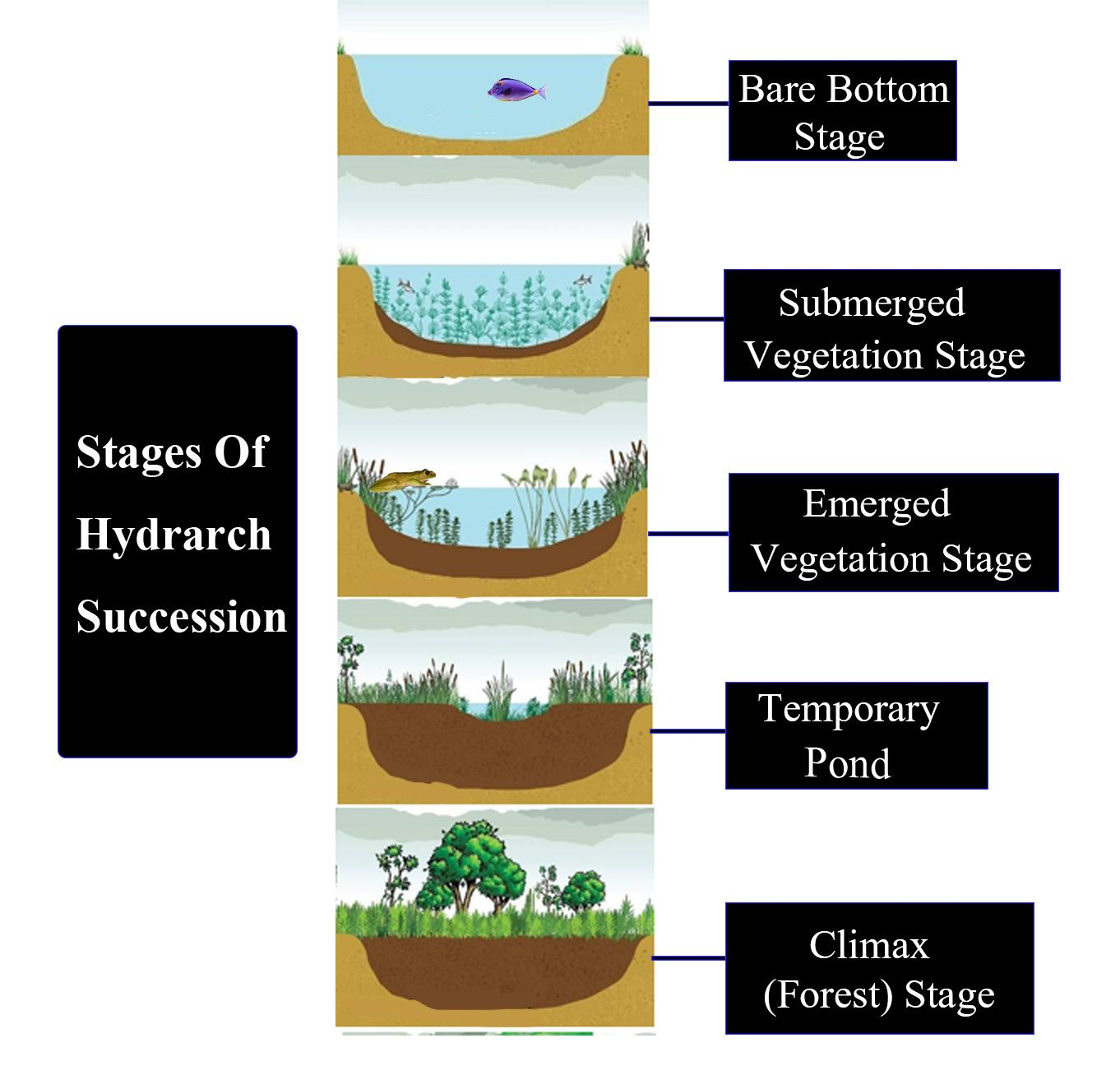
Additional Information: There are four stages of hydrarch succession:
(i) Submersed aquatic plants in the deeper water.
(ii) The Emergent cattails and bulrushes rooted in the mud of shallow water.
(iii) Willow thickets along the banks of the distant shoreline.
(iv) Conifer forest in drier, well-drained soil above the willow thickets.
In xerarch succession, the lichen colonies on these boulders are the first step. With the help of mosses, they trap dust particles and form a layer of soil on the rock surface that allows other plants, such as grasses and herbs, to become established.
So, the correct answer is ‘Medium water condition’.
Note: In xerarch succession, plant succession starts on bare ground or rock and culminates in a mature climax forest. The pioneer species, such as mosses and lichen, result in the gradual accumulation of soil. The forested slopes in the Sierra Nevada (Yosemite National Park) were once bare granite after the last major glacial period 12,000 years ago.
Complete answer:
Hydrarch succession happens in water regions and the successive arrangement progresses from hydric to the mesic conditions. As against the xerarch succession happens in dry zones and arrangement progress from xeric to mesic conditions. Consequently, both hydrarch and xerarch succession lead to medium water conditions (mesic)- neither excessively dry (xeric) nor excessively wet (hydric). Biotic succession in both arid areas and water bodies leads to long-lived plants, greater species diversity, niche specialization, increase in biomass, higher soil humus, food webs, stable biotic community, and mesic conditions.
Additional Information: There are four stages of hydrarch succession:
(i) Submersed aquatic plants in the deeper water.
(ii) The Emergent cattails and bulrushes rooted in the mud of shallow water.
(iii) Willow thickets along the banks of the distant shoreline.
(iv) Conifer forest in drier, well-drained soil above the willow thickets.
In xerarch succession, the lichen colonies on these boulders are the first step. With the help of mosses, they trap dust particles and form a layer of soil on the rock surface that allows other plants, such as grasses and herbs, to become established.
So, the correct answer is ‘Medium water condition’.
Note: In xerarch succession, plant succession starts on bare ground or rock and culminates in a mature climax forest. The pioneer species, such as mosses and lichen, result in the gradual accumulation of soil. The forested slopes in the Sierra Nevada (Yosemite National Park) were once bare granite after the last major glacial period 12,000 years ago.
Recently Updated Pages
Master Class 12 Business Studies: Engaging Questions & Answers for Success

Master Class 12 Chemistry: Engaging Questions & Answers for Success
Master Class 12 Biology: Engaging Questions & Answers for Success
Class 12 Question and Answer - Your Ultimate Solutions Guide
Master Class 11 English: Engaging Questions & Answers for Success
Master Class 11 Social Science: Engaging Questions & Answers for Success
Trending doubts
Which are the Top 10 Largest Countries of the World?
Draw a labelled sketch of the human eye class 12 physics CBSE
The end of compass needle which points towards north class 12 physics CBSE
Differentiate between homogeneous and heterogeneous class 12 chemistry CBSE
In order to find out the different types of gametes class 12 biology NEET_UG
Why is the cell called the structural and functional class 12 biology CBSE