




Body cavity of Hydra is called as
a) Enterocoel
b) Coelenteron
c) Gastrovascular cavity
d) Both B and C
Answer
 Verified
671.1k+ views
Hint: An organ for digestion, circulation, and gaseous exchange along with excretion is located centrally in an organism.
Complete answer:
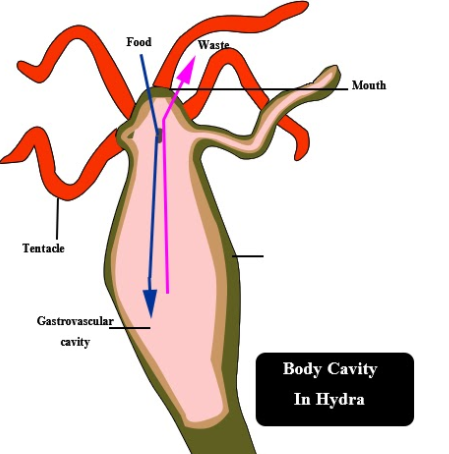
Hydra belongs from a genus of small, freshwater organisms having a sac-like body with a central body cavity. The body cavity of a Hydra is called a Gastrovascular cavity. It is also known as coelenteron. This cavity may extend into a system of canals.
Additional information:
-Hydra is commonly known as a blind gut or blind sac as the food enters and wastes excreted through the same passage.
-The body of Hydra is radially symmetrical with an adhesive foot called the basal disc.
-At the opening of the mouth few tentacles are present which secrete chemicals to capture the prey.
-Hydra is diploblastic, with two body layers: the epidermis (outer layer), and gastrodermis (inner layer).
-The gastrodermis lines the stomach region.
-The extracellular digestion occurs inside the central cavity of the sac-like body.
-The process of respiration and excretion occurs by diffusion through the epidermal surface.
-The larger waste products are excreted out through the mouth.
So, the correct answer is ‘Both B and C'.
Note:Hydra belongs to the Phylum Cnidaria and class Hydrozoa. They have a unique characteristic feature which attracts the biologists is their regenerative ability. They do not age or die at all. They are composed of various stem cells inside the body column to renew themselves. If Hydra is cut into several pieces then each piece will form a new complete Hydra. This ability of growth and development of hydra is called regeneration.
Complete answer:
Hydra belongs from a genus of small, freshwater organisms having a sac-like body with a central body cavity. The body cavity of a Hydra is called a Gastrovascular cavity. It is also known as coelenteron. This cavity may extend into a system of canals.
Additional information:
-Hydra is commonly known as a blind gut or blind sac as the food enters and wastes excreted through the same passage.
-The body of Hydra is radially symmetrical with an adhesive foot called the basal disc.
-At the opening of the mouth few tentacles are present which secrete chemicals to capture the prey.
-Hydra is diploblastic, with two body layers: the epidermis (outer layer), and gastrodermis (inner layer).
-The gastrodermis lines the stomach region.
-The extracellular digestion occurs inside the central cavity of the sac-like body.
-The process of respiration and excretion occurs by diffusion through the epidermal surface.
-The larger waste products are excreted out through the mouth.
So, the correct answer is ‘Both B and C'.
Note:Hydra belongs to the Phylum Cnidaria and class Hydrozoa. They have a unique characteristic feature which attracts the biologists is their regenerative ability. They do not age or die at all. They are composed of various stem cells inside the body column to renew themselves. If Hydra is cut into several pieces then each piece will form a new complete Hydra. This ability of growth and development of hydra is called regeneration.
Recently Updated Pages
Which will be the least stable resonating structure class 11 chemistry CBSE

How many 5 digit telephone numbers can be construc-class-11-maths-CBSE
How do you find the angle of the resultant vector class 11 physics CBSE
Draw labelled diagram of the following i Gram seed class 11 biology CBSE
1 Quintal is equal to a 110 kg b 10 kg c 100kg d 1000 class 11 physics CBSE
What is the need and importance of classification class 11 biology CBSE
Trending doubts
Find the value of the expression given below sin 30circ class 11 maths CBSE
One Metric ton is equal to kg A 10000 B 1000 C 100 class 11 physics CBSE
10 examples of friction in our daily life
Draw a diagram of a plant cell and label at least eight class 11 biology CBSE
Difference between physical and chemical change class 11 chemistry CBSE
Proton was discovered by A Thomson B Rutherford C Chadwick class 11 chemistry CBSE