




Bladderwort is
(a)Drosera
(b)Nepenthes
(c)Dionaea
(d)Utricularia
Answer
 Verified
665.7k+ views
Hint: Bladderworts are carnivorous plants and mostly they are cultivated for their flowers. The trap of bladderwort resembles the shape of a bladder. In Latin, the other name of bladderwort refers to ‘wine flask or leather bottle’.
Complete answer:
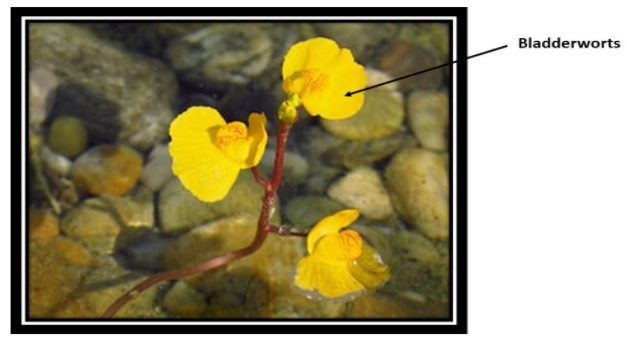
Utricularia (active traps): Bladderworts (genus: Utricularia) are often found in lakes, rivers, and other water bodies with low nutrient content. They can trap small organisms, the size of the trap ranges from 0.2mm to 1.2cm. These plants have a trap that resembles the shape of a bladder. The mouth of the bladder possesses small hair-like overhangs, which will quickly respond to the organism moving along with the water. Upon the approach of these small organisms, the bladder will swell allowing the influx of water containing its prey to enter the plant, after which the catch door present on the mouth of the bladder will close. Now, the prey will be trapped and cannot escape from the plant. The organisms will eventually be digested via the digestive enzymes present in the plant.
Additional Information: Carnivorous plants are distributed widely across every climatic region, which contains ample light and water sources but is under supplied with nutrients. Carnivorous plants utilize nutrients (ex. Nitrogen, potassium, and phosphorous) by trapping and assimilating its prey. Carnivorous plants are classified into 5 types depending on the mechanism by which it traps the prey.
Pitfall taps: for example, Nepenthes.
Flypaper traps: for example, Drosera
Snap traps: for example, Dionaea muscipula (Venus flytrap)
Bladder traps: for example, Utricularia
Lobster pot traps: for example, Genlesia
Nepenthes (passive traps): Nepenthes is the biggest group of pitcher plants. Research on the different species of Nepenthes had revealed that this group of plants utilizes a wax layer, viscoelastic fluid, and wettable peroxisomes to trap its prey and obtain nutrients. The wetted peroxisomes allow the movement of the invertebrates to the pitcher’s mouth. The pitcher’s mouth possesses a digestive enzyme that digests the prey by the enzymatic degradation.
Venus flytrap (active trap): Venus flytrap grows in bogs and wet regions. It catches insects, spiders by snap catching mechanism. Preys are then killed by the enzymatic degradation of the digestive enzymes and the nutrients will be obtained from these organisms for the plant growth.
Snap catching mechanism - Venus flytrap has a tiny hair over the two leaf lobules. When the prey comes in contact with the hairs, the two-leaf lobules close by trapping the insects inside the plants.
So, the correct answer is ‘Utricularia’.
Note: Plants utilizing active traps will capture their prey by physical movement. Venus flytrap, bladderworts use an active transport mechanism. Plants utilizing passive traps will not move to capture their prey. Nepenthes uses a passive trap mechanism.
Complete answer:
Utricularia (active traps): Bladderworts (genus: Utricularia) are often found in lakes, rivers, and other water bodies with low nutrient content. They can trap small organisms, the size of the trap ranges from 0.2mm to 1.2cm. These plants have a trap that resembles the shape of a bladder. The mouth of the bladder possesses small hair-like overhangs, which will quickly respond to the organism moving along with the water. Upon the approach of these small organisms, the bladder will swell allowing the influx of water containing its prey to enter the plant, after which the catch door present on the mouth of the bladder will close. Now, the prey will be trapped and cannot escape from the plant. The organisms will eventually be digested via the digestive enzymes present in the plant.
Additional Information: Carnivorous plants are distributed widely across every climatic region, which contains ample light and water sources but is under supplied with nutrients. Carnivorous plants utilize nutrients (ex. Nitrogen, potassium, and phosphorous) by trapping and assimilating its prey. Carnivorous plants are classified into 5 types depending on the mechanism by which it traps the prey.
Pitfall taps: for example, Nepenthes.
Flypaper traps: for example, Drosera
Snap traps: for example, Dionaea muscipula (Venus flytrap)
Bladder traps: for example, Utricularia
Lobster pot traps: for example, Genlesia
Nepenthes (passive traps): Nepenthes is the biggest group of pitcher plants. Research on the different species of Nepenthes had revealed that this group of plants utilizes a wax layer, viscoelastic fluid, and wettable peroxisomes to trap its prey and obtain nutrients. The wetted peroxisomes allow the movement of the invertebrates to the pitcher’s mouth. The pitcher’s mouth possesses a digestive enzyme that digests the prey by the enzymatic degradation.
Venus flytrap (active trap): Venus flytrap grows in bogs and wet regions. It catches insects, spiders by snap catching mechanism. Preys are then killed by the enzymatic degradation of the digestive enzymes and the nutrients will be obtained from these organisms for the plant growth.
Snap catching mechanism - Venus flytrap has a tiny hair over the two leaf lobules. When the prey comes in contact with the hairs, the two-leaf lobules close by trapping the insects inside the plants.
So, the correct answer is ‘Utricularia’.
Note: Plants utilizing active traps will capture their prey by physical movement. Venus flytrap, bladderworts use an active transport mechanism. Plants utilizing passive traps will not move to capture their prey. Nepenthes uses a passive trap mechanism.
Recently Updated Pages
Which will be the least stable resonating structure class 11 chemistry CBSE

How many 5 digit telephone numbers can be construc-class-11-maths-CBSE
How do you find the angle of the resultant vector class 11 physics CBSE
Draw labelled diagram of the following i Gram seed class 11 biology CBSE
1 Quintal is equal to a 110 kg b 10 kg c 100kg d 1000 class 11 physics CBSE
What is the need and importance of classification class 11 biology CBSE
Trending doubts
Find the value of the expression given below sin 30circ class 11 maths CBSE
One Metric ton is equal to kg A 10000 B 1000 C 100 class 11 physics CBSE
10 examples of friction in our daily life
Draw a diagram of a plant cell and label at least eight class 11 biology CBSE
Difference between physical and chemical change class 11 chemistry CBSE
Proton was discovered by A Thomson B Rutherford C Chadwick class 11 chemistry CBSE