




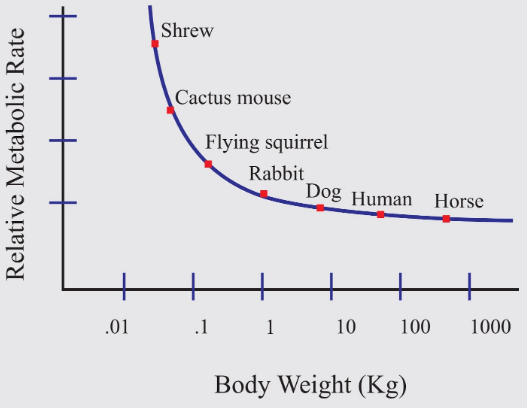
Birds and mammals being homeothermic (capable of maintaining constant body temperature) have evolved a mechanism to regulate their metabolic rate. An inverse relationship is observed between metabolic rate and body weight from the plot of the rate of oxygen consumption versus the bodyweight of different mammals. On the other hand, there is a directly proportional relationship between metabolic rate and surface area to volume ratio. From the given figure it is evident that more internal heat per gram of body weight is generated by the shrew and more heat is lost to the environment than the horse. Thus maintenance of constant body temperature is more difficult for small animals in cold weather.
What would happen if all the vital organs of an animal are kept at approximately the same temperature?
(a) It could not survive in a desert environment
(b) It sweats excessively and becomes dehydrated in hot weather
(c) Its body temperature is determined by the most temperature-sensitive organ
(d) It must always have a large supply of water
Answer
 Verified
567.3k+ views
Hint: Animals belong to the phylum Aves and Mammalia uses metabolic heat to maintain a stable internal body temperature that often differs from the environment.
Complete answer:
If all the vital organs of an animal are kept at approximately the same temperature then its body temperature is determined by the most temperature-sensitive organ. Mammals and Birds are homeothermic animals. Thus, they have the ability to maintain a somewhat constant body temperature.
-In order to achieve a constant body temperature, they have evolved various mechanisms, for example, the most common ones being sweating and shivering.
-In these animals, the body temperature is determined by the most temperature-sensitive organ. So, even when all the organs of the animal are kept at a constant temperature, the body temperature would naturally be only affected by the most temperature-sensitive organ.
-The homeothermy obtained from endothermy is a high-energy strategy.
-The temperature regulation represents the balance between the heat production from metabolic sources and the heat loss through evaporation of perspiration and the processes of radiation, convection, and conduction.
-The body heat is conserved in a cold environment, firstly by constricting the blood vessels near the body surface and later by the waves of muscle contractions, or shivering, which also serves to increase the metabolism.
So, the correct answer is 'Its body temperature is determined by the most temperature-sensitive organ'.
Note:
-Homeotherms are not necessarily endothermic.
-Some homeotherms also maintain constant body temperatures through behavioral mechanisms alone, i.e., behavioral thermoregulation.
-Since many homeothermic animals use enzymes that are specialized for a narrow range of body temperatures, so hypothermia rapidly leads to torpor and then death.
Complete answer:
If all the vital organs of an animal are kept at approximately the same temperature then its body temperature is determined by the most temperature-sensitive organ. Mammals and Birds are homeothermic animals. Thus, they have the ability to maintain a somewhat constant body temperature.
-In order to achieve a constant body temperature, they have evolved various mechanisms, for example, the most common ones being sweating and shivering.
-In these animals, the body temperature is determined by the most temperature-sensitive organ. So, even when all the organs of the animal are kept at a constant temperature, the body temperature would naturally be only affected by the most temperature-sensitive organ.
-The homeothermy obtained from endothermy is a high-energy strategy.
-The temperature regulation represents the balance between the heat production from metabolic sources and the heat loss through evaporation of perspiration and the processes of radiation, convection, and conduction.
-The body heat is conserved in a cold environment, firstly by constricting the blood vessels near the body surface and later by the waves of muscle contractions, or shivering, which also serves to increase the metabolism.
So, the correct answer is 'Its body temperature is determined by the most temperature-sensitive organ'.
Note:
-Homeotherms are not necessarily endothermic.
-Some homeotherms also maintain constant body temperatures through behavioral mechanisms alone, i.e., behavioral thermoregulation.
-Since many homeothermic animals use enzymes that are specialized for a narrow range of body temperatures, so hypothermia rapidly leads to torpor and then death.
Recently Updated Pages
Master Class 12 Economics: Engaging Questions & Answers for Success

Master Class 12 English: Engaging Questions & Answers for Success
Master Class 12 Social Science: Engaging Questions & Answers for Success
Master Class 12 Maths: Engaging Questions & Answers for Success
Master Class 12 Physics: Engaging Questions & Answers for Success
Master Class 12 Business Studies: Engaging Questions & Answers for Success
Trending doubts
Which are the Top 10 Largest Countries of the World?
Draw a labelled sketch of the human eye class 12 physics CBSE
Differentiate between homogeneous and heterogeneous class 12 chemistry CBSE
Why is the cell called the structural and functional class 12 biology CBSE
Draw ray diagrams each showing i myopic eye and ii class 12 physics CBSE
Which is the correct genotypic ratio of mendel dihybrid class 12 biology CBSE