




Biogas contains
(a) ${ CH }_{ 4 }$ + ${ CO }$ + ${ CO }_{ 2 }$
(b) ${ CH }_{ 4 }$ + ${ CO }_{ 2 }$+ ${ H }_{ 2 }$
(c) ${ CO }$ + ${ CO }_{ 2 }$ + ${ H }_{ 2 }$
(d) ${ CO }$ + ${ CO }_{ 2 }$ + ${ NO }_{ 2 }$
Answer
 Verified
574.8k+ views
Hint: Biogas is a mixture of gases produced by the microbial activity of a group of archaebacteria that can be found in the rumen of cattle. It contains some gases which are among the major contributors to global warming.
Complete answer:
Biogas is a mixture of gases produced by the microbial activity of methanogens and used as a fuel. Methanogens are a type of archaebacteria that produces large quantities of methane along with carbon dioxide and hydrogen by acting on cellulosic compounds. Cattle dung is used for the production of biogas as it contains cellulosic material as well as methanogens. They are also found in swamps, marshy areas, sewage, and also in the rumen of cattle and our colon. Cattle dung is used for the production of biogas as it contains cellulosic material as well as methanogens. E.g. Methanobacterium, Methanococcus.
Additional Information:
- Archaebacteria are a group of most primitive prokaryotes depicting one of the earliest life forms of earth. They are particularly known for the absence of peptidoglycan in their wall which is an important component in those of eubacteria. Instead, the cell wall contains branched lipid side chains which decrease membrane fluidity and increase tolerance to extreme heat as well as low pH.
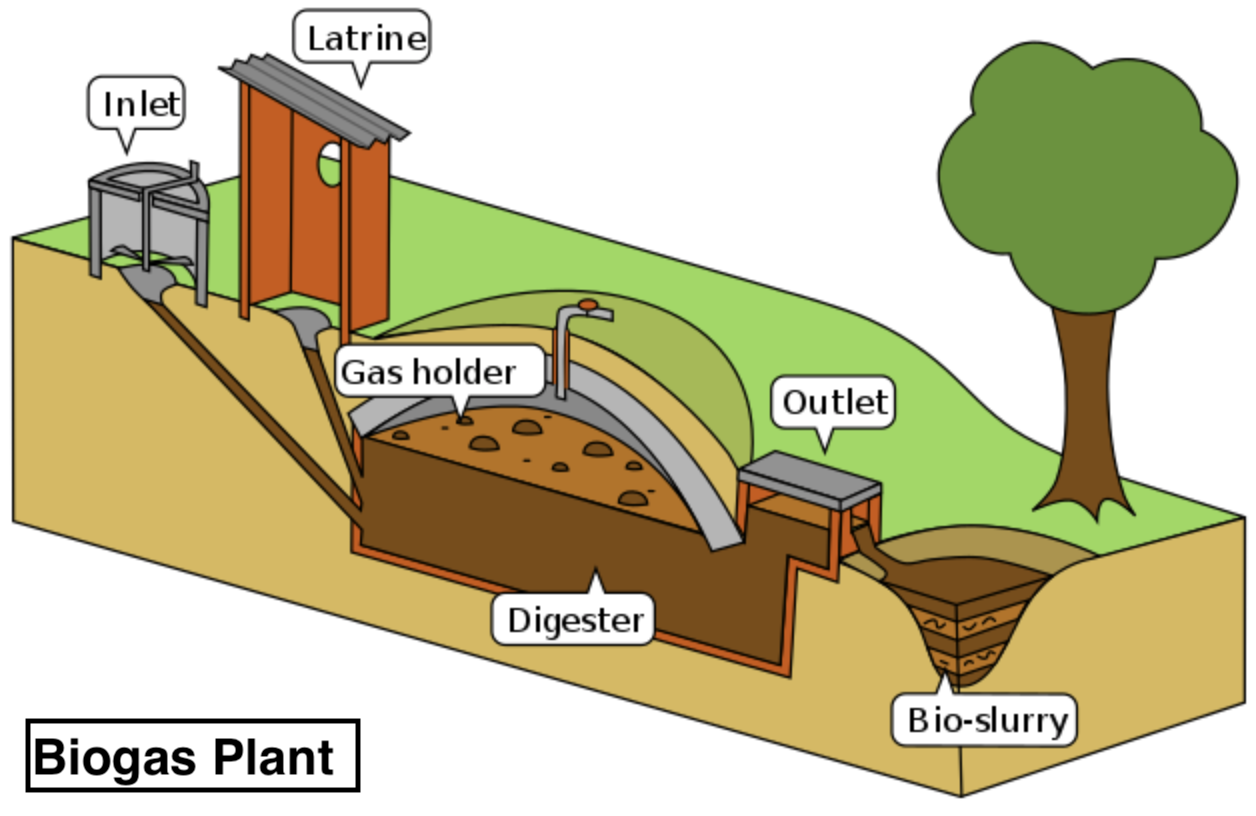
- Archaebacteria are of three major types: methanogens, halophiles, and thermoacidophiles.
- Halophiles are the archaebacteria surviving in environments that are extremely rich in salt content like the Dead sea, salt marshes.E.g. Halobacterium, Halococcus.
- Thermoacidophiles are the archaebacteria possessing the dual ability to tolerate a high temperature as well as an acidic environment. E.g. Thermoproteus.
So, the correct answer is ‘${ CH }_{ 4 }$ + ${ CO }_{ 2 }$+ ${ H }_{ 2 }$.’
Note:
- In the cell membrane of Halophiles, there are special lipids which help them to tolerate high salinity. The absence of sap vacuoles hence plasmolysis, the presence of mucilage covering and high internal salt concentration also help them.
- Thermoacidophiles possess special resistant enzymes that remain functional even in the high temperature and do not denature.
Complete answer:
Biogas is a mixture of gases produced by the microbial activity of methanogens and used as a fuel. Methanogens are a type of archaebacteria that produces large quantities of methane along with carbon dioxide and hydrogen by acting on cellulosic compounds. Cattle dung is used for the production of biogas as it contains cellulosic material as well as methanogens. They are also found in swamps, marshy areas, sewage, and also in the rumen of cattle and our colon. Cattle dung is used for the production of biogas as it contains cellulosic material as well as methanogens. E.g. Methanobacterium, Methanococcus.
Additional Information:
- Archaebacteria are a group of most primitive prokaryotes depicting one of the earliest life forms of earth. They are particularly known for the absence of peptidoglycan in their wall which is an important component in those of eubacteria. Instead, the cell wall contains branched lipid side chains which decrease membrane fluidity and increase tolerance to extreme heat as well as low pH.
- Archaebacteria are of three major types: methanogens, halophiles, and thermoacidophiles.
- Halophiles are the archaebacteria surviving in environments that are extremely rich in salt content like the Dead sea, salt marshes.E.g. Halobacterium, Halococcus.
- Thermoacidophiles are the archaebacteria possessing the dual ability to tolerate a high temperature as well as an acidic environment. E.g. Thermoproteus.
So, the correct answer is ‘${ CH }_{ 4 }$ + ${ CO }_{ 2 }$+ ${ H }_{ 2 }$.’
Note:
- In the cell membrane of Halophiles, there are special lipids which help them to tolerate high salinity. The absence of sap vacuoles hence plasmolysis, the presence of mucilage covering and high internal salt concentration also help them.
- Thermoacidophiles possess special resistant enzymes that remain functional even in the high temperature and do not denature.
Recently Updated Pages
Master Class 12 Economics: Engaging Questions & Answers for Success

Master Class 12 Physics: Engaging Questions & Answers for Success
Master Class 12 English: Engaging Questions & Answers for Success
Master Class 12 Social Science: Engaging Questions & Answers for Success
Master Class 12 Maths: Engaging Questions & Answers for Success
Master Class 12 Business Studies: Engaging Questions & Answers for Success
Trending doubts
Which are the Top 10 Largest Countries of the World?
What are the major means of transport Explain each class 12 social science CBSE
Draw a labelled sketch of the human eye class 12 physics CBSE
Why cannot DNA pass through cell membranes class 12 biology CBSE
Differentiate between insitu conservation and exsitu class 12 biology CBSE
Draw a neat and well labeled diagram of TS of ovary class 12 biology CBSE