




Binary fission occurs in
A. Amoeba
B. Paramecium
C. Bacteria
D. All of the above
Answer
 Verified
604.8k+ views
Hint: Binary fission is a type of asexual reproduction in which no gametes are required. Only a single parent can give rise to two daughter cells. The parent cell splits into two dividing its nucleus into two equal parts into two daughter cells. It is a means of reproduction in primitive or simple cells.
Complete answer: Sexual reproduction and asexual reproduction are both types of reproduction. It requires the fusion of two gametes from two different parents. On the other hand, in asexual reproduction, the fusion of gametes is not required. Asexual reproduction can be of various types. Binary fission is a mode of asexual reproduction.
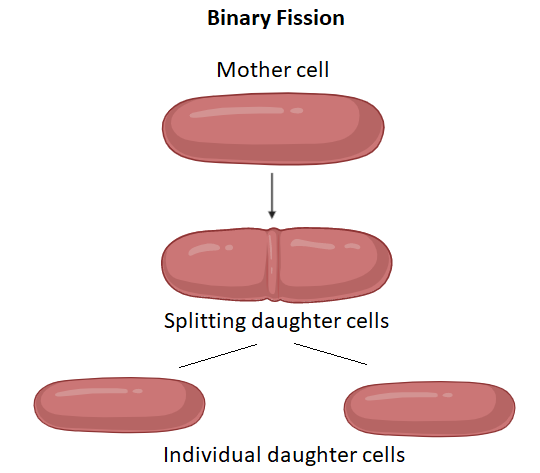
Binary fission involves the splitting of the parent cell into two individual daughter cells. Each one of the daughter cells carries an equal part of the nucleus and protoplasm of the mother cell. It is the simplest mode of reproduction and is seen in primitive or simpler cells. Amoeba, Paramecium, and Bacteria all show binary fission. Binary fission originates through the replication of DNA. The next step involves the segregation of DNA. At last, the mother cell split into two. Binary fission is thought to be as old as 3 billion years old. Prokaryotes are simpler organisms and hence, most of them undergo binary fission. A few of the single-celled eukaryotes also perform binary fission.
Hence, the correct answer is option D.
Note: In multiple fissions, the mother cell divides into more than two daughter cells. Yeast is a eukaryotic organism that undergoes multiple fission. The resultant cells of binary fission are always identical to the mother cell and are called clones.
Complete answer: Sexual reproduction and asexual reproduction are both types of reproduction. It requires the fusion of two gametes from two different parents. On the other hand, in asexual reproduction, the fusion of gametes is not required. Asexual reproduction can be of various types. Binary fission is a mode of asexual reproduction.
Binary fission involves the splitting of the parent cell into two individual daughter cells. Each one of the daughter cells carries an equal part of the nucleus and protoplasm of the mother cell. It is the simplest mode of reproduction and is seen in primitive or simpler cells. Amoeba, Paramecium, and Bacteria all show binary fission. Binary fission originates through the replication of DNA. The next step involves the segregation of DNA. At last, the mother cell split into two. Binary fission is thought to be as old as 3 billion years old. Prokaryotes are simpler organisms and hence, most of them undergo binary fission. A few of the single-celled eukaryotes also perform binary fission.
Hence, the correct answer is option D.
Note: In multiple fissions, the mother cell divides into more than two daughter cells. Yeast is a eukaryotic organism that undergoes multiple fission. The resultant cells of binary fission are always identical to the mother cell and are called clones.
Recently Updated Pages
Master Class 12 Business Studies: Engaging Questions & Answers for Success

Master Class 12 Chemistry: Engaging Questions & Answers for Success
Master Class 12 Biology: Engaging Questions & Answers for Success
Class 12 Question and Answer - Your Ultimate Solutions Guide
Master Class 11 English: Engaging Questions & Answers for Success
Master Class 11 Social Science: Engaging Questions & Answers for Success
Trending doubts
Which are the Top 10 Largest Countries of the World?
Draw a labelled sketch of the human eye class 12 physics CBSE
Differentiate between homogeneous and heterogeneous class 12 chemistry CBSE
In order to find out the different types of gametes class 12 biology NEET_UG
Why is the cell called the structural and functional class 12 biology CBSE
Draw ray diagrams each showing i myopic eye and ii class 12 physics CBSE