




Benzene diazonium chloride on hydrolysis gives:
(A)Benzene
(B)Benzyl Alcohol
(C)Phenol
(D)Chlorobenzene
Answer
 Verified
662.4k+ views
Hint: Diazonium compounds or diazonium salts are a group of organic compounds sharing a common functional group, $R-{{N}_{2}}^{+}{{X}^{-}}$, where R can be any organic group. Many diazonium salts are susceptible to displacement reactions by various substrates, generating nitrogen as a by-product.
Complete step by step solution:
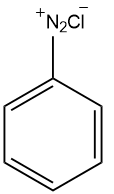
Benzene diazonium chloride is an organic compound with the formula $({{C}_{6}}{{H}_{5}}{{N}_{2}})Cl$. The structure of Benzene diazonium chloride is as follows:
It is a salt of a diazonium cation and chloride. It exists as a colourless solid that is soluble in polar solvents including water. Benzene diazonium chloride can be formed by first mixing benzene with nitric acid, which forms nitrobenzene. Nitrobenzene can then be transformed into aniline and aniline can be mixed with nitrous acid in the presence of hydrochloric acid to form the benzene diazonium chloride molecule. During the preparation of Benzene diazonium chloride, lower temperatures are favoured it because the formed Benzene diazonium chloride will become unstable if the temperature becomes more than ${{5}^{\circ }}C$
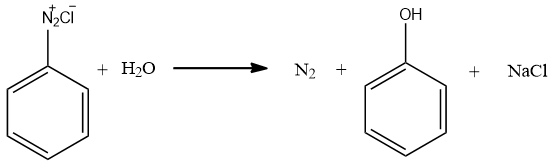
-On hydrolysis of Benzene diazonium chloride, Nitrogen molecules escape as nitrogen gas. The OH group of water attacks the vacant site left after removal of nitrogen gas. This results in the formation of phenol. Also, Small amount of NaCl is also generated.
Therefore, the correct answer is (C) option.
Note: Another common pathway is to undergo a coupling reaction to form a diazo compound. Diazonium salts are important synthetic intermediates that can undergo coupling reactions to form azo dyes and electrophilic substitution reactions to introduce functional groups.
Complete step by step solution:
Benzene diazonium chloride is an organic compound with the formula $({{C}_{6}}{{H}_{5}}{{N}_{2}})Cl$. The structure of Benzene diazonium chloride is as follows:
It is a salt of a diazonium cation and chloride. It exists as a colourless solid that is soluble in polar solvents including water. Benzene diazonium chloride can be formed by first mixing benzene with nitric acid, which forms nitrobenzene. Nitrobenzene can then be transformed into aniline and aniline can be mixed with nitrous acid in the presence of hydrochloric acid to form the benzene diazonium chloride molecule. During the preparation of Benzene diazonium chloride, lower temperatures are favoured it because the formed Benzene diazonium chloride will become unstable if the temperature becomes more than ${{5}^{\circ }}C$
-On hydrolysis of Benzene diazonium chloride, Nitrogen molecules escape as nitrogen gas. The OH group of water attacks the vacant site left after removal of nitrogen gas. This results in the formation of phenol. Also, Small amount of NaCl is also generated.
Therefore, the correct answer is (C) option.
Note: Another common pathway is to undergo a coupling reaction to form a diazo compound. Diazonium salts are important synthetic intermediates that can undergo coupling reactions to form azo dyes and electrophilic substitution reactions to introduce functional groups.
Recently Updated Pages
Explain the structure of megasporangium class 12 biology CBSE

Why is chloroform kept in dark coloured bottles class 12 chemistry CBSE
Derive the balancing condition of a Wheatstone bri class 12 physics CBSE
Draw VI characteristics of a pn junction diode Explain class 12 physics CBSE
Is it possible to carry pride in ones language too class 12 english CBSE
In a population at Hardy Weinberg equilibrium the allele class 12 biology CBSE
Trending doubts
Draw a labelled sketch of the human eye class 12 physics CBSE
Which are the Top 10 Largest Countries of the World?
Draw ray diagrams each showing i myopic eye and ii class 12 physics CBSE
One megawatt is equal to how many units of electri class 12 physics CBSE
Which is the correct genotypic ratio of mendel dihybrid class 12 biology CBSE
Give 10 examples of unisexual and bisexual flowers