




Bateson used the terms coupling and repulsion for linkage and crossing over. Name the correct parental or coupling type along with its cross over or repulsion.
(A) Coupling AABB, aabb; Repulsion AABB, AAbb
(B) Coupling AAbb, aaBB; Repulsion AABB, aabb
(C) Coupling aaBB, aabb; Repulsion AABB, aabb
(D) Coupling AABB, aabb; Repulsion AAbb, aaBB
Answer
 Verified
610.2k+ views
Hint: Coupling in genetics means the case where dominant alleles are on a similar homologous chromosome and both recessive alleles are on the opposite homologous chromosome. On the other hand repulsion is related to the situation where each homologous chromosome has one dominant and one recessive allele respectively from the 2 genes.
Complete answer:
Bateson used the terms coupling and repulsion for linkage and crossing over. Coupling pattern AABB, aabb; Repulsion AAbb, aaBB, is the correct parental or coupling type along with its cross over or repulsion.
Additional Information: W. Bateson, in the year 1905, conducted a cross in sweet pea, where a deviation from independent assortment was seen. The variety of sweet pea plant which has the flowers of blue colour (B) and long pollen (L) was crossed with those of another variety having red flowers (b) and round pollen (l). F1 individuals (BbLl) had flowers of blue colour and long pollen. These plants were crossed with plants having flowers of red colour and round pollen (bbll).
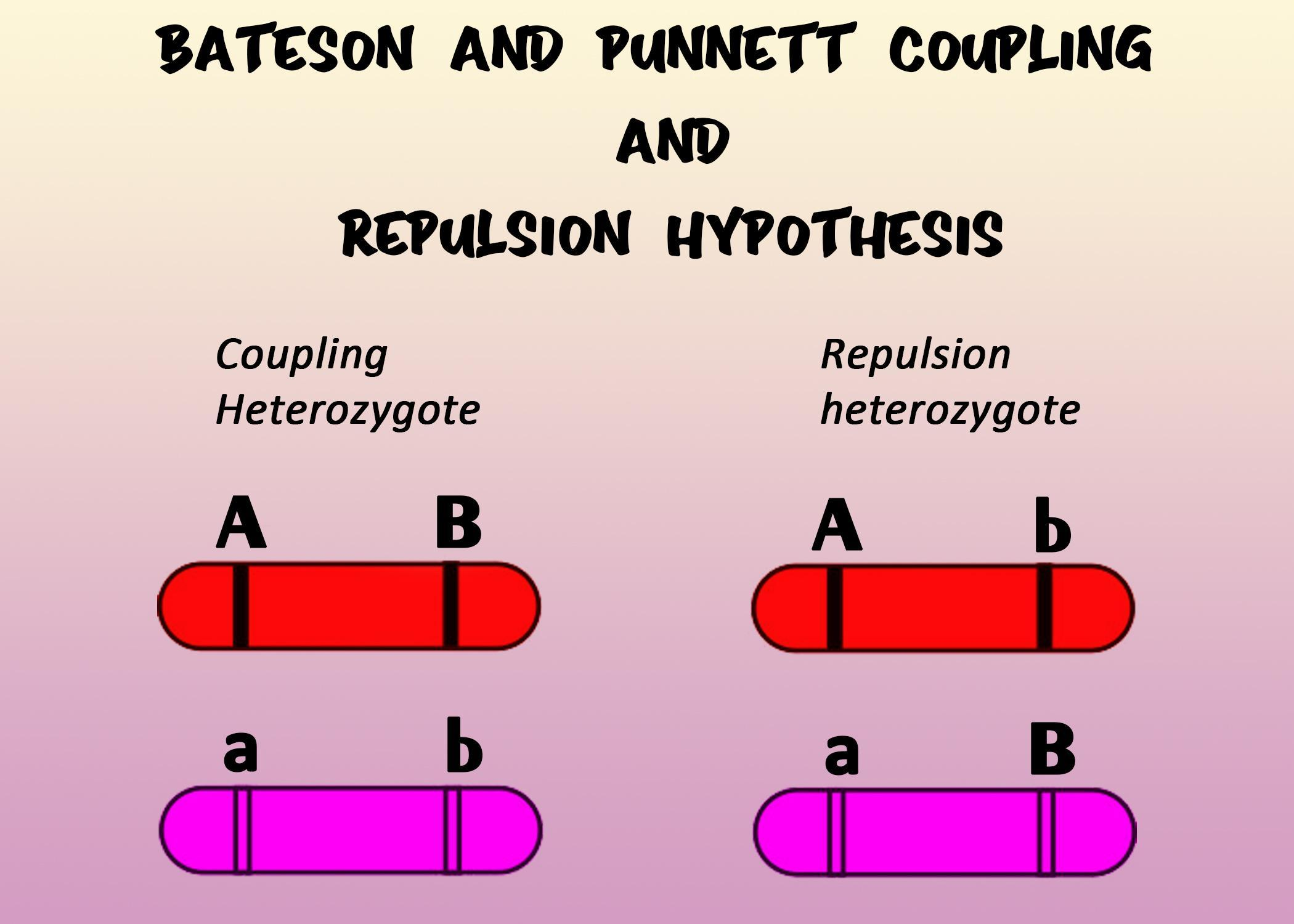
In Bateson's experiment in the repulsion phase, it was noticed that the one parent would have blue flowers and round pollen (BBll) and therefore the other would have red flowers and long pollen (bbLL). The results of a testcross in a repulsion phase were mostly similar to those obtained in the coupling phase which was giving 1:7:7:1 ratio rather than expected 1:1:1:1. Bateson by means of a hypothesis which was referred to as coupling and repulsion hypothesis. explained the lack of independent assortment in his above experiment .
So, the correct answer is ‘Coupling AABB, aabb; Repulsion AAbb, aaBB’.
Note: T.H. Morgan, while performing an experiment with Drosophila, in 1910, found that coupling or repulsion wasn't complete. Morgan proposed that two genes are found in the coupling or in the repulsion phase because these were present on the same chromosome (coupling) or on two different, but homologous chromosomes (repulsion). Such genes are then called linked and therefore the phenomenon is named linkage.
Complete answer:
Bateson used the terms coupling and repulsion for linkage and crossing over. Coupling pattern AABB, aabb; Repulsion AAbb, aaBB, is the correct parental or coupling type along with its cross over or repulsion.
Additional Information: W. Bateson, in the year 1905, conducted a cross in sweet pea, where a deviation from independent assortment was seen. The variety of sweet pea plant which has the flowers of blue colour (B) and long pollen (L) was crossed with those of another variety having red flowers (b) and round pollen (l). F1 individuals (BbLl) had flowers of blue colour and long pollen. These plants were crossed with plants having flowers of red colour and round pollen (bbll).
In Bateson's experiment in the repulsion phase, it was noticed that the one parent would have blue flowers and round pollen (BBll) and therefore the other would have red flowers and long pollen (bbLL). The results of a testcross in a repulsion phase were mostly similar to those obtained in the coupling phase which was giving 1:7:7:1 ratio rather than expected 1:1:1:1. Bateson by means of a hypothesis which was referred to as coupling and repulsion hypothesis. explained the lack of independent assortment in his above experiment .
So, the correct answer is ‘Coupling AABB, aabb; Repulsion AAbb, aaBB’.
Note: T.H. Morgan, while performing an experiment with Drosophila, in 1910, found that coupling or repulsion wasn't complete. Morgan proposed that two genes are found in the coupling or in the repulsion phase because these were present on the same chromosome (coupling) or on two different, but homologous chromosomes (repulsion). Such genes are then called linked and therefore the phenomenon is named linkage.
Recently Updated Pages
Master Class 12 Economics: Engaging Questions & Answers for Success

Master Class 12 English: Engaging Questions & Answers for Success
Master Class 12 Social Science: Engaging Questions & Answers for Success
Master Class 12 Maths: Engaging Questions & Answers for Success
Master Class 12 Physics: Engaging Questions & Answers for Success
Master Class 12 Business Studies: Engaging Questions & Answers for Success
Trending doubts
Which are the Top 10 Largest Countries of the World?
Draw a labelled sketch of the human eye class 12 physics CBSE
Differentiate between homogeneous and heterogeneous class 12 chemistry CBSE
Why is the cell called the structural and functional class 12 biology CBSE
Draw ray diagrams each showing i myopic eye and ii class 12 physics CBSE
Which is the correct genotypic ratio of mendel dihybrid class 12 biology CBSE