




How many bands are seen when immunoglobulin G analyzed on a sodium dodecyl sulfate-polyacrylamide gel electrophoresis (SDS-PAGE) under reducing conditions.
a) \[6\]
b) \[1\]
c) \[2\]
d) \[4\]
Answer
 Verified
547.5k+ views
Hint: Sodium dodecyl sulfate-polyacrylamide gel electrophoresis (SDS-PAGE) is used to separate mainly proteins and as we know that immunoglobulins are made of proteins. It has two heavy chains and two light chains which are joined together by disulfide bonds.
Complete answer :
As we know from our knowledge that an immunoglobulin contains two light chains and two heavy chains. The densities and sizes of these are different. Any kind of gel electrophoresis depends upon size only. The SDS-PAGE is very useful for small proteins and peptides. It differentiated various molecules based on their molecular mass.
Since immunoglobulin contains only two types of chain. One heavy chain and one light chain. Therefore the number of bands formed will be two.
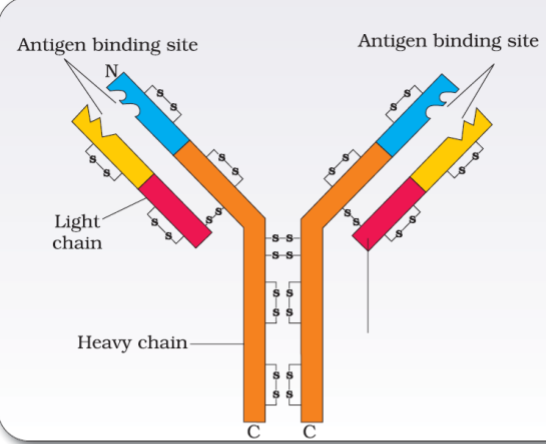
So the correct answer is (C) that is \[2\].
Additional information:
The reducing agent used in SDS-PAGE is \[2\]-mercaptoethanol.
The normal biochemistry behind this is we denature the proteins in the presence of SDS and the reducing agent by heating. SDS will bind to the protein causing it to unfold, whereas the reducing agent will reduce the disulfide bonds and various molecules are separated. Therefore, polypeptide and peptide of different molecular masses are separated. The SDS provides a negative charge to these molecules and is placed on an acrylamide gel. Then these negatively charged molecules placed against the anode.
The mobility of these molecules will be inversely proportional to their molecular mass and therefore we get separate bands.
Note:
Always remember in gel electrophoresis the mobility of molecules does not depend on their or the charge provided to them. Their mobility depends upon their size.
The sieving effect is provided by the gel used.
The smaller the molecule further it will be from the loading site.
Complete answer :
As we know from our knowledge that an immunoglobulin contains two light chains and two heavy chains. The densities and sizes of these are different. Any kind of gel electrophoresis depends upon size only. The SDS-PAGE is very useful for small proteins and peptides. It differentiated various molecules based on their molecular mass.
Since immunoglobulin contains only two types of chain. One heavy chain and one light chain. Therefore the number of bands formed will be two.
So the correct answer is (C) that is \[2\].
Additional information:
The reducing agent used in SDS-PAGE is \[2\]-mercaptoethanol.
The normal biochemistry behind this is we denature the proteins in the presence of SDS and the reducing agent by heating. SDS will bind to the protein causing it to unfold, whereas the reducing agent will reduce the disulfide bonds and various molecules are separated. Therefore, polypeptide and peptide of different molecular masses are separated. The SDS provides a negative charge to these molecules and is placed on an acrylamide gel. Then these negatively charged molecules placed against the anode.
The mobility of these molecules will be inversely proportional to their molecular mass and therefore we get separate bands.
Note:
Always remember in gel electrophoresis the mobility of molecules does not depend on their or the charge provided to them. Their mobility depends upon their size.
The sieving effect is provided by the gel used.
The smaller the molecule further it will be from the loading site.
Recently Updated Pages
Master Class 12 Economics: Engaging Questions & Answers for Success

Master Class 12 Physics: Engaging Questions & Answers for Success
Master Class 12 English: Engaging Questions & Answers for Success
Master Class 12 Social Science: Engaging Questions & Answers for Success
Master Class 12 Maths: Engaging Questions & Answers for Success
Master Class 12 Business Studies: Engaging Questions & Answers for Success
Trending doubts
Which are the Top 10 Largest Countries of the World?
What are the major means of transport Explain each class 12 social science CBSE
Draw a labelled sketch of the human eye class 12 physics CBSE
Why cannot DNA pass through cell membranes class 12 biology CBSE
Differentiate between insitu conservation and exsitu class 12 biology CBSE
Draw a neat and well labeled diagram of TS of ovary class 12 biology CBSE