




Bakelite is formed by the reaction of:
A. Phenol and formaldehyde
B. Formaldehyde and aniline
C. Adipic acid and ethylene glycol
D. Phthalic acid and ethylene glycol.
Answer
 Verified
648.6k+ views
Hint: The materials made up from the long chains of the molecules are known as polymers and the process used to make them is known as polymerisation. Bakelite is also a polymer made up from the synthetic components, it comes under the category of plastic.
Complete step by step answer: Bakelite is basically a polymer made up of synthetic components. The monomer units used in making Bakelite are phenol and formaldehyde.
3d Structure of Bakelite is:
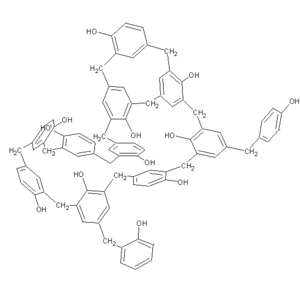
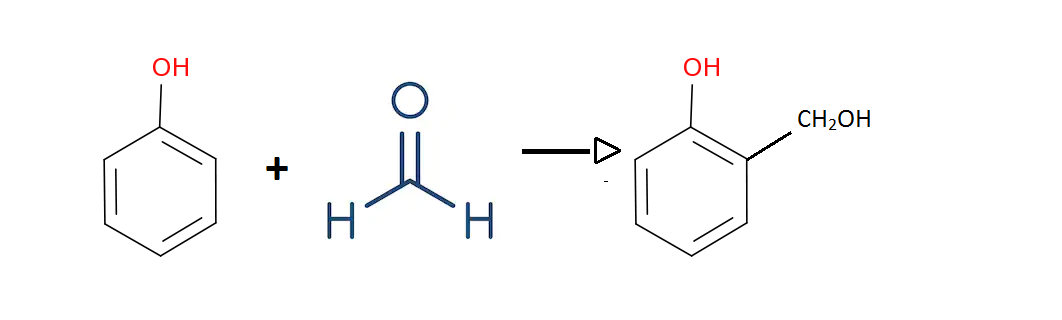
Bakelite is formed from the reaction of phenol and formaldehyde. Basically it is formed in two steps. In the first step formaldehyde reacts with phenol and produces o-Hydroxymethyl phenol. Then o-Hydroxy methyl phenol and phenol come together and form Bakelite.The reaction is condensation polymerisation as two molecules condense and give out by-product. In case of bakelite phenol and formaldehyde condense to form the monomer giving out $H_2O$ as a by-product. Bakelite is also called a co-polymer.
Reaction:
Phenol reacts with formaldehyde to produce o-Hydroxy methyl phenol.
Now produced complex (o-Hydroxymethyl phenol) and phenol come together to form Bakelite
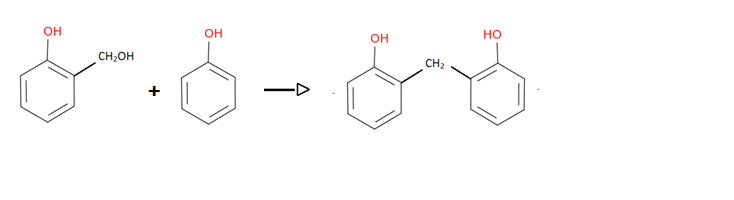
Hence the obtained product in the above reaction is Bakelite.
And when this reaction proceeds at larger extent or we can say multiple units come together, Bakelite will expand its size gradually and make a chain like structure.
Hence we can say that Bakelite is formed by the reaction of Phenol and formaldehyde.
So, the correct answer is “Option A”.
Note:
Bakelite is widely used in our daily life. It has high resistance to heat and electricity both so it is used in electrical appliances and in making handles of utensils. Due to high tensile strength it has some industrial uses also.
Complete step by step answer: Bakelite is basically a polymer made up of synthetic components. The monomer units used in making Bakelite are phenol and formaldehyde.
3d Structure of Bakelite is:
Bakelite is formed from the reaction of phenol and formaldehyde. Basically it is formed in two steps. In the first step formaldehyde reacts with phenol and produces o-Hydroxymethyl phenol. Then o-Hydroxy methyl phenol and phenol come together and form Bakelite.The reaction is condensation polymerisation as two molecules condense and give out by-product. In case of bakelite phenol and formaldehyde condense to form the monomer giving out $H_2O$ as a by-product. Bakelite is also called a co-polymer.
Reaction:
Phenol reacts with formaldehyde to produce o-Hydroxy methyl phenol.
Now produced complex (o-Hydroxymethyl phenol) and phenol come together to form Bakelite
Hence the obtained product in the above reaction is Bakelite.
And when this reaction proceeds at larger extent or we can say multiple units come together, Bakelite will expand its size gradually and make a chain like structure.
Hence we can say that Bakelite is formed by the reaction of Phenol and formaldehyde.
So, the correct answer is “Option A”.
Note:
Bakelite is widely used in our daily life. It has high resistance to heat and electricity both so it is used in electrical appliances and in making handles of utensils. Due to high tensile strength it has some industrial uses also.
Recently Updated Pages
Explain the structure of megasporangium class 12 biology CBSE

Why is chloroform kept in dark coloured bottles class 12 chemistry CBSE
Derive the balancing condition of a Wheatstone bri class 12 physics CBSE
Draw VI characteristics of a pn junction diode Explain class 12 physics CBSE
Is it possible to carry pride in ones language too class 12 english CBSE
In a population at Hardy Weinberg equilibrium the allele class 12 biology CBSE
Trending doubts
Draw a labelled sketch of the human eye class 12 physics CBSE
Which are the Top 10 Largest Countries of the World?
Draw ray diagrams each showing i myopic eye and ii class 12 physics CBSE
Which is the correct genotypic ratio of mendel dihybrid class 12 biology CBSE
Differentiate between homogeneous and heterogeneous class 12 chemistry CBSE
Which animal never drinks water in its entire life class 12 biology CBSE