




Bacterial flagella are made of
A. Carbohydrate
B. Lipid
C. Amide
D. Protein
Answer
 Verified
621.3k+ views
Hint: The bacterial flagellum is composed of the protein flagellant. Its shape is a 20-nanometer-thick empty cylinder. It is helical and has a sharp twist simply outside the external layer; this "snare" permits the pivot of the helix to point straightforwardly away from the cell.
Complete step by step answer:
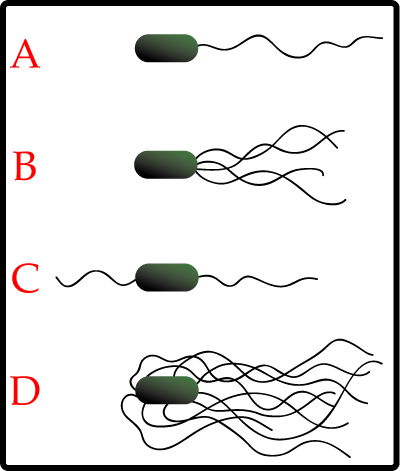
Bacterial flagellum process: Bacterial flagella are long furry structures that help in their velocity. They are found at either or the two closures of a bacterium or everywhere on its surface. The flagella beat in a propeller-like movement to enable the bacterium to push toward supplements; away from poisonous synthetic substances; or on account of photosynthetic cyanobacteria, at the light. The fiber composed of flagellant protein lies outer to the cell surface and structures a barrel shaped structure with an empty center. Snare is the adaptable structure toward the finish of the fiber, joined to the basal body which navigates the external divider and film structure. A flagellum is a whip-like structure that permits a cell to move. They are found in every one of the three areas of the living scene: microbes, archaea, and eukaryote, otherwise called protests, plants, creatures, and organisms. While every one of the three sorts of flagella are utilized for velocity, they are fundamentally altogether different
Bacterial flagellum structures: Bacterial flagella are helically formed structures containing the protein flagellant. The base of the flagellum (the snare) close to the cell surface is joined to the basal body encased in the cell envelope. The flagellum turns a clockwise or counterclockwise way, in a movement like that of a propeller.
Thus, the option (c) is correct.
Note:
They are the principal segment of the cell divider. Lipids are the major auxiliary segments of natural films/plasma layers. Replacement of hydroxyl gathering of a carboxylic corrosive with amino gathering acquires amides. The prokaryotic flagellum is a hair-like helical extremity that presents motility or self-impetus, the limit of a cell to swim uninhibitedly through a fluid living space, to the bacterium.
Complete step by step answer:
Bacterial flagellum process: Bacterial flagella are long furry structures that help in their velocity. They are found at either or the two closures of a bacterium or everywhere on its surface. The flagella beat in a propeller-like movement to enable the bacterium to push toward supplements; away from poisonous synthetic substances; or on account of photosynthetic cyanobacteria, at the light. The fiber composed of flagellant protein lies outer to the cell surface and structures a barrel shaped structure with an empty center. Snare is the adaptable structure toward the finish of the fiber, joined to the basal body which navigates the external divider and film structure. A flagellum is a whip-like structure that permits a cell to move. They are found in every one of the three areas of the living scene: microbes, archaea, and eukaryote, otherwise called protests, plants, creatures, and organisms. While every one of the three sorts of flagella are utilized for velocity, they are fundamentally altogether different
Bacterial flagellum structures: Bacterial flagella are helically formed structures containing the protein flagellant. The base of the flagellum (the snare) close to the cell surface is joined to the basal body encased in the cell envelope. The flagellum turns a clockwise or counterclockwise way, in a movement like that of a propeller.
Thus, the option (c) is correct.
Note:
They are the principal segment of the cell divider. Lipids are the major auxiliary segments of natural films/plasma layers. Replacement of hydroxyl gathering of a carboxylic corrosive with amino gathering acquires amides. The prokaryotic flagellum is a hair-like helical extremity that presents motility or self-impetus, the limit of a cell to swim uninhibitedly through a fluid living space, to the bacterium.
Recently Updated Pages
Master Class 12 Business Studies: Engaging Questions & Answers for Success

Master Class 12 Chemistry: Engaging Questions & Answers for Success
Master Class 12 Biology: Engaging Questions & Answers for Success
Class 12 Question and Answer - Your Ultimate Solutions Guide
Master Class 11 English: Engaging Questions & Answers for Success
Master Class 11 Social Science: Engaging Questions & Answers for Success
Trending doubts
Which are the Top 10 Largest Countries of the World?
Draw a labelled sketch of the human eye class 12 physics CBSE
Differentiate between homogeneous and heterogeneous class 12 chemistry CBSE
In order to find out the different types of gametes class 12 biology NEET_UG
Why is the cell called the structural and functional class 12 biology CBSE
Draw ray diagrams each showing i myopic eye and ii class 12 physics CBSE