




Azoxybenzene can be obtained by the treatment of nitro-benzene with:
A.\[{{O}_{2}}\]
B.\[{{H}_{2}}/Pt\]
C.\[N{{a}_{3}}A{{s}_{2}}{{O}_{3}}/NaOH\]
D.\[Zn/NaOH\]
Answer
 Verified
635.4k+ views
Hint:Azobenzene is made by using two molecules of nitrobenzene, and the two nitrogens are attached to each other by a double bond.
In this conversion process, the reduction of nitrobenzene takes place.
Complete step by step answer:
The structure of nitrobenzene has a nitro group attached to the benzene ring. Nitrobenzene is an organic compound which has the chemical formula \[{{C}_{6}}{{H}_{5}}N{{O}_{2}}\]. It is water-insoluble, and has pale yellow oil type texture with an almond-like odour. It freezes in order to give greenish-yellow crystals. It is produced on a huge scale from benzene as a precursor to aniline. In the laboratory, it is occasionally used as a solvent, especially for electrophilic reagents.
The word azoxy means that the compound contains a nitrogen-nitrogen double bond as well as a nitrogen oxygen bond. They are considered as \[N-oxides\] of azo compounds. Azoxy compounds are \[1,3-dipoles\]. They undergo \[1,3\text{ }dipolar\] cycloaddition with double bonds. Most compounds containing azoxy have aryl substituents. They are normally prepared by reduction of nitro compounds, such as the reduction of nitrobenzene with the help of arsenous oxide to azoxybenzene.
Azoxybenzene is an organic compound with the formula \[{{C}_{6}}{{H}_{5}}N\left( O \right)N{{C}_{6}}{{H}_{5}}\]. It is a yellow, low-melting solid. The molecule has a planar \[{{C}_{2}}{{N}_{2}}O\] core.
The structure of nitrobenzene and azobenzene is shown the given diagram below.
This diagram depicts the conversion of nitrobenzene to azoxybenzene by the use of \[N{{a}_{3}}A{{s}_{2}}{{O}_{3}}/NaOH\] as a reagent.
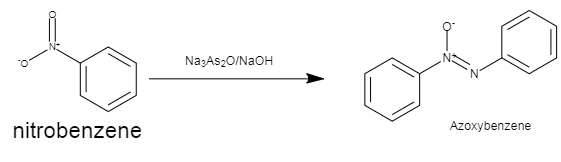
A detailed mechanism of the reaction is explained below.
In this process, Nitrobenzene first reduces to nitrobenzene and \[N-hydroxyaniline\]. Some of the nitrobenzene could further get reduced to aniline and \[N-phenylhydroxylamine\], both of which are termed as nucleophiles and can react with the nitroso \[N=O\] bond (which is analogous to a carbonyl). Elimination of water in both reactions results in formation of azobenzene and azobenzene respectively.
So the correct option is C.
Note:Nitrobenzene is a toxic chemical with a number of harmful effects
-Acute inhalation, or oral, and dermal exposure to nitrobenzene in human beings produces a condition called methemoglobinemia, in which hemoglobin in blood, is converted to methemoglobin, which results in lowering in the amount of oxygen released to the tissues of the human body.
In this conversion process, the reduction of nitrobenzene takes place.
Complete step by step answer:
The structure of nitrobenzene has a nitro group attached to the benzene ring. Nitrobenzene is an organic compound which has the chemical formula \[{{C}_{6}}{{H}_{5}}N{{O}_{2}}\]. It is water-insoluble, and has pale yellow oil type texture with an almond-like odour. It freezes in order to give greenish-yellow crystals. It is produced on a huge scale from benzene as a precursor to aniline. In the laboratory, it is occasionally used as a solvent, especially for electrophilic reagents.
The word azoxy means that the compound contains a nitrogen-nitrogen double bond as well as a nitrogen oxygen bond. They are considered as \[N-oxides\] of azo compounds. Azoxy compounds are \[1,3-dipoles\]. They undergo \[1,3\text{ }dipolar\] cycloaddition with double bonds. Most compounds containing azoxy have aryl substituents. They are normally prepared by reduction of nitro compounds, such as the reduction of nitrobenzene with the help of arsenous oxide to azoxybenzene.
Azoxybenzene is an organic compound with the formula \[{{C}_{6}}{{H}_{5}}N\left( O \right)N{{C}_{6}}{{H}_{5}}\]. It is a yellow, low-melting solid. The molecule has a planar \[{{C}_{2}}{{N}_{2}}O\] core.
The structure of nitrobenzene and azobenzene is shown the given diagram below.
This diagram depicts the conversion of nitrobenzene to azoxybenzene by the use of \[N{{a}_{3}}A{{s}_{2}}{{O}_{3}}/NaOH\] as a reagent.
A detailed mechanism of the reaction is explained below.
In this process, Nitrobenzene first reduces to nitrobenzene and \[N-hydroxyaniline\]. Some of the nitrobenzene could further get reduced to aniline and \[N-phenylhydroxylamine\], both of which are termed as nucleophiles and can react with the nitroso \[N=O\] bond (which is analogous to a carbonyl). Elimination of water in both reactions results in formation of azobenzene and azobenzene respectively.
So the correct option is C.
Note:Nitrobenzene is a toxic chemical with a number of harmful effects
-Acute inhalation, or oral, and dermal exposure to nitrobenzene in human beings produces a condition called methemoglobinemia, in which hemoglobin in blood, is converted to methemoglobin, which results in lowering in the amount of oxygen released to the tissues of the human body.
Recently Updated Pages
Which of the following graphs shows the variation of class 12 physics CBSE

Draw a labelled diagram of the human male reproductive class 12 biology CBSE
Describe the experiment to compare the emf of two cells class 12 physics CBSE
What is standard hydrogen electrode
What is conventional current and electric current class 12 physics CBSE
2Bromopentane is treated with an alcoholic KOH solution class 12 chemistry CBSE
Trending doubts
Draw a labelled sketch of the human eye class 12 physics CBSE
Which are the Top 10 Largest Countries of the World?
Differentiate between homogeneous and heterogeneous class 12 chemistry CBSE
Draw ray diagrams each showing i myopic eye and ii class 12 physics CBSE
Which is the correct genotypic ratio of mendel dihybrid class 12 biology CBSE
What is the Full Form of PVC, PET, HDPE, LDPE, PP and PS ?