




How is average rate of change related to slope?
Answer
 Verified
601.5k+ views
Hint: Slope is just a way of measuring the inclination of a line or the steepness of the line. It is defined by, change in $y$ due to the change in x. The average rate of change about a point as the interval over which the average is being taken is reduced to zero.
Average rate of change \[ = \dfrac{{{y_2} - {y_1}}}{{{x_2} - {x_1}}}\]
$({x_1},{y_1})$ - coordinates of first point in the line
\[({x_2},{y_2})\] - coordinates of second point in the line
Complete step-by-step solution:
Let’s assume the coordinates of those points as follows:
${x_1}$ coordinate is $ - 1$ and $x_2^{}$ coordinate is $3$
${y_1}$ coordinate is $ - 6$ and ${y_2}$ coordinate is $6$
Let us consider the two points ${\text{ (}} - 1, - 6{\text{) and }}(3,6){\text{ }}$
Average rate of change \[ = \dfrac{{{y_2} - {y_1}}}{{{x_2} - {x_1}}}\]
${x_1} = - 1$ and ${x_2} = 3$
${y_1} = - 6$ and ${y_2} = 6$
Now, substitute the two points in the formula of average rate of change
Average rate of change $ = \dfrac{{6 - ( - 6)}}{{3 - ( - 1)}}$
Adding the two terms,
$ = \dfrac{{6 + 6}}{{3 + 1}} = \dfrac{{12}}{4}$
Simplifying the terms,
$ = \dfrac{{12}}{4} = 3$
Average rate of change $ = 3$
Slope is calculated by finding the ratio of the vertical change to horizontal change between two distinct points on a line. The coordinates points to point a graph. And then to draw a straight line through the two points. Slope is something also referred to as the rate of change.
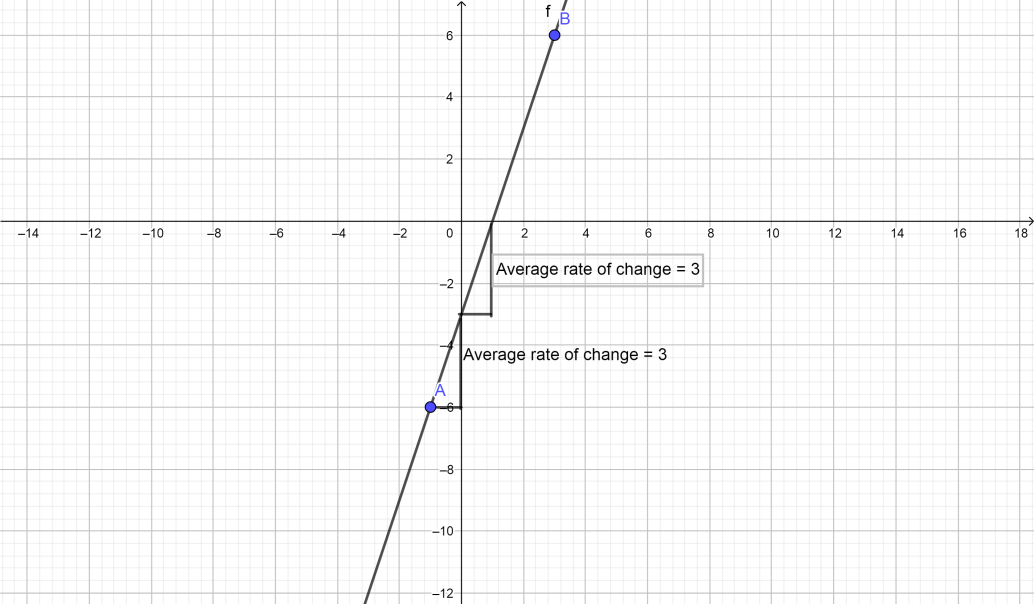
When we moved $1$ in the $x$ , we moved up $3$ in the $y$ . If you move 2 in the $x - $ direction, you’re going to move $6$ in the $y$. $6/2$ is the same thing as $3$ . This is the average rate of change between two points.
Note: The rate of change between two points on either side of x becomes closer to the slope of x as the distance between the two points is reduced. When we work with functions, the average rate of change is expressed using function notation.
For the function is,
\[\operatorname{y} = f(x)\] , where $\operatorname{x} = a$ and $\operatorname{x} = b$
Average rate of change $ = \dfrac{{{\text{change in }}y}}{{{\text{change in }}x}} = \dfrac{{f(b) - f(a)}}{{b - a}}$
Average rate of change \[ = \dfrac{{{y_2} - {y_1}}}{{{x_2} - {x_1}}}\]
$({x_1},{y_1})$ - coordinates of first point in the line
\[({x_2},{y_2})\] - coordinates of second point in the line
Complete step-by-step solution:
Let’s assume the coordinates of those points as follows:
${x_1}$ coordinate is $ - 1$ and $x_2^{}$ coordinate is $3$
${y_1}$ coordinate is $ - 6$ and ${y_2}$ coordinate is $6$
Let us consider the two points ${\text{ (}} - 1, - 6{\text{) and }}(3,6){\text{ }}$
Average rate of change \[ = \dfrac{{{y_2} - {y_1}}}{{{x_2} - {x_1}}}\]
${x_1} = - 1$ and ${x_2} = 3$
${y_1} = - 6$ and ${y_2} = 6$
Now, substitute the two points in the formula of average rate of change
Average rate of change $ = \dfrac{{6 - ( - 6)}}{{3 - ( - 1)}}$
Adding the two terms,
$ = \dfrac{{6 + 6}}{{3 + 1}} = \dfrac{{12}}{4}$
Simplifying the terms,
$ = \dfrac{{12}}{4} = 3$
Average rate of change $ = 3$
Slope is calculated by finding the ratio of the vertical change to horizontal change between two distinct points on a line. The coordinates points to point a graph. And then to draw a straight line through the two points. Slope is something also referred to as the rate of change.
When we moved $1$ in the $x$ , we moved up $3$ in the $y$ . If you move 2 in the $x - $ direction, you’re going to move $6$ in the $y$. $6/2$ is the same thing as $3$ . This is the average rate of change between two points.
Note: The rate of change between two points on either side of x becomes closer to the slope of x as the distance between the two points is reduced. When we work with functions, the average rate of change is expressed using function notation.
For the function is,
\[\operatorname{y} = f(x)\] , where $\operatorname{x} = a$ and $\operatorname{x} = b$
Average rate of change $ = \dfrac{{{\text{change in }}y}}{{{\text{change in }}x}} = \dfrac{{f(b) - f(a)}}{{b - a}}$
Recently Updated Pages
Master Class 12 Business Studies: Engaging Questions & Answers for Success

Master Class 12 Chemistry: Engaging Questions & Answers for Success
Master Class 12 Biology: Engaging Questions & Answers for Success
Class 12 Question and Answer - Your Ultimate Solutions Guide
Master Class 11 English: Engaging Questions & Answers for Success
Master Class 11 Social Science: Engaging Questions & Answers for Success
Trending doubts
Which are the Top 10 Largest Countries of the World?
The total number of vertebrae in man is a30 b31 c32 class 12 biology CBSE
Draw a labelled sketch of the human eye class 12 physics CBSE
The number of cranial nerves in a frog is A 10 pairs class 12 biology CBSE
Differentiate between homogeneous and heterogeneous class 12 chemistry CBSE
Differentiate between Pyramid of energy and pyramid class 12 biology CBSE