



At 9 O' clock the angle formed between the hands of a clock is
A) Complete angle
B) Reflex angle
C) Zero angle
D) None
Answer
 Verified
625.2k+ views
Hint:
Here we have to find the angle between the hands of a clock at 9 O'clock. The clock has the shape of a circle and the clock contains the number from 1 to 12. The angle between each consecutive number or each division is \[30^\circ \]. At 9 O'clock, the hour hand points towards 12 and the minute hand points towards 9. We will find the number of divisions between 9 and 12 and then we will multiply it with \[30^\circ \] to get the required angle between the hands of a clock.
Complete step by step solution:
We need to find the angle formed between the hands of a clock at 9’ O clock.
At 9 O'clock, the hour hand points towards 12 and the minute hand points towards 9. Let’s draw the figure for the same.
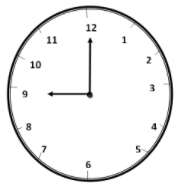
Case 1: In anticlockwise direction.
The difference between 9 and 12 \[ = 12 - 9 = 3\]
We know the angle between the consecutive numbers or separation between the numbers is \[30^\circ \].
Therefore, the angle between the hands of a clock is equal to the product of their difference and angle between the consecutive numbers.
Required angle between the hands of a clock \[ = 3 \times 30^\circ = 90^\circ \]
Case 2: In clockwise direction:
The actual difference between 9 and 12 \[ = 12 - 3 = 9\]
We know the angle between the consecutive numbers or separation between the numbers is \[30^\circ \].
Therefore, the angle between the hands of a clock is equal to the product of their difference and angle between the consecutive numbers.
Required angle between the hands of a clock \[ = 3 \times 90^\circ = 270^\circ \]
We can observe that the angle between the hands of a clock is a reflex angle is \[90^\circ \] when measured in the anticlockwise direction, which is not given in the option but it is \[270^\circ \] when we measure it in the clockwise direction and it is also known as a reflex angle.
Therefore, the correct option is option B.
Note:
We have seen that the angle between the hands of a clock is a reflex angle. A reflex angle is defined as the larger angle formed i.e. it is more than \[180^\circ \] but it is less than \[360^\circ \]. Here in this question, we have obtained two angles between the hands of a clock, one which is more than \[180^\circ \] is reflex angle and one which is less than \[180^\circ \] is either acute or obtuse angle, but we have got \[90^\circ \], which is known as a right angle.
Here we have to find the angle between the hands of a clock at 9 O'clock. The clock has the shape of a circle and the clock contains the number from 1 to 12. The angle between each consecutive number or each division is \[30^\circ \]. At 9 O'clock, the hour hand points towards 12 and the minute hand points towards 9. We will find the number of divisions between 9 and 12 and then we will multiply it with \[30^\circ \] to get the required angle between the hands of a clock.
Complete step by step solution:
We need to find the angle formed between the hands of a clock at 9’ O clock.
At 9 O'clock, the hour hand points towards 12 and the minute hand points towards 9. Let’s draw the figure for the same.
Case 1: In anticlockwise direction.
The difference between 9 and 12 \[ = 12 - 9 = 3\]
We know the angle between the consecutive numbers or separation between the numbers is \[30^\circ \].
Therefore, the angle between the hands of a clock is equal to the product of their difference and angle between the consecutive numbers.
Required angle between the hands of a clock \[ = 3 \times 30^\circ = 90^\circ \]
Case 2: In clockwise direction:
The actual difference between 9 and 12 \[ = 12 - 3 = 9\]
We know the angle between the consecutive numbers or separation between the numbers is \[30^\circ \].
Therefore, the angle between the hands of a clock is equal to the product of their difference and angle between the consecutive numbers.
Required angle between the hands of a clock \[ = 3 \times 90^\circ = 270^\circ \]
We can observe that the angle between the hands of a clock is a reflex angle is \[90^\circ \] when measured in the anticlockwise direction, which is not given in the option but it is \[270^\circ \] when we measure it in the clockwise direction and it is also known as a reflex angle.
Therefore, the correct option is option B.
Note:
We have seen that the angle between the hands of a clock is a reflex angle. A reflex angle is defined as the larger angle formed i.e. it is more than \[180^\circ \] but it is less than \[360^\circ \]. Here in this question, we have obtained two angles between the hands of a clock, one which is more than \[180^\circ \] is reflex angle and one which is less than \[180^\circ \] is either acute or obtuse angle, but we have got \[90^\circ \], which is known as a right angle.
Recently Updated Pages
Basicity of sulphurous acid and sulphuric acid are

Master Class 12 Economics: Engaging Questions & Answers for Success
Master Class 12 Biology: Engaging Questions & Answers for Success
Master Class 11 English: Engaging Questions & Answers for Success
Master Class 11 Physics: Engaging Questions & Answers for Success
Master Class 11 Computer Science: Engaging Questions & Answers for Success
Trending doubts
Difference Between Plant Cell and Animal Cell
Fill the blanks with the suitable prepositions 1 The class 9 english CBSE
What is pollution? How many types of pollution? Define it
What is the full form of pH?
What is the Full Form of ICSE, CBSE and SSC
How do you solve for x in the equation xy x + y class 9 maths CBSE