




Assume that the earth moves around sun in a circular orbit of radius R and there
exists a planet which also moves around the sun in circular orbit with an angular speed twice
as large as that of the earth. The radius of the planet is
$ {\text{A}}{\text{. }}{{\text{2}}^{\dfrac{{ - 2}}{3}}}R \\
{\text{B}}{\text{. }}{{\text{2}}^{\dfrac{2}{3}}}R \\
{\text{C}}{\text{. }}{{\text{2}}^{\dfrac{{ - 1}}{3}}}R \\
{\text{D}}{\text{. }}\dfrac{R}{{\sqrt 2 }} \\ $
Answer
 Verified
593.4k+ views
Hint: We can make use of Kepler’s third law of periods for the planetary motion. We are given the value of the angular speeds from which we can obtain the time periods of the planets around the sun. Comparing the equations of the third law for two planets, we can get the required answer.
Formula used:
Kepler’s third law of planetary motion, the law of periods, is given as
${T^2} \propto {a^3}$
Complete step-by-step solution:
We know that Kepler’s third law of planetary motion is given as
${T^2} \propto {a^3}$
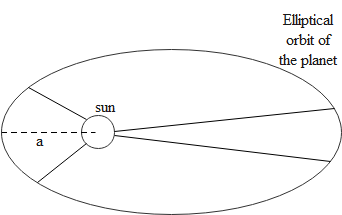
Here T is the time period of a planet around the sun while a represents the length of the semi-major axis of the elliptical path of that planet around the sun. We know that time period is inversely related to angular velocity while if we assume the orbits to be circular then the length of the semi-major axis is directly related to the radius of the circular path of the planet It can be written in terms of the angular velocity in the following way.
$T \propto \dfrac{1}{\omega } \\
a \propto R \\
\therefore \dfrac{1}{{{\omega ^2}}} \propto {R^3}{\text{ }}...............{\text{(i)}} \\ $
We are given that the radius of the circular orbit of the earth is ${R_1}$ and let ${\omega _1}$ be the angular velocity of the earth around the sun. For another planet, let ${\omega _2}$ be its angular velocity which is given to be twice that of earth. Therefore, we can write
${\omega _2} = 2{\omega _1}$
Let ${R_2}$ be the radius of the circular path of the other planet. Using the equation (i), we can write
$ \dfrac{{R_1^3}}{{R_2^3}} = \dfrac{{\omega _2^2}}{{\omega _1^2}} \\
\Rightarrow R_2^3 = \dfrac{{\omega _1^2}}{{\omega _2^2}}R_1^3 \\ $
Inserting the known values, we get
$R_2^3 = \dfrac{{\omega _1^2}}{{{{\left( {2{\omega _1}} \right)}^2}}}R_1^3 = \dfrac{{R_1^3}}{4} \\
\Rightarrow {R_2} = \dfrac{{{R_1}}}{{{2^{\dfrac{2}{3}}}}} \\
\Rightarrow {R_2} = {2^{\dfrac{{ - 2}}{3}}}{R_1} \\ $
This is the required answer. Hence, the correct answer is option A.
Note: It should be noted from the law of periods that the greater the time period of the planet, the farther away it is from the sun. In terms of the angular velocity, we can say that the nearer planets have greater angular velocity while farther planets have smaller angular velocity.
Formula used:
Kepler’s third law of planetary motion, the law of periods, is given as
${T^2} \propto {a^3}$
Complete step-by-step solution:
We know that Kepler’s third law of planetary motion is given as
${T^2} \propto {a^3}$
Here T is the time period of a planet around the sun while a represents the length of the semi-major axis of the elliptical path of that planet around the sun. We know that time period is inversely related to angular velocity while if we assume the orbits to be circular then the length of the semi-major axis is directly related to the radius of the circular path of the planet It can be written in terms of the angular velocity in the following way.
$T \propto \dfrac{1}{\omega } \\
a \propto R \\
\therefore \dfrac{1}{{{\omega ^2}}} \propto {R^3}{\text{ }}...............{\text{(i)}} \\ $
We are given that the radius of the circular orbit of the earth is ${R_1}$ and let ${\omega _1}$ be the angular velocity of the earth around the sun. For another planet, let ${\omega _2}$ be its angular velocity which is given to be twice that of earth. Therefore, we can write
${\omega _2} = 2{\omega _1}$
Let ${R_2}$ be the radius of the circular path of the other planet. Using the equation (i), we can write
$ \dfrac{{R_1^3}}{{R_2^3}} = \dfrac{{\omega _2^2}}{{\omega _1^2}} \\
\Rightarrow R_2^3 = \dfrac{{\omega _1^2}}{{\omega _2^2}}R_1^3 \\ $
Inserting the known values, we get
$R_2^3 = \dfrac{{\omega _1^2}}{{{{\left( {2{\omega _1}} \right)}^2}}}R_1^3 = \dfrac{{R_1^3}}{4} \\
\Rightarrow {R_2} = \dfrac{{{R_1}}}{{{2^{\dfrac{2}{3}}}}} \\
\Rightarrow {R_2} = {2^{\dfrac{{ - 2}}{3}}}{R_1} \\ $
This is the required answer. Hence, the correct answer is option A.
Note: It should be noted from the law of periods that the greater the time period of the planet, the farther away it is from the sun. In terms of the angular velocity, we can say that the nearer planets have greater angular velocity while farther planets have smaller angular velocity.
Recently Updated Pages
Master Class 11 Social Science: Engaging Questions & Answers for Success

Master Class 11 English: Engaging Questions & Answers for Success
Master Class 11 Maths: Engaging Questions & Answers for Success
Master Class 11 Chemistry: Engaging Questions & Answers for Success
Master Class 11 Biology: Engaging Questions & Answers for Success
Master Class 11 Physics: Engaging Questions & Answers for Success
Trending doubts
Differentiate between an exothermic and an endothermic class 11 chemistry CBSE
One Metric ton is equal to kg A 10000 B 1000 C 100 class 11 physics CBSE
Difference Between Prokaryotic Cells and Eukaryotic Cells
There are 720 permutations of the digits 1 2 3 4 5 class 11 maths CBSE
Draw a diagram of a plant cell and label at least eight class 11 biology CBSE
Which chemical is known as king of chemicals A H 2 class 11 chemistry CBSE