




Assertion:
Trihydroxy glutaric acid (HCOO-CHOH-CHOH-CHOH-COOH) exists in four stereoisomeric forms, two of which are optically active while the other two are meso forms.
Reason:
It contains two asymmetric and one pseudo-asymmetric carbon atoms.
(A) Both assertion and reason are correct and the reason is the correct explanation for the assertion.
(B) Both assertion and reason are correct but the reason is not the correct explanation for the assertion.
(C) Assertion is correct but the reason is incorrect
(D) Both assertion and reason are incorrect.
Answer
 Verified
618k+ views
Hint: In order to know whether the given assertion and reason are correct or incorrect, we must first know about the structure of trihydroxy glutaric acid. On seeing the structure, it will be little easy to determine the presence of asymmetric and pseudo asymmetric carbon.
Complete step by step answer:
- Let us move to the given question. On seeing the structure of Trihydroxy glutaric acid we can say that there are three chiral carbon, but among that one is pseudo- asymmetric carbon. Therefore, we can say that there are two asymmetric carbon and one pseudo-asymmetric carbon will be present in the Trihydroxy glutaric acid.
- The optical isomers and meso forms of Trihydroxy glutaric acid can be found using the following formula.
The total optical isomers present = \[{2^{3 - 1}} - {2^{\dfrac{{3 - 1}}{2}}} = {2^2} - {2^1} = 4 - 2 = 2\]
The total meso forms present = \[{2^{\dfrac{{3 - 1}}{2}}} = {2^1} = 2\]
Therefore, total stereoisomers present in the Trihydroxy glutaric acid is = \[2 + 2 = 4\]
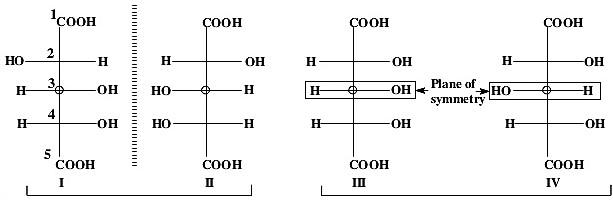
We can say that the above given assertion is correct and also the reason is correct.
Hence, we can say that the reason is the correct explanation for the assertion.
The correct option is option “A” .
Note: We have to remember that the enantiomers and diastereoisomers are not the same. When the two isomers given are said to be the mirror image of one another, then it is said to be the enantiomers. When the two isomers given are not the mirror image of one another, then it is called diastereoisomers.
Complete step by step answer:
- Let us move to the given question. On seeing the structure of Trihydroxy glutaric acid we can say that there are three chiral carbon, but among that one is pseudo- asymmetric carbon. Therefore, we can say that there are two asymmetric carbon and one pseudo-asymmetric carbon will be present in the Trihydroxy glutaric acid.
- The optical isomers and meso forms of Trihydroxy glutaric acid can be found using the following formula.
The total optical isomers present = \[{2^{3 - 1}} - {2^{\dfrac{{3 - 1}}{2}}} = {2^2} - {2^1} = 4 - 2 = 2\]
The total meso forms present = \[{2^{\dfrac{{3 - 1}}{2}}} = {2^1} = 2\]
Therefore, total stereoisomers present in the Trihydroxy glutaric acid is = \[2 + 2 = 4\]
We can say that the above given assertion is correct and also the reason is correct.
Hence, we can say that the reason is the correct explanation for the assertion.
The correct option is option “A” .
Note: We have to remember that the enantiomers and diastereoisomers are not the same. When the two isomers given are said to be the mirror image of one another, then it is said to be the enantiomers. When the two isomers given are not the mirror image of one another, then it is called diastereoisomers.
Recently Updated Pages
Master Class 12 Economics: Engaging Questions & Answers for Success

Master Class 12 Social Science: Engaging Questions & Answers for Success
Master Class 12 English: Engaging Questions & Answers for Success
Master Class 12 Maths: Engaging Questions & Answers for Success
Master Class 12 Physics: Engaging Questions & Answers for Success
Master Class 12 Biology: Engaging Questions & Answers for Success
Trending doubts
Draw a labelled sketch of the human eye class 12 physics CBSE
Which are the Top 10 Largest Countries of the World?
Draw ray diagrams each showing i myopic eye and ii class 12 physics CBSE
Which is the correct genotypic ratio of mendel dihybrid class 12 biology CBSE
Differentiate between homogeneous and heterogeneous class 12 chemistry CBSE
Which animal never drinks water in its entire life class 12 biology CBSE