




Assertion
The radial probability distribution curves of $1s$ , $2p$ , $3d$ - orbitals are identical in shape.
Reason
A.The number of nodal planes present in these orbits is different.
B.Both assertion and reason are correct and reason is the correct explanation for assertion
C.Both assertion and reason are correct but reason is not correct explanation for assertion
D.Assertion is correct but reason is incorrect
E.Assertion is incorrect but reason is correct
Answer
 Verified
618.9k+ views
Hint:We need to remember that the electron density at a radial distance from the atomic nucleus is given by the radial distribution curve. \[4\pi {r^2}{\psi ^2}\] (radial probability density function) value becomes $0$ at a nodal point, it is also called a radial node. Radial nodes are equal to \[n - l\], where, $l$ is the azimuthal quantum number and $n$ is the principal quantum number.
Complete step by step answer:
We must have to know that the nodal planes are locals around the nuclear cores where the probability of discovering electrons is zero. The direction of these planes are found by settling the Schrodinger wave condition particles or atoms to discover the state of nuclear and subatomic orbitals.
Let us find the assertion and reason are correct or not one by one to find the correct option.
Assertion:
The given orbitals are $1s$ , $2p$ , $3d$ . The principal quantum number and azimuthal quantum number are related as $l = n - 1$ . Using the formula, radial nodes are equal to \[n - l\] , where, $l$ is the azimuthal quantum number and $n$ is the principal quantum number.
The principal quantum number $(n)$ value for $1s$ , $2p$ & $3d$ orbitals are $1$ , $2$ , & $3$ .
The azimuthal quantum number $(l)$ value for $1s$ , $2p$ & $3d$ are $0$ , $1$ & $2$ .
For $1s$ orbital the radial nodes are equal to \[1 - 0\]$ = 1$.
For $2p$ orbital radial nodes are equal to \[n - l\] $ = 2 - 1 = 1$.
Similarly for $3d$ orbital, $3 - 2 = 1$ .
Radial nodes for $1s$ , $2p$ & $3d$ orbitals equal to $1$, this shows the radial probability distribution curves of $1s$ , $2p$ & $3d$ orbitals are identical in shape.
Let us see the reason:
Reason says the number of nodal planes present in these orbits is different. First find out the nodal planes.
Nodal planes = $l.$
The $l$ values for $s,p\& d$ are $0,1\& 2$.
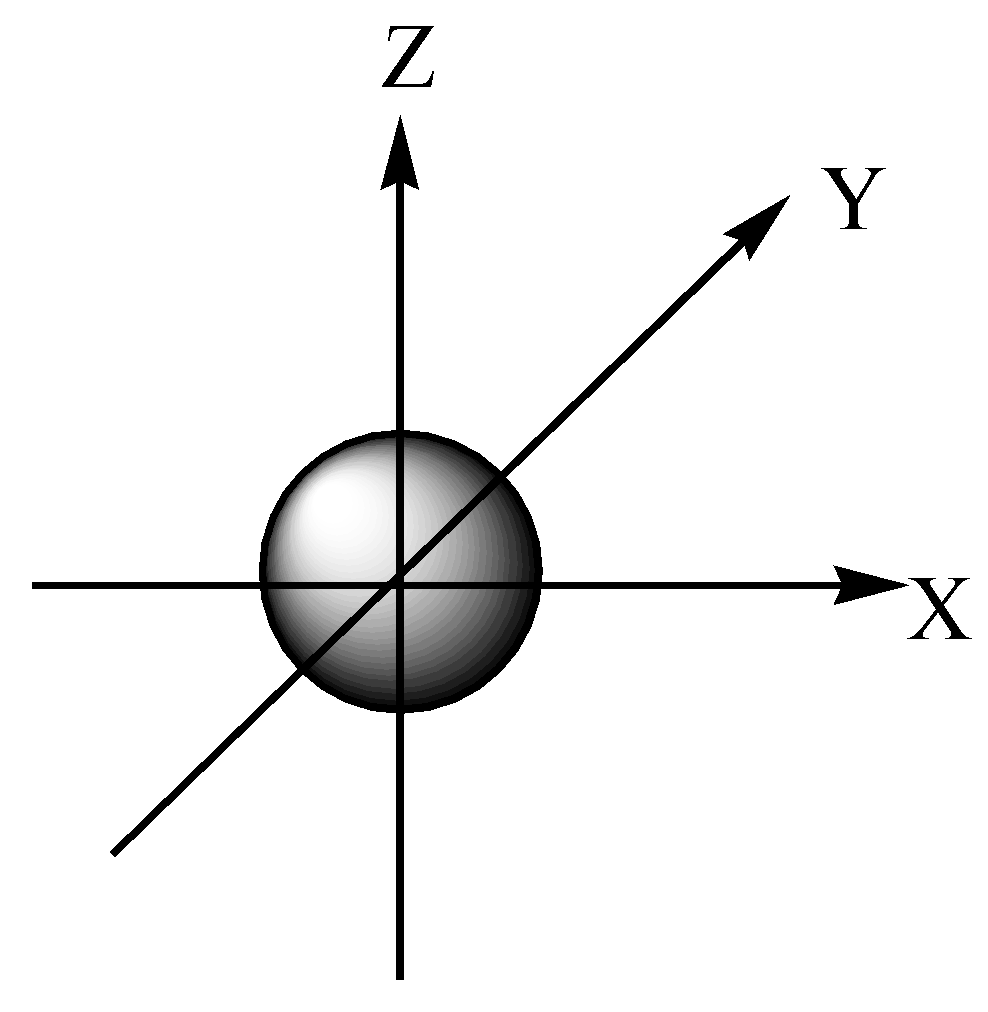
$s$ orbital is spherical in shape and there is no nodal plane.
$p$ orbital is dumbbell-shaped and has two lobes, there is a nodal plane.

$d$ orbital is clover in shape and it has two nodal planes.

The number of nodal planes present in the above orbital is different.
Option B. both assertion and reason are correct but reason is not correct explanation for assertion is the correct answer.
Note:
We need to remember that the nodal surface (also called a radial node), which is a hollow sphere region in which electrons can’t be. A nodal plane (also called an angular node), which is either a plane, where electrons can’t be, or a conic surface ( \[{d_z}_{^2}\] orbital). For determining the electron configuration of an atom, quantum numbers are used. And also used for the probable location of the atom’s electron.
Complete step by step answer:
We must have to know that the nodal planes are locals around the nuclear cores where the probability of discovering electrons is zero. The direction of these planes are found by settling the Schrodinger wave condition particles or atoms to discover the state of nuclear and subatomic orbitals.
Let us find the assertion and reason are correct or not one by one to find the correct option.
Assertion:
The given orbitals are $1s$ , $2p$ , $3d$ . The principal quantum number and azimuthal quantum number are related as $l = n - 1$ . Using the formula, radial nodes are equal to \[n - l\] , where, $l$ is the azimuthal quantum number and $n$ is the principal quantum number.
The principal quantum number $(n)$ value for $1s$ , $2p$ & $3d$ orbitals are $1$ , $2$ , & $3$ .
The azimuthal quantum number $(l)$ value for $1s$ , $2p$ & $3d$ are $0$ , $1$ & $2$ .
For $1s$ orbital the radial nodes are equal to \[1 - 0\]$ = 1$.
For $2p$ orbital radial nodes are equal to \[n - l\] $ = 2 - 1 = 1$.
Similarly for $3d$ orbital, $3 - 2 = 1$ .
Radial nodes for $1s$ , $2p$ & $3d$ orbitals equal to $1$, this shows the radial probability distribution curves of $1s$ , $2p$ & $3d$ orbitals are identical in shape.
Let us see the reason:
Reason says the number of nodal planes present in these orbits is different. First find out the nodal planes.
Nodal planes = $l.$
The $l$ values for $s,p\& d$ are $0,1\& 2$.
$s$ orbital is spherical in shape and there is no nodal plane.
$p$ orbital is dumbbell-shaped and has two lobes, there is a nodal plane.
$d$ orbital is clover in shape and it has two nodal planes.
The number of nodal planes present in the above orbital is different.
Option B. both assertion and reason are correct but reason is not correct explanation for assertion is the correct answer.
Note:
We need to remember that the nodal surface (also called a radial node), which is a hollow sphere region in which electrons can’t be. A nodal plane (also called an angular node), which is either a plane, where electrons can’t be, or a conic surface ( \[{d_z}_{^2}\] orbital). For determining the electron configuration of an atom, quantum numbers are used. And also used for the probable location of the atom’s electron.
Recently Updated Pages
Master Class 12 Economics: Engaging Questions & Answers for Success

Master Class 12 Social Science: Engaging Questions & Answers for Success
Master Class 12 English: Engaging Questions & Answers for Success
Master Class 12 Maths: Engaging Questions & Answers for Success
Master Class 12 Physics: Engaging Questions & Answers for Success
Master Class 12 Biology: Engaging Questions & Answers for Success
Trending doubts
What is the Full Form of PVC, PET, HDPE, LDPE, PP and PS ?
Draw a ray diagram of compound microscope when the class 12 physics CBSE
Derive an expression for the electric field intensity class 12 physics CBSE
Ethylidene chloride and ethylene dichloride are A Chain class 12 chemistry CBSE
Calculate the equivalent resistance between a and b class 12 physics CBSE
Derive an expression of the magnetic field at the center class 12 physics CBSE