




Assertion: The locant $(2,8,7)$ is preferred over the locant $(3,4,9)$
Reason: Lowest locant number at first difference is preferred.
A.Both Assertion and Reason are correct and Reason is the correct explanation for Assertion.
B.Both Assertion and Reason are correct but Reason is not the correct explanation for Assertion.
C.Assertion is correct but Reason is incorrect.
D.Assertion is incorrect but Reason is correct.
Answer
 Verified
550.5k+ views
Hint: In order to answer this question, we must know what a locant is. A locant is the number of the carbon atom on which the substituent is located. According to the IUPAC nomenclature, the naming of organic compounds should be such that the longest continuous carbon chain should be selected as the parent chain. Then, if the compound contains any substituents, the lowest locant set should be selected.
Complete answer: A locant is the number of carbon atom on which the substituent is located and a locant set is a set of the number of carbon atoms on which the substituents are located.
While naming an organic compound, the longest chain must be selected firstly. If the organic compound contains one or more than one substituents, then the substituent(s) must be assigned the lowest possible locant number.
This could be explained with the help of a simple hydrocarbon with ten carbon atoms in the parent chain.
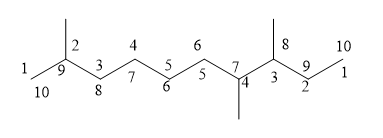
Methyl groups are added as substituents for convenience. The longest possible carbon chain is numbered $1 - 10$ from both the ends. (The numbers above the bond line represent the numbering from left to right and the numbers below the bond line represent the numbering from right to left). The locants in the locant set must be arranged in the increasing numerical order.
$(2,7,8)$ is the locant set that we get if we number from left to right.
$(3,4,9)$ is the locant set that we get if we number from right to left.
To choose the lowest locant set, we have to identify the first point of difference. Here we can see that the first locant itself is different in both the locant sets. We have to compare the first locants and the locant set that has a smaller value for the first locant will be selected. Here, $2 < 3$ and thus the locant set $(2,7,8)$ is preferred.
Therefore, the correct option is (A) Both Assertion and Reason are correct and Reason is the correct explanation for Assertion.
Note:
According to the IUPAC nomenclature, the “first point of difference” rule must be preferred for naming organic compounds. The “sum rule” cannot be used in most cases. In the above situation, if we were to use the sum rule, then the sum of locant sets would be:
$(2,8,7) = (2 + 8 + 7) = 17$
$(3,4,9) = (3 + 4 + 9) = 16$
The lowest sum is obtained from the locant set $(3,4,9)$ . If we were to use the sum rule, this would be the preferred set. But the correct name of the molecule is $2,7,8 - $ trimethyl decane.
Complete answer: A locant is the number of carbon atom on which the substituent is located and a locant set is a set of the number of carbon atoms on which the substituents are located.
While naming an organic compound, the longest chain must be selected firstly. If the organic compound contains one or more than one substituents, then the substituent(s) must be assigned the lowest possible locant number.
This could be explained with the help of a simple hydrocarbon with ten carbon atoms in the parent chain.
Methyl groups are added as substituents for convenience. The longest possible carbon chain is numbered $1 - 10$ from both the ends. (The numbers above the bond line represent the numbering from left to right and the numbers below the bond line represent the numbering from right to left). The locants in the locant set must be arranged in the increasing numerical order.
$(2,7,8)$ is the locant set that we get if we number from left to right.
$(3,4,9)$ is the locant set that we get if we number from right to left.
To choose the lowest locant set, we have to identify the first point of difference. Here we can see that the first locant itself is different in both the locant sets. We have to compare the first locants and the locant set that has a smaller value for the first locant will be selected. Here, $2 < 3$ and thus the locant set $(2,7,8)$ is preferred.
Therefore, the correct option is (A) Both Assertion and Reason are correct and Reason is the correct explanation for Assertion.
Note:
According to the IUPAC nomenclature, the “first point of difference” rule must be preferred for naming organic compounds. The “sum rule” cannot be used in most cases. In the above situation, if we were to use the sum rule, then the sum of locant sets would be:
$(2,8,7) = (2 + 8 + 7) = 17$
$(3,4,9) = (3 + 4 + 9) = 16$
The lowest sum is obtained from the locant set $(3,4,9)$ . If we were to use the sum rule, this would be the preferred set. But the correct name of the molecule is $2,7,8 - $ trimethyl decane.
Recently Updated Pages
Master Class 12 Business Studies: Engaging Questions & Answers for Success

Master Class 12 Chemistry: Engaging Questions & Answers for Success
Master Class 12 Biology: Engaging Questions & Answers for Success
Class 12 Question and Answer - Your Ultimate Solutions Guide
Master Class 11 English: Engaging Questions & Answers for Success
Master Class 11 Social Science: Engaging Questions & Answers for Success
Trending doubts
Which are the Top 10 Largest Countries of the World?
Draw a labelled sketch of the human eye class 12 physics CBSE
Differentiate between homogeneous and heterogeneous class 12 chemistry CBSE
Why is the cell called the structural and functional class 12 biology CBSE
Draw ray diagrams each showing i myopic eye and ii class 12 physics CBSE
Which is the correct genotypic ratio of mendel dihybrid class 12 biology CBSE