




Assertion- Surface tension has the same units as force gradient.
Reason- Surface tension is the force gradient along the surface of liquid.
A.)Both Assertion and Reason are correct and Reason is the correct explanation for Assertion
B.)Both Assertion and Reason are correct but Reason is not the correct explanation for the Assertion
C.)Assertion is correct but Reason is incorrect
D.)Both Assertion and Reason are incorrect
Answer
 Verified
617.4k+ views
Hint: Surface tension tends to compress to the smallest region of potential liquid surfaces. Surface tension allows organisms to move and roll along the water surface, typically denser than water. Surface stress at liquid-ice interfaces culminated in a greater attractiveness of liquid molecules (by coherence) than the air molecules (by adhesion).
Step by Step Answer:
Two key structures are at play. First of which is an intrinsic power of fluid bond on the surface molecules. Second, there's a tangential power similar to the liquid top. The net result is the liquid behaves as a woven elastic film covering the back. Since water molecules are comparatively bound to each other by a hydrogen network, water is closer than most other liquids. Water has an enhanced surface tension. Surface friction is a significant influence in the capillary process.
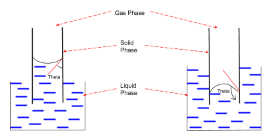
The surface tension of liquid can be determined on the hypothetical direction drawn from a liquid surface as the force per unit length (force gradient), which works perpendicular to the line on each side of the surface and at each point, tangentially to the liquid.
Thus, we can say that the surface tension and the force gradient have the very same dimensions.
Hence, option A is the correct answer.
Note: Tension of the surface has a unit-length intensity or a unit-area strength element. Both are similar, although the word surface energy, which is a more general concept in that it extends even to solids, is popular to be used as it corresponds to energy per unit of space.
Step by Step Answer:
Two key structures are at play. First of which is an intrinsic power of fluid bond on the surface molecules. Second, there's a tangential power similar to the liquid top. The net result is the liquid behaves as a woven elastic film covering the back. Since water molecules are comparatively bound to each other by a hydrogen network, water is closer than most other liquids. Water has an enhanced surface tension. Surface friction is a significant influence in the capillary process.
The surface tension of liquid can be determined on the hypothetical direction drawn from a liquid surface as the force per unit length (force gradient), which works perpendicular to the line on each side of the surface and at each point, tangentially to the liquid.
Thus, we can say that the surface tension and the force gradient have the very same dimensions.
Hence, option A is the correct answer.
Note: Tension of the surface has a unit-length intensity or a unit-area strength element. Both are similar, although the word surface energy, which is a more general concept in that it extends even to solids, is popular to be used as it corresponds to energy per unit of space.
Recently Updated Pages
Three beakers labelled as A B and C each containing 25 mL of water were taken A small amount of NaOH anhydrous CuSO4 and NaCl were added to the beakers A B and C respectively It was observed that there was an increase in the temperature of the solutions contained in beakers A and B whereas in case of beaker C the temperature of the solution falls Which one of the following statements isarecorrect i In beakers A and B exothermic process has occurred ii In beakers A and B endothermic process has occurred iii In beaker C exothermic process has occurred iv In beaker C endothermic process has occurred

Master Class 11 Social Science: Engaging Questions & Answers for Success
Master Class 11 Physics: Engaging Questions & Answers for Success
Master Class 11 Maths: Engaging Questions & Answers for Success
Master Class 11 Economics: Engaging Questions & Answers for Success
Master Class 11 Computer Science: Engaging Questions & Answers for Success
Three beakers labelled as A B and C each containing 25 mL of water were taken A small amount of NaOH anhydrous CuSO4 and NaCl were added to the beakers A B and C respectively It was observed that there was an increase in the temperature of the solutions contained in beakers A and B whereas in case of beaker C the temperature of the solution falls Which one of the following statements isarecorrect i In beakers A and B exothermic process has occurred ii In beakers A and B endothermic process has occurred iii In beaker C exothermic process has occurred iv In beaker C endothermic process has occurred
Master Class 11 Social Science: Engaging Questions & Answers for Success
Master Class 11 Physics: Engaging Questions & Answers for Success
Trending doubts
One Metric ton is equal to kg A 10000 B 1000 C 100 class 11 physics CBSE
There are 720 permutations of the digits 1 2 3 4 5 class 11 maths CBSE
State and prove Bernoullis theorem class 11 physics CBSE
Draw a diagram of a plant cell and label at least eight class 11 biology CBSE
Difference Between Prokaryotic Cells and Eukaryotic Cells
1 Quintal is equal to a 110 kg b 10 kg c 100kg d 1000 class 11 physics CBSE